HuagongsheHuagongshe Chemistry Print Report · For research reference only
(2R)-2-Amino-3,3-dimethylbutan-1-ol
(R)-(-)-TERT-LEUCINOL · (2R)-2-Amino-3,3-dimethylbutan-1-ol · H-D-TLE-OL · D-T-LEUCINOL · D-Tert-Leucinol · H-D-(TBU)GLY-OL · (R)-TERT-LEUCINOL · D-T-BUTYLGLYCINOL
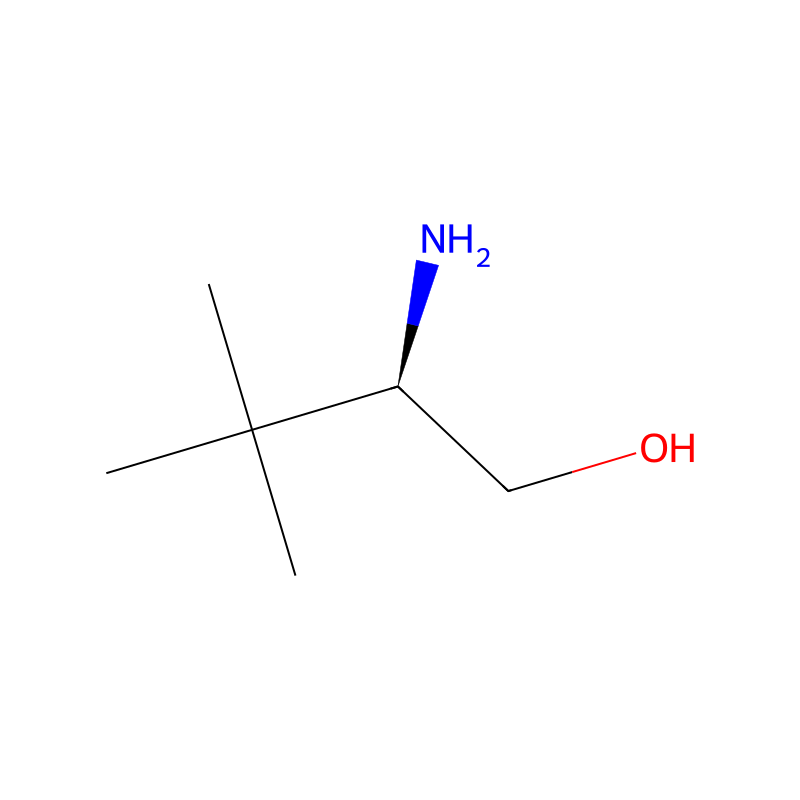
Identifiers & Physical Properties
| CAS No. | 112245-09-7 |
|---|---|
| Molecular formula | C6H15NO |
| Average molar mass | 117.19 g/mol |
| Monoisotopic mass | 117.1153641 g/mol |
| SMILES | CC(C)(C)[C@@H](N)CO |
| InChIKey | JBULSURVMXPBNA-YFKPBYRVSA-N |
| PubChem CID | 6932847 |
| EC No. | 634-525-7 |
| DTXSID | DTXSID60426146 |
Chemical & Physical Properties
| XLogP | 0.4 |
|---|---|
| Topological polar surface area | 46.3 |
| Hydrogen bond donors | 2 |
| Hydrogen bond acceptors | 2 |
| Rotatable bonds | 2 |
| Heavy atoms | 8 |
| Formal charge | 0 |
| Complexity | 65 |
| Melting point | 30-33 °C(lit.) |
| Boiling point | 70 °C0.4 mm Hg(lit.) |
| Density | 0.9 g/mL at 25 °C(lit.) |
| Flash point | 194 °F |
| Storage conditions | Keep in dark place,Inert atmosphere,2-8°C |
| Physical state | Liquid |
| pKa (acidity coefficient) | 12.88±0.10(Predicted) |
| Color | Colorless to yellow |
| optical activity | [α]20/D 37°, c = 1.5 in ethanol |
| Major applications | peptide synthesis |
| InChI | InChI=1S/C6H15NO/c1-6(2,3)5(7)4-8/h5,8H,4,7H2,1-3H3/t5-/m0/s1 |
| InChIKey | JBULSURVMXPBNA-YFKPBYRVSA-N |
| SMILES | C(O)[C@H](N)C(C)(C)C |
| UNSPSC Code | 12352209 |
| NACRES | NA.22 |
| GHS pictogram | GHS07 |
| Signal word | Warning |
| GHS hazard statements | H315-H319-H335 |
| GHS precautionary statements | P261-P264-P271-P280-P302+P352-P305+P351+P338 |
| Target organs | Respiratory system |
| Personal protective equipment (PPE) | dust mask type N95 (US), Eyeshields, Gloves |
| Hazard symbols | Xi |
| Risk statements (R) | 36/37/38 |
| Safety statements (S) | 26-36 |
| Water hazard class (WGK) | 3 |
| Customs code | 2922190090 |
| Storage class | 11 - Combustible Solids |
| Hazard class | Eye Irrit. 2Skin Irrit. 2STOT SE 3 |
Safety & Regulations
| GHS classification | WarningH315 (100%): Causes skin irritation [Warning Skin corrosion/irritation]H319 (100%): Causes serious eye irritation [Warning Serious eye damage/eye irritation]H335 (100%): May cause respiratory irritation [Warning Specific target organ toxicity, single exposureRespiratory tract irritation]P261, P264, P264+P265, P271, P280, P302+P352, P304+P340, P305+P351+P338, P319, P321, P332+P317, P337+P317, P362+P364, P403+P233, P405, and P501 (click each P-code to see the statement)Aggregated GHS information provided per 45 reports by companies from 7 notifications to the ECHA C&L Inventory. Each notification may be associated with multiple companies.Information may vary between notifications depending on impurities, additives, and other factors. The percentage value in parenthesis indicates the notified classification ratio from companies that provide hazard codes. Only hazard codes with percentage values above 10% are shown. For more detailed information, please visit ECHA C&L website. |
|---|---|
| Hazard Classes and Categories | Skin Irrit. 2 (100%)Eye Irrit. 2 (100%)STOT SE 3 (100%) |
| Personal protective equipment (PPE) | dust mask type N95 (US), Eyeshields, Gloves |
| Water hazard class (WGK) | 3 |
| Customs code | 2922190090 |
| Risk statements (R) | 36/37/38 |
| Signal word | Warning |
| GHS pictogram | GHS07 |
| Hazard symbols | Xi |
| Safety statements (S) | 26-36 |
| Storage class | 11 - Combustible Solids |
| Target organs | Respiratory system |
| GHS hazard statements | H315-H319-H335 |
| Hazard class | Eye Irrit. 2Skin Irrit. 2STOT SE 3 |
| GHS precautionary statements | P261-P264-P271-P280-P302+P352-P305+P351+P338 |
Applications & Uses
Uses
(R)-Tert-leucinol (H-D-Tle-ol) is a chiral molecular compound with optical activity and its enantiomeric form is (S)-tert-leucinol. (R)-Tert-leucinol belongs to the class of α-amino alcohols, which have certain biological activities and are potent reversible inhibitors of protein synthesis. (R)-Tert-leucinol can be used as a chiral ligand for asymmetric catalytic reactions. Its derivatives are also used as optical splitting reagents, for peptidyl alcohol synthesis in peptide drugs, and as inhibitors of protein hydrolysis.