HomeMCPWorkbenchSkills
HomeWorkbenchNotificationsMe
llms.txt · MCP GuidePrivacy Policy · Terms of Service · Supportv1.8.3
  1. Home
  2. /Compound

1,4-Bis(bromomethyl)benzene

HCID 69335
New reaction
Print
Basic informationNames & identifiersPropertiesSafety & regulationChemistry & industryRelated reactionsCompound notes
Substructure searchFind similar structures

Basic information

CAS
623-24-5
Standard SMILES
BrCc1ccc(CBr)cc1
InChIKey
RBZMSGOBSOCYHR-UHFFFAOYSA-N
Molecular formula
C8H8Br2
Average molar mass
263.96 g/mol
Monoisotopic mass
261.89928

Names & identifiers

Preferred name
1,4-Bis(bromomethyl)benzene
IUPAC
1,4-bis(bromomethyl)benzene
English name
alpha,alpha'-Dibromo-p-xylene
Molecular formula
C8H8Br2
Molecular weight
263.96

Names & synonyms

1,4-Bis(bromomethyl)benzene623-24-5Benzene, 1,4-bis(bromomethyl)-p-Xylylene bromide1,4-di(bromomethyl)benzeneCCRIS 1775EINECS 210-781-1p-.alpha.,.alpha.'-DibromoxyleneDTXSID6060767Benzene, 1,4-bis[bromomethyl]-RefChem:73137p-alpha,alpha'-Dibromoxylene
Show more names
α,α′-Dibromo-p-xylene1,4-bis(bromomethyl)-benzenP-XYLENE DIBROMIDENSC 6226O-dibroMo-benzylAKOS BBS-00000840α,α'-Dibromo-p-xyL
DTXCID2043298RBZMSGOBSOCYHR-UHFFFAOYSA-Np-Xylylene dibromidealpha,alpha'-Dibromo-p-xylenep-Bis(bromomethyl)benzenep-(Bromomethyl)benzene1,4-Dibromomethylbenzene1,4-Bis-bromomethyl-benzene

Database identifiers

CAS
623-24-5
PubChem CID
69335
DTXSID
DTXSID6060767
EC Number
210-781-1
Nikkaji
J31.712H

Properties

Computed structural properties

XLogP
3
Topological polar surface area
0 Ų
Hydrogen bond donors
0
Hydrogen bond acceptors
0
Rotatable bonds
2
Heavy atoms
10
Formal charge
0
Complexity
73.3

Experimental & physicochemical properties

Chemical ClassesOther Classes -> Halogenated Monoaromatics
SpringerMaterials PropertiesDensity
Physical DescriptionWhite crystalline powder; [Alfa Aesar MSDS]

Physicochemical properties

Melting point
143 · 143-145 °C(lit.)
Boiling point
245 °C · 245 °C(lit.)
Density
2.012 · 2.012
refractive index
1.614 · 1.614
Flash point
155 · 155-158°C/14mm
storage temp.
Keep in dark place,Sealed in dry,Room Temperature
solubility
1 g/10 · dioxane: soluble1g/10 mL (hot)
form
Crystalline Powder and Coarse Crystals
color
White to beige

Safety & regulation

Safety information is for reference only and does not replace the supplier’s Safety Data Sheet (SDS), applicable regulations, or professional assessment.

GHS classification

GHS Classification · 4 items

Danger

H314 (97.9%): Causes severe skin burns and eye damage [Danger Skin corrosion/irritation]

P260, P264, P280, P301+P330+P331, P302+P361+P354, P304+P340, P305+P354+P338, P316, P321, P363, P405, and P501 (click each P-code to see the statement)

Aggregated GHS information provided per 47 reports by companies from 7 notifications to the ECHA C&L Inventory.

Hazard information

Hazards SummaryCauses burns and lachrymation; Inhalation may cause corrosive injuries to upper respiratory tract and lungs; [Alfa Aesar MSDS]
Hazard Classes and CategoriesSkin Corr. 1B (97.9%)

Toxicology

Adverse EffectsDermatotoxin - Skin burns.

Safety data

F
8-19-21
PPE
Eyeshields, Faceshields, Gloves, type P3 (EN 143) respirator cartridges
wgk
3
tsca
TSCA listed
ridadr
UN 3448 6.1/PG 2
hs_code
2903999090
risk_code
34-22
Signal word
Warning
Symbol(GHS)
GHS07
hazard_code
C

Chemistry & industry

Uses & manufacturing

General Manufacturing InformationBenzene, 1,4-bis(bromomethyl)-: ACTIVE

Applications

UsesIt is an important raw material and intermediate used in Organic Synthesis, Pharmaceuticals, Agrochemicals.

Upstream & downstream products

Upstream raw materials

Benzoyl peroxidep-XyleneN-Bromosuccinimide1,4-BenzenedimethanolCarbon tetrachlorideDichloromethanePhosphorus tribromideNISTC502863Benzene, 1-(dibromomethyl)-4-methyl-Bis(bromomethyl) ether

Downstream products

1,4-Bis(imidazole-l-ylmethyl)benzene1,4-Benzenedimethanethiol1,4-Phenylenediacetonitrile1,4-Bis(3-formylphenoxy)xylene

Related reactions

90 records
New reaction record
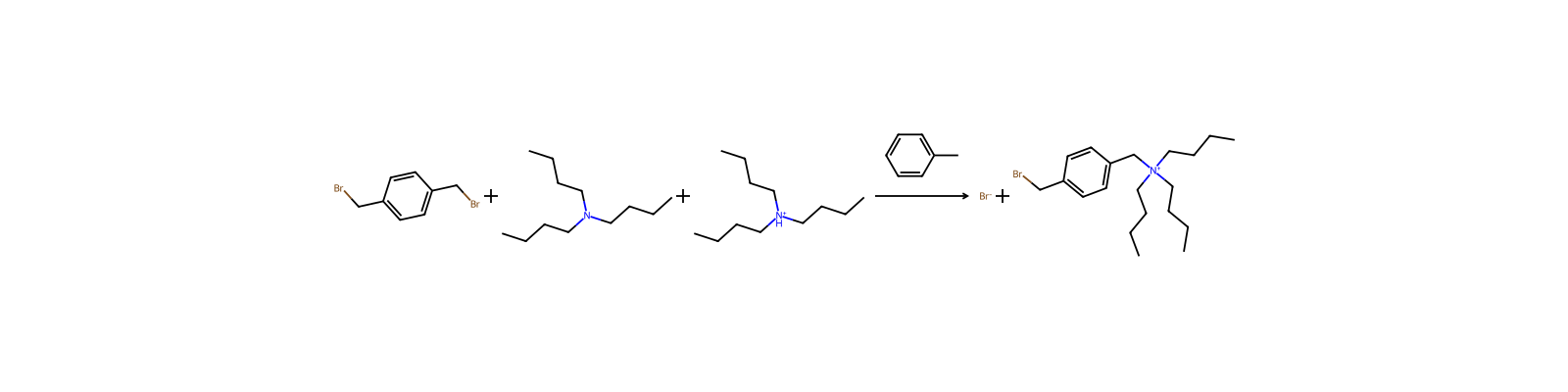
HRID 66171 reaction equation
HRID 66171As reactant
HRID 133712 reaction equation
HRID 133712As reactant
HRID 133720 reaction equation
HRID 133720As reactant
HRID 133722 reaction equation
HRID 133722As reactant
HRID 162722 reaction equation
HRID 162722As reactant
HRID 262205 reaction equation
HRID 262205As reactant
HRID 266002 reaction equation
HRID 266002As reactant
HRID 266004 reaction equation
HRID 266004As reactant
PreviousPage 1 of 12

Compound notes

On this pageBasic informationNames & identifiersPropertiesSafety & regulationChemistry & industryRelated reactionsCompound notes
Water Solubility
soluble, hydrolyses
Sensitive
Lachrymatory
BRN
1100019 · 1100019
InChI
1S/C8H8Br2/c9-5-7-1-2-8(6-10)4-3-7/h1-4H,5-6H2
InChIKey
RBZMSGOBSOCYHR-UHFFFAOYSA-N
SMILES
BrCc1ccc(CBr)cc1
CAS DataBase Reference
623 · 623-24-5(CAS DataBase Reference)
NIST Chemistry Reference
1 · Benzene, 1,4-bis(bromomethyl)-(623-24-5)
EPA Substance Registry System
1 · 1,4-Bis(bromomethyl)benzene (623-24-5)
UNSPSC Code
12352100 · 12352100
NACRES
22 · NA.22
Symbol(GHS)
7 · GHS07
Signal word
Warning
Hazard statements
315 · H315-H319-H335
Precautionary statements
261 · P261-P264-P271-P280-P302+P352-P305+P351+P338
target organs
Respiratory system
PPE
3 · Eyeshields, Faceshields, Gloves, type P3 (EN 143) respirator cartridges
Hazard Codes
C
Risk Statements
34 · 34-22
Safety Statements
26 · 26-36/37/39-45
RIDADR
3448 · UN 3448 6.1/PG 2
WGK Germany
3 · 3
F
8 · 8-19-21
Hazard Note
Corrosive/Lachrymatory
TSCA
TSCA listed
HazardClass
8 · 8
PackingGroup
III
HS Code
2903999090 · 2903999090
Storage Class
6.1 A · 6.1A - Combustible acute toxic Cat. 1 and 2very toxic hazardous materials
Hazard Classifications
2 Skin · Eye Irrit. 2Skin Irrit. 2STOT SE 3
Limited Quantities
0.5 Kg · 0.5 Kg (solid)
Excepted Quantities
Max Inner Pack (1g or 1ml) and Max Outer Pack (500g or 500ml)
hazard_note
Corrosive/Lachrymatory
safety_code
26-36/37/39-45
hazard_class
8
Storage Class
6.1A - Combustible acute toxic Cat. 1 and 2very toxic hazardous materials
packing_group
III
target organs
Respiratory system
Hazard statements
H315-H319-H335
Limited Quantities
0.5 Kg (solid)
Excepted Quantities
Max Inner Pack (1g or 1ml) and Max Outer Pack (500g or 500ml)
Hazard Classifications
Eye Irrit. 2Skin Irrit. 2STOT SE 3
Precautionary statements
P261-P264-P271-P280-P302+P352-P305+P351+P338