
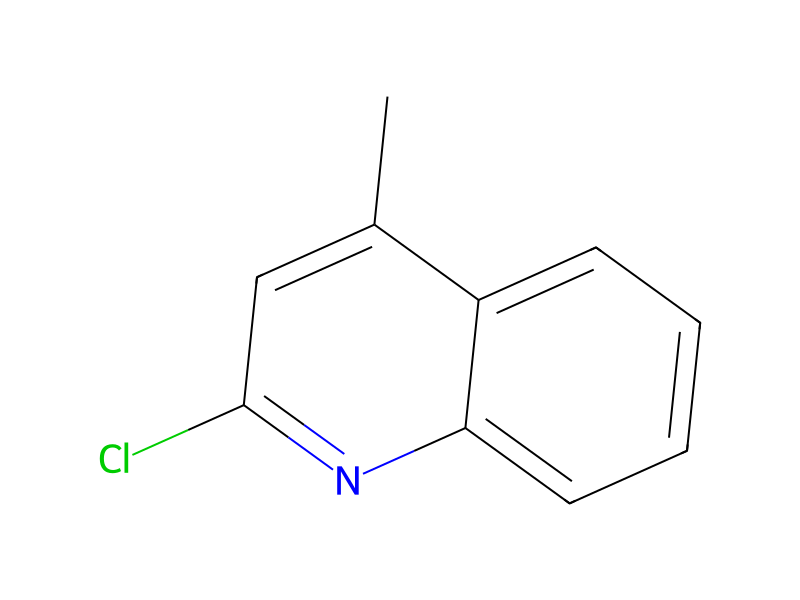
Basic information
- Standard SMILES
Cc1cc(Cl)nc2ccccc12- InChIKey
PFEIMKNQOIFKSW-UHFFFAOYSA-N- Molecular formula
- C10H8ClN
- Average molar mass
- 177.63 g/mol
- Monoisotopic mass
- 177.03452694
Names & identifiers
- Preferred name
- 2-Chloro-4-methylquinoline
- IUPAC
- 2-chloro-4-methylquinoline
- English name
- 2-Chlorolepidine
- Molecular formula
- C10H8ClN
- Molecular weight
- 177.63
Names & synonyms
2-Chloro-4-methylquinoline634-47-9Quinoline, 2-chloro-4-methyl-Lepidine, 2-chloro-EINECS 211-209-3NSC 96476DTXSID00212808RefChem:86252Lepidine, 2-chloro-(8CI)DTXCID90135299Quinoline, 2-chloro-4-methyl-(9CI)211-209-3
Show more names
AKOS BB-6898Chlorolepidine3-chlorolepidineAKOS BBS-000002152-Chlorolepidine >OTAVA-BB BB01161100262-chloro-4-methyl-quinolin
InChI=1/C10H8ClN/c1-7-6-10(11)12-9-5-3-2-4-8(7)9/h2-6H,1HPFEIMKNQOIFKSW-UHFFFAOYSA-N2-Chlorolepidine2-chloro-4-methyl-quinolineMFCD000067422-chloro-4methylquinoline2U5ATH9EJR2-Chloro-4-methylquinolin
Database identifiers
- CAS
634-47-9- PubChem CID
- 69449
- DTXSID
DTXSID00212808- UNII
- 2U5ATH9EJR
- EC Number
- 211-209-3
- Nikkaji
- J95.797F
Properties
Computed structural properties
- XLogP
- 3.5
- Topological polar surface area
- 12.9 Ų
- Hydrogen bond donors
- 0
- Hydrogen bond acceptors
- 1
- Rotatable bonds
- 0
- Heavy atoms
- 12
- Formal charge
- 0
- Complexity
- 160
Experimental & physicochemical properties
SpringerMaterials PropertiesNuclear quadrupole resonance spectroscopy
Physicochemical properties
- Melting point
- 55 · 55-58 °C(lit.)
- Boiling point
- 296 °C · 296 °C(lit.)
- Density
- 1.181 · 1.1810 (rough estimate)
- refractive index
- 1.6224 · 1.6224 (estimate)
- Flash point
- 296 °C · 296°C
- storage temp.
- Inert atmosphere,Room Temperature
- form
- powder to crystal
- pka
- 0.98 · 0.98±0.50(Predicted)
- color
- White to Almost white
- BRN
- 118333 · 118333
- InChI
- InChI=1S/C10H8ClN/c1-7-6-10(11)12-9-5-3-2-4-8(7)9/h2-6H,1H3
- InChIKey
- PFEIMKNQOIFKSW-UHFFFAOYSA-N
- SMILES
- N1C2C(=CC=CC=2)C(C)=CC=1Cl
- CAS DataBase Reference
- 634 · 634-47-9(CAS DataBase Reference)
- FDA UNII
- 2 U5ATH9EJR · 2U5ATH9EJR
- NIST Chemistry Reference
- 2 · Quinoline, 2-chloro-4-methyl-(634-47-9)
- UNSPSC Code
- 12352100 · 12352100
- NACRES
- 22 · NA.22
- Symbol(GHS)
- 7 · GHS07
- Signal word
- Warning
- Hazard statements
- 315 · H315-H319-H335
- Precautionary statements
- 261 · P261-P305+P351+P338
- Hazard Codes
- Xi
- Risk Statements
- 36 · 36/37/38
- Safety Statements
- 26 · 26-37/39-36-24/25
- WGK Germany
- 3 · 3
- HS Code
- 29334900 · 29334900
- Storage Class
- 13 · 13 - Non Combustible Solids
- Hazard Classifications
- 2 Skin · Eye Irrit. 2Skin Irrit. 2STOT SE 3
Safety & regulation
GHS classification
GHS Classification
Warning
H315 (100%): Causes skin irritation [Warning Skin corrosion/irritation]
P261, P264, P264+P265, P271, P280, P302+P352, P304+P340, P305+P351+P338, P319, P321, P332+P317, P337+P317, P362+P364, P403+P233, P405, and P501 (click each P-code to see the statement)
Aggregated GHS information provided per 45 reports by companies from 5 notifications to the ECHA C&L Inventory. Each notification may be associated with multiple companies.
Hazard information
Hazard Classes and CategoriesSkin Irrit. 2 (100%)
Safety data
- wgk
- 3
- hs_code
- 29334900
- risk_code
- 36/37/38
- Signal word
- Warning
- Symbol(GHS)
- GHS07
- hazard_code
- Xi
- safety_code
- 26-37/39-36-24/25
- Storage Class
- 13 - Non Combustible Solids
- Hazard statements
- H315-H319-H335
- Hazard Classifications
- Eye Irrit. 2Skin Irrit. 2STOT SE 3
- Precautionary statements
- P261-P305+P351+P338
Chemistry & industry
Applications
Description4-Methyl-2-chloro-quinoline is an organic intermediate. It has been reported that it can be used to prepare graphite electrodes based on CrO-FeO-PbO and quinoline modified and a modified vermiculite adsorbent for the adsorption and removal of benzene in chemical wastewater.
Uses2-Chloro-4-methyl-quinoline is a useful synthetic intermediate. It is an intermediate used to synthesize 4-Methyl-2-(1-piperidinyl)-quinoline (M320715) which is a potent inhibitor of TRPC4 channels, responsible for various stimulation, muscle response due to interaction with the environment. 2-Chloro-4-methyl-quinoline is also considered as a cyanine dye.
Preparation methods
PreparationThe mixture of 2-hydroxy-4-methylquinoline and phosphorus oxychloride was heated to 80-85°C. After the solid was completely dissolved, the mixture was poured into ice water, the mixture was extracted with ether, and the ether extract was distilled out of ether. Afterwards, carry out vacuum distillation, collect 132-135 ℃ (0.4kPa) fraction, namely 2-chloro-4-methylquinoline. For further purification, petroleum ether (boiling point 40-50°C) can be used for recrystallization, and the yield is 86%-89%.
Upstream & downstream products
Upstream raw materials
Downstream products
Suppliers50 total
河北凡博医药科技有限公司15588346797
梯希爱(上海)化成工业发展有限公司021-67121386 · [email protected]
衢州润东化工有限公司0570-8789886 18892685668 · [email protected]
陕西科贝莱药物研发有限公司13119135307 · [email protected]
上海阿拉丁生化科技股份有限公司400-6206333 13167063860 · [email protected]
湖北威德利化学试剂有限公司181-6332-1995 18062128043 · [email protected]
毕佳索(上海毕得医药科技股份有限公司)400-6005915 · [email protected]
上海麦克林生化科技股份有限公司021-50706066 15221275939 · [email protected]
杭州品高化工有限公司0571-87658025 · [email protected]
温州共赢化学有限公司+86-0086-577-64498589 +86-15355981851 · [email protected]
普善实业(陕西)有限公司029-81310890 18165209495 · [email protected]
宁波季诺化学品有限公司0574-87314919 057487319282 · [email protected]
河北展药生物科技有限公司15369953316 +8615369953316 · [email protected]
Hunan Jibang Biological Technology Co., LTD13776644403 · [email protected]
Dayang Chem (Hangzhou) Co.,Ltd.+86-0571-88938639 17705817739 · [email protected]
郑州鸿晟医药科技有限公司0371-55695890 15637198702 · [email protected]
韶远科技(上海)有限公司021-50795510 4000665055 · [email protected]
上海迈瑞尔生化科技有限公司4006356688 18621169109 · [email protected]
北京华威锐科化工有限公司0757-86329057 18934348241 · [email protected]
北京索莱宝科技有限公司010-50973130 17801761073 · [email protected]
阿法埃莎(中国)化学有限公司400-6106006 · [email protected]
上海德默医药科技有限公司400-021-7337 2355568890 · [email protected]
安耐吉化学&3A(安徽泽升科技股份有限公司)400-0056266 · [email protected]
湖北长耀生物科技有限公司17683887209 17683887209 · [email protected]
上海瀚鸿科技股份有限公司021-54306202 13764082696 · [email protected]
南京圣亿来化工有限公司19951936396 · [email protected]
湖北成海化工有限公司027-59220433 18327245847 · [email protected]
上海健超生物科技有限公司15021035486 18081542813 · [email protected]
同创医药(苏州)有限公司0512-63263366 18912765016 · [email protected]
白银承泽化工科技有限公司+86 943-8535351 13389336721 · [email protected]
上海特伯化学科技有限公司+86-21-60341587 · [email protected]
TCI AMERICA800-4238616 · [email protected]
TOKYO CHEMICAL INDUSTRY CO., LTD.03-36680489 · [email protected]
TCI Europe320-37350700 · [email protected]
越林试剂021-62960152 · [email protected]
上海毕得医药科技股份有限公司400-164-7117 18317119277 · [email protected]
Labnetwork lnc.+86-27-50766799 +86-18062016861 · [email protected]
湖南华腾制药有限公司400-8592883 · [email protected]
苏州科为化学有限公司512-62706911 13401923197 · [email protected]
上海馨远医药科技有限公司021-24206007 13764915196 · [email protected]
杭州杰恒化工有限公司0571-87396432 · [email protected]
Sigma-Aldrich西格玛奥德里奇(上海)贸易有限公司021-61415566 800-8193336 · [email protected]
重庆奥舍生物化工有限公司023-63225655 13320248848 · [email protected]
九鼎化学(上海)科技有限公司4009209199 · [email protected]
Henan Alfa Chemical Co., Ltd+8618339805032 · [email protected]
厦门志信化学有限公司+86-5922680277 +86-13806087780 · [email protected]
上海玻尔化学试剂有限公司19102157732 · [email protected]
Alfa Chemistry+1-5166625404 · [email protected]
艾吉析科技(上海)有限公司17721401538;17717235263 17721401538 · [email protected]
陕西缔都医药化工有限公司029-029-81120477 17792793610 · [email protected]
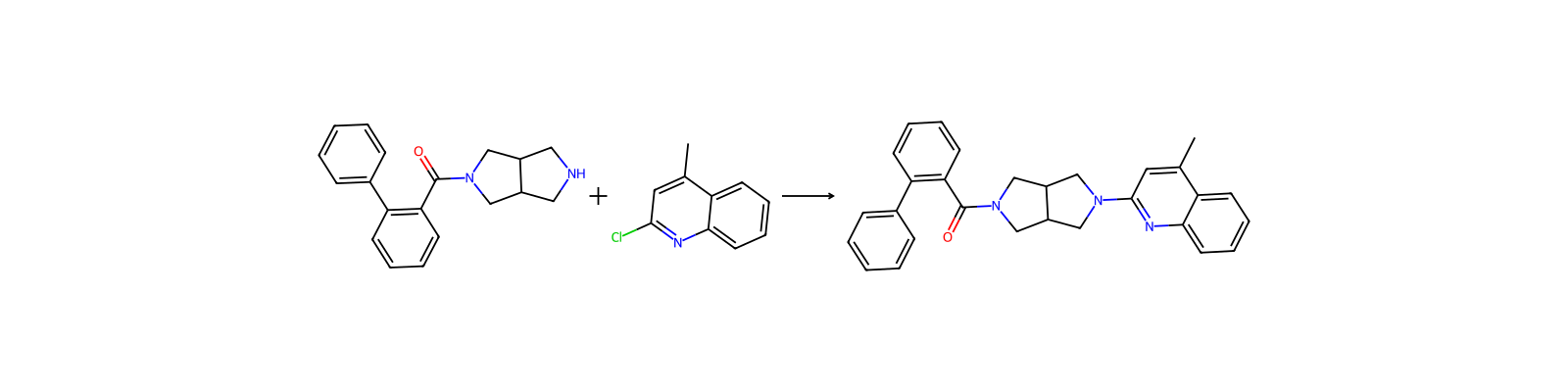
Related reactions
19 records


Linked notes
Loading…