
Benzhydrylpiperazine
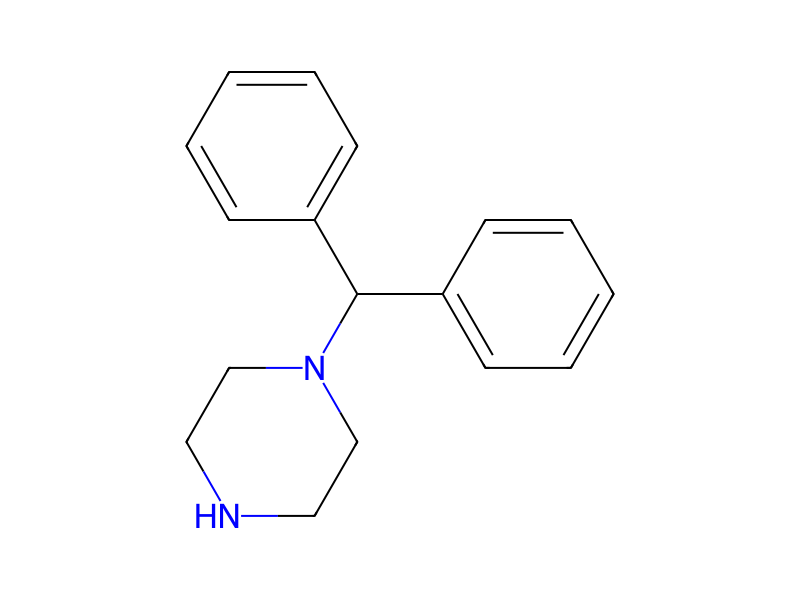
Basic information
- CAS
841-77-0- Standard SMILES
c1ccc(C(c2ccccc2)N2CCNCC2)cc1- InChIKey
NWVNXDKZIQLBNM-UHFFFAOYSA-N- Molecular formula
- C17H20N2
- Average molar mass
- 252.35 g/mol
- Monoisotopic mass
- 252.16264865
Overview
RN given refers to parent cpd; structure in first source
Names & identifiers
- Preferred name
- Benzhydrylpiperazine
- IUPAC
- 1-benzhydrylpiperazine
- English name
- 1-Benzhydrylpiperazine
- Molecular formula
- C17H20N2
- Molecular weight
- 252.35
Names & synonyms
1-Benzhydrylpiperazine841-77-01-(Diphenylmethyl)piperazineBenzhydrylpiperazineNorcyclizine4-BenzhydrylpiperazineN-(Diphenylmethyl)piperazinePiperazine, 1-(diphenylmethyl)-NU6V5ZHD9PNSC-35536DTXSID80232968RefChem:166584
Show more names
NSC 35536AKOS NCG1-0108AKOS BBS-00003601TIMTEC-BB SBB003136Benzhydrol piperzineLABOTEST-BB LT00454383
DTXCID10155459212-667-7Diphenylmethylpiperazine1-Benzhydryl-piperazineN-BenzhydrylpiperazineNormethylcyclizineCinnarizine EP Impurity AMFCD00038379
Database identifiers
- CAS
841-77-0- PubChem CID
- 70048
- DTXSID
DTXSID80232968- ChEMBL
CHEMBL1490469- UNII
- NU6V5ZHD9P
- EC Number
- 212-667-7
- Nikkaji
- J29.024F
Properties
Computed structural properties
- XLogP
- 2.8
- Topological polar surface area
- 15.3 Ų
- Hydrogen bond donors
- 1
- Hydrogen bond acceptors
- 2
- Rotatable bonds
- 3
- Heavy atoms
- 19
- Formal charge
- 0
- Complexity
- 230
Experimental & physicochemical properties
DrugsPharmaceuticals -> Metabolite of Cinnarizine
Solubility25 [ug/mL] (The mean of the results at pH 7.4)
Physicochemical properties
- Melting point
- 90 · 90-93 °C
- Boiling point
- 185 °C/2mmHg · 185°C/2mmHg(lit.)
- Density
- 1.0546 · 1.0546 (rough estimate)
- vapor pressure
- 0.001 Pa · 0.001Pa at 20℃
- refractive index
- 1.5794 · 1.5794 (estimate)
- Flash point
- 115 °C · 115 °C
- storage temp.
- Keep in dark place,Sealed in dry,Room Temperature
- solubility
- Methanol (Slightly)
- pka
- 9.05 · 9.05±0.10(Predicted)
- form
- Crystalline Powder
- color
- White to light yellow
Safety & regulation
Safety information is for reference only and does not replace the supplier’s Safety Data Sheet (SDS), applicable regulations, or professional assessment.
GHS classification
GHS Classification
This chemical does not meet GHS hazard criteria for 1.9% (1 of 52) of reports.
Warning
H302 (92.3%): Harmful if swallowed [Warning Acute toxicity, oral]
P261, P264, P264+P265, P270, P271, P280, P301+P317, P302+P352, P304+P340, P305+P351+P338, P317, P319, P321, P330, P332+P317, P337+P317, P362+P364, P403+P233, P405, and P501 (click each P-code to see the statement)
Aggregated GHS information provided per 52 reports by companies from 10 notifications to the ECHA C&L Inventory. Each notification may be associated with multiple companies.
Hazard information
Regulatory InformationREACH registered substance: 1-benzhydrylpiperazine (EC: 212-667-7)
Hazard Classes and CategoriesAcute Tox. 4 (92.3%)
Safety data
- F
- 34
- PPE
- Eyeshields, Faceshields, Gloves, type N95 (US)
- wgk
- 3
- rtecs
- TL6465000
- hs_code
- 29339900
- risk_code
- 22
- Signal word
- Warning
- Symbol(GHS)
- GHS07
- hazard_code
- Xn,Xi
- safety_code
- 22-24/25
- hazard_class
- IRRITANT
- Storage Class
- 6.1C - Combustible acute toxic Cat.3toxic compounds or compounds which causing chronic effects
Chemistry & industry
Pharmacology
Metabolism/Metabolites1-Benzhydrylpiperazine is a known human metabolite of cinnarizine.
Applications
UsesCinnarizine (C465300) impurity.
Uses1-(Diphenylmethyl)piperazine [N-(Diphenylmethyl)piperazine] may be used for the synthesis of 2-nitro-3,4,4-trichloro-1-(propylthio)-1-[4-(diphenylmethyl)piperazin-1-yl]-1,3-butadiene and 2-nitro-3,4,4-trichloro-1-(octadecylthio)-1-[4-(diphenylmethyl)piperazin-1-yl]-1,3-butadiene.
Uses1-Benzhydrylpiperazine is an intermediate used in drug synthesis
General Description1-(Diphenylmethyl)piperazine is an intermediate during drug synthesis. It has been reported to be formed during the oxidative metabolism of cinnarizine (CZ) [1-(diphenylmethyl)-4-(3-phenyl-2-propenyl)-piperazine] in rat liver microsomes. It reacts with quinone in acetonitrile, followed by oxidation with an alkaline potassium ferricyanide, to afford 4-amino-3,6-di(tert-butyl)-o-benzoquinones.
Upstream & downstream products
Upstream raw materials
Downstream products
Related reactions
331 records



Compound notes
Loading…