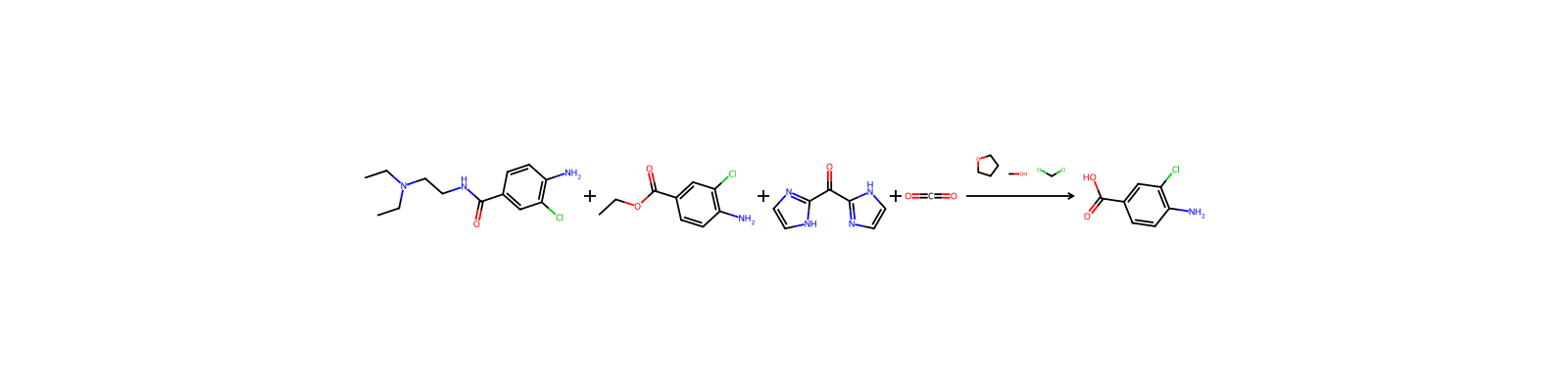

Basic information
- CAS
891-60-1- Standard SMILES
CCN(CC)CCNC(=O)c1ccc(N)c(Cl)c1- InChIKey
YEYAKZXEBSVURO-UHFFFAOYSA-N- Molecular formula
- C13H20ClN3O
- Average molar mass
- 269.77 g/mol
- Monoisotopic mass
- 269.12948994
Overview
Declopramide is a third-generation DNA repair inhibitor that modulates multi-drug resistance.
Names & identifiers
- Preferred name
- Declopramide
- IUPAC
- 4-amino-3-chloro-N-[2-(diethylamino)ethyl]benzamide
- English name
- Declopramide
- Molecular formula
- C13H20ClN3O
- Molecular weight
- 269.77
Names & synonyms
declopramide891-60-14-Amino-3-chloro-N-[2-(diethylamino)ethyl]benzamide4-amino-3-chloro-n-(2-(diethylamino)ethyl)benzamidedeclopramida3-chloro-procainamideDTXSID20862460916GJF577DdeclopramidumOXi-104RefChem:131321DTXCID00811219
Show more names
IMO-B4-amino-3-chloro-N-(2-diethylaminoethyl)benzamide4-azanyl-3-chloro-N-(2-diethylaminoethyl)benzamideBenzamide, 4-amino-3-chloro-N-[2-(diethylamino)ethyl]-
3-ChloroprocainamideDeclopramide [INN]UNII-916GJF577DYEYAKZXEBSVURO-UHFFFAOYSA-NSCHEMBL922516orb1700755CHEMBL1618378SCHEMBL30719968
Database identifiers
- CAS
891-60-1- PubChem CID
- 70177
- DTXSID
DTXSID20862460- ChEMBL
CHEMBL1618378- UNII
- 916GJF577D
- Nikkaji
- J1.088.659G
Properties
Computed structural properties
- XLogP
- 1.7
- Topological polar surface area
- 58.4 Ų
- Hydrogen bond donors
- 2
- Hydrogen bond acceptors
- 3
- Rotatable bonds
- 6
- Heavy atoms
- 18
- Formal charge
- 0
- Complexity
- 259
Experimental & physicochemical properties
DrugsPharmaceuticals -> Listed in ZINC15
Physicochemical properties
- Boiling point
- 404.2 · 404.2±45.0 °C(Predicted)
- Density
- 1.153 · 1.153±0.06 g/cm3(Predicted)
- pka
- 13.76 · 13.76±0.46(Predicted)
- FDA UNII
- 916 GJF577D · 916GJF577D
Chemistry & industry
Pharmacology
Mechanism of Action
Declopramide is a member of the N-substituted benzamide class of DNA repair inhibitors. There are two possible mechanisms of action of declopramide, with one involving (nuclear localizing factor kappaB) NFkB and the other involving the activation of the caspase cascade via the mitochondrial pathway, both of which lead to cell death (apoptosis). Declopramide may also increase the susceptibility of cancer cells to traditional radiation and/or chemotherapy treatment. It is proposed that G2/M cell cycle block is induced by pathways other than the protein 53 (p53) pathway.
Applications
UsesDeclopramide (3-Chloroprocainamide) is an orally active antitumor agent, which inhibits proliferation of cancer cells HL60 and K562, and inhibits tumor growth of human brain astrocytoma (T24) in mouse model. Declopramide induces apoptosis, inhibits NF-κB through inhibition of IκBα degradation. Declopramide serves also as chemosensitizer in research[1][2][3].
Suppliers5 total
上海陶术生物科技股份有限公司+1-781-999-5354; +1-00000000000 · [email protected]
砌块化学科技(上海)有限公司021-20432219 13918097649 · [email protected]
上海一飞生物科技有限公司021-65675885 18964387627 · [email protected]
TargetMol中国(陶术生物)15002134094 · [email protected]
上海阿摩尔生物科技有限公司13370042665 18916960931 · [email protected]
Related reactions
3 records


Compound notes
Loading…