HomeMCPWorkbenchSkills
HomeWorkbenchNotificationsMe
llms.txt · MCP GuidePrivacy Policy · Terms of Service · Supportv1.8.3
  1. Home
  2. /Compound

9-Aminoacridine

HCID 7019
New reaction
Print

Completing data — refresh the page later to see the latest

Basic informationOverviewNames & identifiersPropertiesSafety & regulationChemistry & industryRelated reactionsCompound notes
Substructure searchFind similar structures

Basic information

CAS
90-45-9
Standard SMILES
Nc1c2ccccc2nc2ccccc12
InChIKey
XJGFWWJLMVZSIG-UHFFFAOYSA-N
Molecular formula
C13H10N2
Average molar mass
194.23 g/mol
Monoisotopic mass
194.08439833

Overview

9-aminoacridine appears as yellow needles. Free soluble in alcohol.

Names & identifiers

Preferred name
9-Aminoacridine
IUPAC
acridin-9-amine
English name
9-Aminoacridine
Molecular formula
C13H10N2
Molecular weight
194.23

Names & synonyms

9-AMINOACRIDINE90-45-9Acridin-9-amineAminacrine9-AcridinamineAminoacridineAminacrinIzoacridina10-Amino-5-azaanthraceneAminoacridinaAcridine, 9-amino-Aminoacridinum
Show more names
9AAAcramineAcriflexNSC 13000NSC 28747
5-AminoacridineNSC-1300078OY3Z0P7ZDTXSID2024456CHEBI:74789NSC13000NSC28747Aminoacrine

Database identifiers

CAS
90-45-9
PubChem CID
7019
DTXSID
DTXSID2024456
ChEMBL
CHEMBL43184
ChEBI
CHEBI:74789
UNII
78OY3Z0P7Z
EC Number
201-995-6
Nikkaji
J3.917I、J761.367I

Properties

Computed structural propertiesFilling in

XLogP
2.8
Topological polar surface area
38.9 Ų
Hydrogen bond donors
1
Hydrogen bond acceptors
2
Rotatable bonds
0
Heavy atoms
15
Formal charge
0
Complexity
207

Experimental & physicochemical properties

SpringerMaterials PropertiesAngular frequency
LogP2.74
Solubilityless than 1 mg/mL at 68 °F (NTP, 1992)
Melting Point466 °F (NTP, 1992)
Physical Description9-aminoacridine appears as yellow needles. Free soluble in alcohol.
Collision Cross Section · 3 items

139.3 Ų [M-H]- [CCS Type: DT; Buffer gas: N2; Ionization: ESI-; Dataset: TOXCAST; Source Identifier: DTXSID7024457]

136.8 Ų [M+H]+ [CCS Type: TW; Method: calibrated with polyalanine and drug standards]

135 Ų [M+H]+ [CCS Type: TW; Method: calibrated with polyalanine and drug standards]

Physicochemical properties

Melting point
238 · 238-240℃
Boiling point
320.68 °C · 320.68°C (rough estimate)

Safety & regulation

Safety information is for reference only and does not replace the supplier’s Safety Data Sheet (SDS), applicable regulations, or professional assessment.

GHS classification

GHS Classification · 4 items

Warning

H315 (100%): Causes skin irritation [Warning Skin corrosion/irritation]

P261, P264, P264+P265, P271, P280, P302+P352, P304+P340, P305+P351+P338, P319, P321, P332+P317, P337+P317, P362+P364, P403+P233, P405, and P501 (click each P-code to see the statement)

Aggregated GHS information provided per 40 reports by companies from 3 notifications to the ECHA C&L Inventory. Each notification may be associated with multiple companies.

Hazard information

Regulatory Information · 2 items

Chemical: 9-Acridinamine

9-Aminoacridine: Does not have an individual approval but may be used under an appropriate group standard

Other Safety InformationEvaluation - Chemicals not considered for in depth evaluation - Not commercially active in Australia
Fire HazardsFlash point data for this chemical are not available; however, it is probably combustible. (NTP, 1992)
Health HazardsSYMPTOMS: Symptoms of exposure to this compound may include gastrointestinal mucosa irritation, nausea and vomiting.
Reactive GroupAmines, Phosphines, and Pyridines
Reactivity Profile · 1 item

9-AMINOACRIDINE is a moderately strong base. Neutralizes acids to form salts plus water in exothermic reactions. May be incompatible with isocyanates, halogenated organics, peroxides, phenols (acidic), epoxides, anhydrides, and acid halides. Flammable gaseous hydrogen is generated in combination with strong reducing agents, such as hydrides.

Chemistry & industry

Pharmacology

ATC Code · 2 items

D - Dermatologicals

QD - Dermatologicals

MeSH Pharmacological Classification · 4 items

Substances used on humans and other animals that destroy harmful microorganisms or inhibit their activity. They are distinguished from DISINFECTANTS, which are used on inanimate objects.

Chemicals that emit light after excitation by light. The wave length of the emitted light is usually longer than that of the incident light. Fluorochromes are substances that cause fluorescence in other substances, i.e., dyes used to mark or label other compounds with fluorescent tags.

Substances used for the detection, identification, analysis, etc. of chemical, biological, or pathologic processes or conditions. Indicators are substances that change in physical appearance, e.g., color, at or approaching the endpoint of a chemical titration, e.g., on the passage between acidity and alkalinity. Reagents are substances used for the detection or determination of another substance by chemical or microscopical means, especially analysis. Types of reagents are precipitants, solvents, oxidizers, reducers, fluxes, and colorimetric reagents. (From Grant & Hackh's Chemical Dictionary, 5th ed, p301, p499)

Chemical agents that increase the rate of genetic mutation by interfering with the function of nucleic acids. A clastogen is a specific mutagen that causes breaks in chromosomes.

Uses & manufacturing

UsesSynthetic Polymer MALDI Matrix Compounds
Applications · 4 items

UsesAcridine analog. DNA intercalating agent.

Usesantibacterial

UsesA MALDI matrix exhibiting low background and good sensitivity in the analysis of low molecular weight anions, such as metabolites, in negative mode

Yellow needles. Free soluble in alcohol.

Related reactions

12 records
New reaction record
HRID 356846 reaction equation
HRID 356846As product
HRID 357488 reaction equation
HRID 357488As product
HRID 362191 reaction equation
HRID 362191As product
HRID 393884 reaction equation
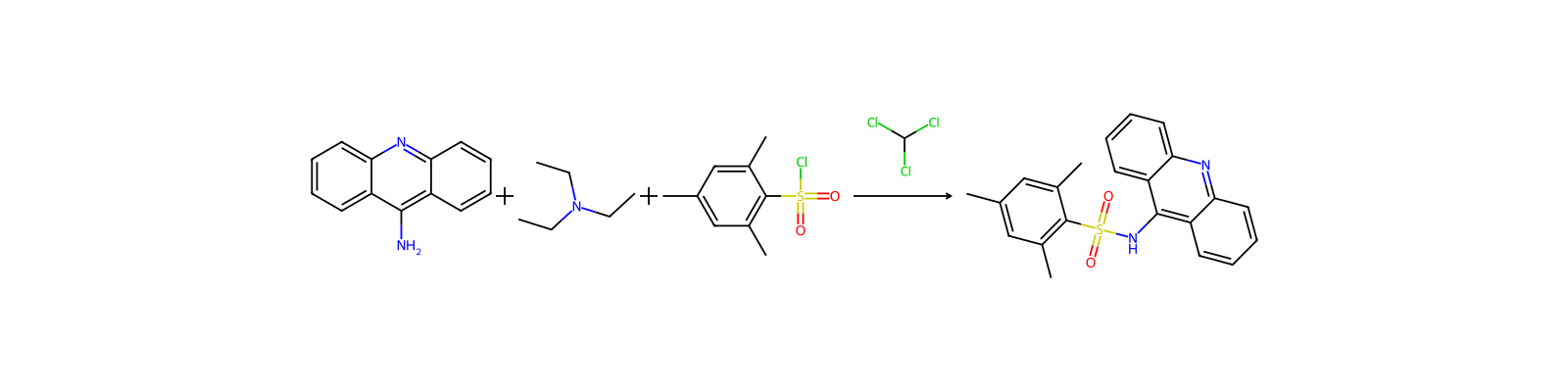
HRID 393884As reactant
HRID 479987 reaction equation
HRID 479987As reactant
HRID 852829 reaction equation
HRID 852829As reactant
HRID 953250 reaction equation
HRID 953250As reactant
HRID 1018752 reaction equation
HRID 1018752As reactant
PreviousPage 1 of 2

Compound notes

On this pageBasic informationOverviewNames & identifiersPropertiesSafety & regulationChemistry & industryRelated reactionsCompound notes
Density
1.268 · 1.268
refractive index
1.5014 · 1.5014 (estimate)
storage temp.
30 °C · Store below +30°C.
solubility
ethanol: hazy
pka
9.99 · 9.99(at 20℃)
form
Solid
color
Yellow
Water Solubility
11.65 mg/L · 11.65mg/L(24 ºC)
λmax
406 nm · 406nm(DMF)(lit.)
Merck
14 · 14,407
Stability
Stable. Incompatible with strong oxidizing agents.
InChI
1S/C13H10N2/c14-13-9-5-1-3-7-11(9)15-12-8-4-2-6-10(12)13/h1-8H,(H2,14,15)
InChIKey
XJGFWWJLMVZSIG-UHFFFAOYSA-N
SMILES
Nc1c2ccccc2nc3ccccc13
CAS DataBase Reference
90 · 90-45-9(CAS DataBase Reference)
EWG's Food Scores
1 · 1
FDA UNII
78 OY3Z0P7Z · 78OY3Z0P7Z
ATC code
8 AA02 · D08AA02
EPA Substance Registry System
9 · 9-Aminoacridine (90-45-9)
UNSPSC Code
12352116 · 12352116
NACRES
22 · NA.22
Symbol(GHS)
7 · GHS07,GHS09
Signal word
Warning
Hazard statements
302 · H302-H315-H319-H335-H410
Precautionary statements
261 · P261-P264-P273-P301+P312-P302+P352-P305+P351+P338
target organs
Respiratory system
Hazard Codes
Xi
Risk Statements
36 · 36/37/38
Safety Statements
26 · 26-36
RIDADR
2811 · 2811
WGK Germany
3 · 3
RTECS
7300000 · AR7300000
HS Code
2933 · 2933 99 80
HazardClass
6.1 · 6.1(b)
PackingGroup
III
Storage Class
11 · 11 - Combustible Solids
Hazard Classifications
4 OralAquatic · Acute Tox. 4 OralAquatic Acute 1Aquatic Chronic 1Eye Irrit. 2Skin Irrit. 2STOT SE 3
Toxicity
50 intraperitoneal · LD50 intraperitoneal in mouse: 68mg/kg
Air and Water Reactions
Insoluble in water.
Hazard Classes and CategoriesSkin Irrit. 2 (100%)

Safety & protection

Fire FightingFires involving this material can be controlled using a dry chemical, carbon dioxide or Halon extinguisher. (NTP, 1992)
First Aid · 1 item

EYES: First check the victim for contact lenses and remove if present. Flush victim's eyes with water or normal saline solution for 20 to 30 minutes while simultaneously calling a hospital or poison control center. Do not put any ointments, oils, or medication in the victim's eyes without specific instructions from a physician. IMMEDIATELY transport the victim after flushing eyes to a hospital even if no symptoms (such as redness or irritation) develop.

Nonfire Spill Response · 1 item

SMALL SPILLS AND LEAKAGE: Should a spill occur while you are handling this chemical, FIRST REMOVE ALL SOURCES OF IGNITION, then you should dampen the solid spill material with 60-70% ethanol and transfer the dampened material to a suitable container. Use absorbent paper dampened with 60-70% ethanol to pick up any remaining material. Seal the absorbent paper, and any of your clothes, which may be contaminated, in a vapor-tight plastic bag for eventual disposal. Solvent wash all contaminated surfaces with 60-70% ethanol followed by washing with a soap and water solution. Do not reenter the contaminated area until the Safety Officer (or other responsible person) has verified that the area has been properly cleaned.

Personal Protective Equipment (PPE) · 1 item

RECOMMENDED RESPIRATOR: Where the neat test chemical is weighed and diluted, wear a NIOSH-approved half face respirator equipped with a combination filter cartridge, i.e. organic vapor/acid gas/HEPA (specific for organic vapors, HCl, acid gas, SO2 and a high efficiency particulate filter). (NTP, 1992)

Safety data

wgk
3
rtecs
AR7300000
ridadr
2811
hs_code
2933 99 80
Toxicity
LD50 intraperitoneal in mouse: 68mg/kg
risk_code
36/37/38
Signal word
Warning
Symbol(GHS)
GHS07,GHS09
hazard_code
Xi
safety_code
26-36
hazard_class
6.1(b)
Storage Class
11 - Combustible Solids
packing_group
III
target organs
Respiratory system
Hazard statements
H302-H315-H319-H335-H410
Hazard Classifications
Acute Tox. 4 OralAquatic Acute 1Aquatic Chronic 1Eye Irrit. 2Skin Irrit. 2STOT SE 3
Precautionary statements
P261-P264-P273-P301+P312-P302+P352-P305+P351+P338
General Description

Upstream & downstream products

Upstream raw materials

Phosphorus pentachloride9-ChloroacridineAnthranilic acid

Downstream products

Kallikrein
Additional notes · 1 item

DefinitionChEBI: An aminoacridine that is acridine in which the hydrogen at position 9 is replaced by an amino group. A fluorescent dyd and topical antiseptic agent, it is used (usually as the hydrochloride salt) in eye drops for the treatment of superficial eye infections