
HRID 128845As product
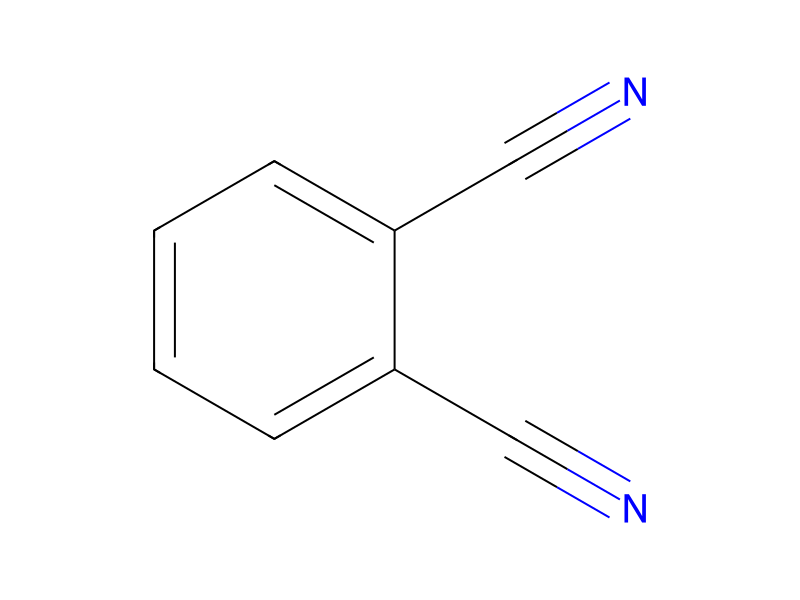
91-15-6N#Cc1ccccc1C#NXQZYPMVTSDWCCE-UHFFFAOYSA-NPhthalonitrile is a dinitrile that is benzene which is substituted by cyano groups at positions 1 and 2. It is a member of benzenes and a dinitrile.
91-15-6DTXSID8029604CHEMBL3185350CHEBI:232056log Kow = 0.99
0.58
0.99
1.238 g/cu cm
1.24 g/cm³
NEEDLES FROM WATER OR PETROLEUM ETHER
Buff-colored crystals
Faint grayish yellow
Soluble in alcohol and ether
Soluble in acetone and benzene.
In water, 395 mg/l @ 25 °C.
Solubility in water, g/100ml at 25 °C: 0.06
162 °C
162 °C
Safety information is for reference only and does not replace the supplier’s Safety Data Sheet (SDS), applicable regulations, or professional assessment.
Danger
H300 (28.4%): Fatal if swallowed [Danger Acute toxicity, oral]
P261, P262, P264, P270, P271, P273, P280, P301+P316, P302+P352, P304+P340, P316, P321, P330, P361+P364, P403+P233, P405, and P501 (click each P-code to see the statement)
Aggregated GHS information provided per 162 reports by companies from 11 notifications to the ECHA C&L Inventory. Each notification may be associated with multiple companies.
Danger
H301: Toxic if swallowed [Danger Acute toxicity, oral]
REACH registered substance: Phthalonitrile (EC: 202-044-8)
Phthalonitrile: Does not have an individual approval but may be used under an appropriate group standard
Inhalation of high concentrations may cause CNS effects; [ICSC] Emergency treatment: Benzyl cyanide; [HSDB] Lethal doses cause tremor and convulsions in rats; [RTECS] TLV Basis = convulsions and decreased body weight; Unlike the aliphatic nitriles, aromatic nitriles such as m-phthalodinitrile do not liberate cyanide in the body. [ACGIH] An acute neurotoxin; Not irritating to skin or eyes; [Reference #1] See m-Phthalodinitrile. See NITRILES.
Organic nitriles are converted into cyanide ions through the action of cytochrome P450 enzymes in the liver. Cyanide is rapidly absorbed and distributed throughout the body. Cyanide is mainly metabolized into thiocyanate by either rhodanese or 3-mercaptopyruvate sulfur transferase. Cyanide metabolites are excreted in the urine. (L96)
Used as an intermediate mainly for the production of phthalocyanine dyes; Also used in sintering metals; [ACGIH]
Metal Extraction and Refining [Category: Industry]
Intermediate in organic synthesis, (esp pigments and dyes), base material for high temp lubricants and coatings
Insecticide, synergist /Former/
Used as a starting material for producing phthalocyanine pigments, fluorescent brighteners and photographic sensitizers.
Phthalonitrile is used as a precursor to phthalocyanine pigments (which are precursors to the blue dye in jeans), fluorescent brighteners, and photographic sensitizers. (L611)
Vapor phase reaction of ammonia and phthalic anhydride over alumina catalyst @ high temp.
Produced commercially from o-xylene by ammoxidation; produced commercially from phthalic acid, phthalic anhydride, phthalamide or phthalimide by reaction with ammonia and elimination of water @ 300-500 °C in gas-phase with catalyst.
1,2-Benzenedicarbonitrile: ACTIVE
HIGHLY TOXIC STOMACH POISON FOR CATERPILLARS & DIPTEROUS LARVAE.


138 °C
141 °C
0.00569 [mmHg]
0.05 millibar @ 20 °C (3.75X10⁻² mm Hg)
Vapor pressure, Pa at 20 °C: 4
Acute Tox. 2 (28.4%)
Acute toxicity (Oral) - Category 3
Acute toxicity (Oral) - Category 3
Fresh air, rest. Refer for medical attention.
Rinse skin with plenty of water or shower.
First rinse with plenty of water for several minutes (remove contact lenses if easily possible), then refer for medical attention.
Rinse mouth. Induce vomiting (ONLY IN CONSCIOUS PERSONS!). Give a slurry of activated charcoal in water to drink. Refer for medical attention .
SRP: At the time of review, criteria for land treatment or burial (sanitary landfill) disposal practices are subject to significant revision. Prior to implementing land disposal of waste residue (including waste sludge), consult with environmental regulatory agencies for guidance on acceptable disposal practices.
Personal protection: particulate filter respirator adapted to the airborne concentration of the substance. Do NOT let this chemical enter the environment. Sweep spilled substance into covered containers. Carefully collect remainder. Then store and dispose of according to local regulations.
Antidotes to cyanide poisoning include hydroxocobalamin and sodium nitrite, which release the cyanide from the cytochrome system, and rhodanase, which is an enzyme occurring naturally in mammals that combines serum cyanide with thiosulfate, producing comparatively harmless thiocyanate. Oxygen therapy can also be administered. (L97)
Exposure to high levels of cyanide for a short time harms the brain and heart and can even cause coma, seizures, apnea, cardiac arrest and death. Chronic inhalation of cyanide causes breathing difficulties, chest pain, vomiting, blood changes, headaches, and enlargement of the thyroid gland. Skin contact with cyanide salts can irritate and produce sores. (L96, L97)
TERRESTRIAL FATE: Based on a classification scheme(1), an estimated Koc value of 82(SRC), determined from a log Kow of 0.99(2) and a regression-derived equation(3), indicates that 1,2-benzenedicarbonitrile is expected to have high mobility in soil(SRC). Volatilization of 1,2-benzenedicarbonitrile from moist soil surfaces is not expected to be an important fate process(SRC) given an estimated Henry's Law constant of 5.0X10⁻⁷ atm-cu m/mole(SRC), using a fragment constant estimation method(4). 1,2-Benzenedicarbonitrile is not expected to volatilize from dry soil surfaces(SRC) based upon a vapor pressure of 3.75X10⁻² mm Hg(5).
AQUATIC FATE: Based on a classification scheme(1), an estimated Koc value of 82(SRC), determined from a log Kow of 0.99(2) and a regression-derived equation(3), indicates that 1,2-benzenedicarbonitrile is not expected to adsorb to suspended solids and sediment(SRC). Volatilization from water surfaces is not expected(3) based upon an estimated Henry's Law constant of 5.0X10⁻⁷ atm-cu m/mole(SRC), developed using a fragment constant estimation method(4). According to a classification scheme(5), a range of BCF values of 0.8 to <5.5 for carp(6), suggests the potential for bioconcentration in aquatic organisms is low(SRC).
ATMOSPHERIC FATE: According to a model of gas/particle partitioning of semivolatile organic compounds in the atmosphere(1), 1,2-benzenedicarbonitrile, which has a vapor pressure of 3.75X10⁻² mm Hg at 25 °C(2), is expected to exist solely as a vapor in the ambient atmosphere(SRC). Vapor-phase 1,2-benzenedicarbonitrile is degraded in the atmosphere by reaction with photochemically-produced hydroxyl radicals(SRC); the half-life for this reaction in air is estimated to be 356 days(SRC), calculated from its rate constant of 4.5X10⁻¹⁴ cu cm/molecule-sec at 25 °C(SRC) determined using a structure estimation method(3).
The substance can be absorbed into the body by inhalation and by ingestion.
Oral (L96) ; inhalation (L96) ; dermal (L96)
Organic nitriles decompose into cyanide ions both in vivo and in vitro. Consequently the primary mechanism of toxicity for organic nitriles is their production of toxic cyanide ions or hydrogen cyanide. Cyanide is an inhibitor of cytochrome c oxidase in the fourth complex of the electron transport chain (found in the membrane of the mitochondria of eukaryotic cells). It complexes with the ferric iron atom in this enzyme. The binding of cyanide to this cytochrome prevents transport of electrons from cytochrome c oxidase to oxygen. As a result, the electron transport chain is disrupted and the cell can no longer aerobically produce ATP for energy. Tissues that mainly depend on aerobic respiration, such as the central nervous system and the heart, are particularly affected. Cyanide is also known produce some of its toxic effects by binding to catalase, glutathione peroxidase, methemoglobin, hydroxocobalamin, phosphatase, tyrosinase, ascorbic acid oxidase, xanthine oxidase, succinic dehydrogenase, and Cu/Zn superoxide dismutase. Cyanide binds to the ferric ion of methemoglobin to form inactive cyanmethemoglobin. (L97)
Dizziness. Headache. Nausea. Vomiting. Convulsions. Unconsciousness.
Dizziness. Headache. Nausea. Vomiting. Convulsions. Unconsciousness.
Cyanide poisoning is identified by rapid, deep breathing and shortness of breath, general weakness, giddiness, headaches, vertigo, confusion, convulsions/seizures and eventually loss of consciousness. (L96, L97)
The Koc of 1,2-benzenedicarbonitrile is estimated as 82(SRC), using a measured log Kow of 0.99(1) and a regression-derived equation(2). According to a classification scheme(3), this estimated Koc value suggests that 1,2-benzenedicarbonitrile is expected to have high mobility in soil(SRC).
COMPARISON OF 20 WORKERS (AGE 32-62) WITH POSSIBLE EXPOSURE FOR 2-24 YR, FROM WHICH 7 SUFFERED ACUTE POISONING IN 1953-66, WITH CORRESPONDING CONTROL GROUP SHOWED NO SIGNIFICANT DIFFERENCES IN CHROMOSOMES.
MORTALITY RATE OF 221 EXPOSED WORKERS WAS INSIGNIFICANTLY GREATER THAN THAT OF INTERNAL OR EXTERNAL CONTROL GROUPS.
NO EVIDENCE FOR CHRONIC TOXICITY OF PHTHALONITRILE WAS FOUND. EXAM OF EXPOSED WORKERS FOR LEUKOSIS OR CARCINOGENIC EFFECTS, CLINICAL & NEUROLOGICAL EXAM OF 81 EXPOSED WORKERS, EEG STUDIES OF WORKERS GAVE RESULTS WITHIN NORMAL LIMITS.
1,2-Benzenedicarbonitrile's production and use as an intermediate in organic synthesis (esp, pigments and dyes) and as a base material for high temperature lubricants and coatings(1) may result in its release to the environment through various waste streams(SRC).
UsesPhthalodinitrile monomers can be polymerized thermally in the presence of small amounts of curing agents into thermosetting polymers. Phthalodinitrile is a precursor to phthalocyanine which is used as a dye or pigment.
UsesPhthalonitrile is used as an intermediate for chemical synthesis in the production of building blocks for colorants and coatings, life science and agricultural chemicals. It is also used as a precursor to phthalocyanine pigments (which are precursors to the blue dye in jeans), fluorescent brighteners, and photographic sensitizers.
PreparationPhthalonitrile can be produced from phthalic acid, phthalic anhydride, phthalamide, or phthalimide by reaction with ammonia and elimination of water at 300–500°C in the gas phase in the presence of a catalyst. In a single-stage continuous process, o-xylene is converted to phthalonitrile by reaction with ammonia and oxygen in the gas phase in a fluidized-bed reactor. Generally, metal oxide mixtures containing vanadium, antimony, chromium, and molybdenum, with further active components such as iron, tungsten, and alkali-metal oxides, on an alumina or silica support are used as catalysts.