
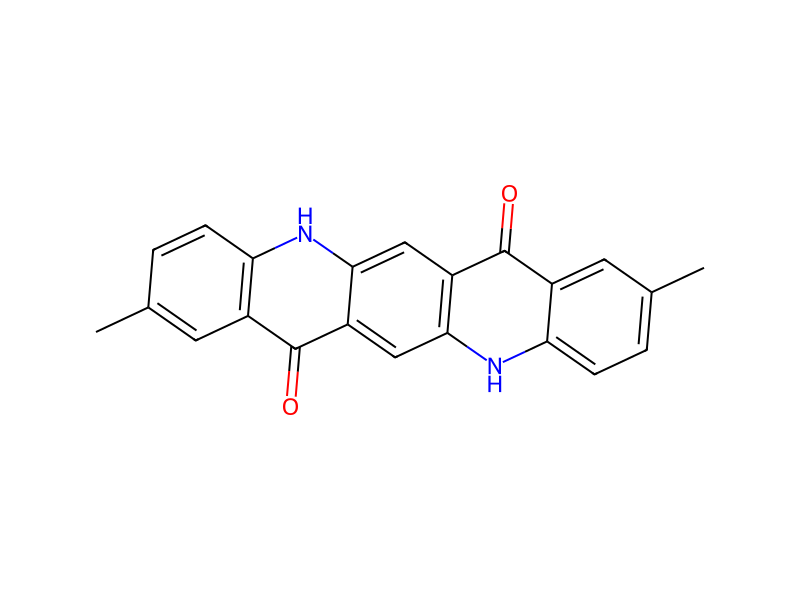
Basic information
- Standard SMILES
Cc1ccc2[nH]c3cc4c(=O)c5cc(C)ccc5[nH]c4cc3c(=O)c2c1- InChIKey
TXWSZJSDZKWQAU-UHFFFAOYSA-N- Molecular formula
- C22H16N2O2
- Average molar mass
- 340.4 g/mol
- Monoisotopic mass
- 340.12117776
Names & identifiers
- Preferred name
- 5,12-Dihydro-2,9-dimethylquino(2,3-b)acridine-7,14-dione
- IUPAC
- 2,9-dimethyl-5,12-dihydroquinolino[2,3-b]acridine-7,14-dione
- English name
- Pigment Red 122
- Molecular formula
- C22H16N2O2
- Molecular weight
- 340.37
Names & synonyms
Quino[2,3-b]acridine-7,14-dione, 5,12-dihydro-2,9-dimethyl-5,12-Dihydro-2,9-dimethylquino(2,3-b)acridine-7,14-dioneQuino(2,3-b)acridine-7,14-dione, 5,12-dihydro-2,9-dimethyl-5,12-dihydro-2,9-dimethylquino[2,3-b]acridine-7,14-dioneRefChem:527589980-26-72,9-Dimethylquinacridone2,9-Dimethylquinolino[2,3-b]acridine-7,14(5H,12H)-dioneHostaperm Pink E2,9-dimethyl-5,12-dihydroquinolino[2,3-b]acridine-7,14-dioneC.I. 73915MFCD00071968
Show more names
PIGMENT REDC.I.P.R.122122PIGMENT RED9 PIGMENT RED 98 PIGMENT RED 8Pigment Red 122Quindo Red -WTRANSQUINACRIDONE112 PIGMENT RED 112
28UCS3P84CDTXSID2052655Quino(2,3-b)acridin-7,14-dione, 5,12-dihydro-2,9-dimethyl-Sunfast MagentaPermanent Pink EFastogen Super Magneta RHostaperm Pink EBLionogen Magneta R
Database identifiers
- CAS
980-26-7- PubChem CID
- 70423
- DTXSID
DTXSID2052655- UNII
- 28UCS3P84C
- EC Number
- 213-561-3
- Nikkaji
- J39.767I
Properties
Computed structural properties
- XLogP
- 4.8
- Topological polar surface area
- 58.2 Ų
- Hydrogen bond donors
- 2
- Hydrogen bond acceptors
- 4
- Rotatable bonds
- 0
- Heavy atoms
- 26
- Formal charge
- 0
- Complexity
- 553
Experimental & physicochemical properties
Physical DescriptionLiquid; Wet Solid; Other Solid; Dry Powder; Liquid; Liquid; Dry Powder; Wet Solid; CBI
Collision Cross Section183.4 Ų [M+H]+ [CCS Type: DT; Buffer gas: N2; Ionization: APCI+; Dataset: TOXCAST; Source Identifier: DTXSID2052655];185.7 Ų [M-H]- [CCS Type: DT; Buffer gas: N2; Ionization: ESI-; Dataset: TOXCAST; Source Identifier: DTXSID2052655]
Physicochemical properties
- Boiling point
- 601.6 · 601.6±55.0 °C(Predicted)
- Density
- 1.45 g/cm3 · 1.45 g/cm3
- storage temp.
- Keep in dark place,Inert atmosphere,Room temperature
- form
- Solid
- pka
- -2.49 · -2.49±0.20(Predicted)
- color
- Pink to Dark Purple
- Cosmetics Ingredients Functions
- COLORANT
- LogP
- 2.2 at · 2.2 at 24℃ and pH7
- CAS DataBase Reference
- 980 · 980-26-7(CAS DataBase Reference)
- FDA UNII
- 28 UCS3P84C · 28UCS3P84C
- EPA Substance Registry System
- 122 · C.I. Pigment Red 122 (980-26-7)
- Symbol(GHS)
- 7 · GHS07
- Signal word
- Warning
- Hazard statements
- 302 · H302-H315-H319-H335
- Precautionary statements
- 280 · P280-P305+P351+P338
- TSCA
- TSCA listed
- Toxicity
- 50 oral · LD50 oral in rat: > 23gm/kg
- REACH Registrations
- Active
Safety & regulation
GHS classification
GHS Classification
This chemical does not meet GHS hazard criteria for 88.3% (808 of 915) of all reports.
H412 (11.5%): Harmful to aquatic life with long lasting effects [Hazardous to the aquatic environment, long-term hazard]
P273, and P501 (click each P-code to see the statement)
Aggregated GHS information provided per 915 reports by companies from 8 notifications to the ECHA C&L Inventory.;Reported as not meeting GHS hazard criteria per 808 of 915 reports by companies.;There are 4 notifications provided by 107 of 915 reports by companies with hazard statement code(s).;Information may vary between notifications depending on impurities, additives, and other factors. The percentage value in parenthesis indicates the notified classification ratio from companies that provide hazard codes. Only hazard codes with percentage values above 10% are shown. For more detailed information, please visit ECHA C&L website.
Hazard information
Regulatory Information
Chemical: Quino[2,3-b]acridine-7,14-dione, 5,12-dihydro-2,9-dimethyl-
Quino[2,3-b]acridine-7,14-dione, 5,12-dihydro-2,9-dimethyl- is listed on the EPA's Chemical Data Reporting (CDR) system. Manufacturers and importers of Quino[2,3-b]acridine-7,14-dione, 5,12-dihydro-2,9-dimethyl- are required to report information about their production and use of this chemical to the EPA under the Toxic Substances Control Act (TSCA). (40 eCFR Part 711)
Status: Active Update: 12-04-2023 https://echa.europa.eu/registration-dossier/-/registered-dossier/15097
Quino[2,3-b]acridine-7,14-dione, 5,12-dihydro-2,9-dimethyl-: Does not have an individual approval but may be used under an appropriate group standard
Hazard Classes and CategoriesAquatic Chronic 3 (11.5%)
Regulatory information
Regulatory Information
Chemical: Quino[2,3-b]acridine-7,14-dione, 5,12-dihydro-2,9-dimethyl-
Quino[2,3-b]acridine-7,14-dione, 5,12-dihydro-2,9-dimethyl- is listed on the EPA's Chemical Data Reporting (CDR) system. Manufacturers and importers of Quino[2,3-b]acridine-7,14-dione, 5,12-dihydro-2,9-dimethyl- are required to report information about their production and use of this chemical to the EPA under the Toxic Substances Control Act (TSCA). (40 eCFR Part 711)
Status: Active Update: 12-04-2023 https://echa.europa.eu/registration-dossier/-/registered-dossier/15097
Quino[2,3-b]acridine-7,14-dione, 5,12-dihydro-2,9-dimethyl-: Does not have an individual approval but may be used under an appropriate group standard
Safety data
- tsca
- TSCA listed
- Toxicity
- LD50 oral in rat: > 23gm/kg
- Signal word
- Warning
- Symbol(GHS)
- GHS07
- Hazard statements
- H302-H315-H319-H335
- REACH Registrations
- Active
- Precautionary statements
- P280-P305+P351+P338
Chemistry & industry
Uses & manufacturing
UsesPlastics -> Typical concentration range in plastic materials -> 2%
U.S. Production2023: 1,000,000 - <2,500,000 lb;2022: 1,000,000 - <2,500,000 lb;2021: 1,000,000 - <2,500,000 lb;2020: 1,000,000 - <2,500,000 lb
Consumer UsesOther;Dye;Pigment;Not Known or Reasonably Ascertainable
Industry UsesOther;Pigment;Dye
Use Classification
Cosmetics -> Cosmetic colorant
Plastics -> Pigments agents
Plastics -> Polymer Type -> Polyolefin-I; PUR; Polyolefin-II; PVC (soft); ABS; PVC (rigid); PET; PMMA; PA; PC; (E)PS
General Manufacturing Information
Machinery Manufacturing;Wood Product Manufacturing;Printing Ink Manufacturing;Synthetic Dye and Pigment Manufacturing;Paint and Coating Manufacturing;Plastics Material and Resin Manufacturing;Construction;Furniture and Related Product Manufacturing;Plastics Product Manufacturing;Transportation Equipment Manufacturing;Electrical Equipment, Appliance, and Component Manufacturing;Printing and Related Support Activities
Quino[2,3-b]acridine-7,14-dione, 5,12-dihydro-2,9-dimethyl-: ACTIVE
Applications
UsesPigment Red 122 is a very bright bluish-red, with a hue close to magenta. It exhibits excellent migration resistance and outstanding thermal stability, providing a pure bluish-red or magenta color. It is mainly used for coloring high-grade paints, inks, plastics (PS, PO, ABS, PVC, PC, PBT), rubber, and as a dosing coloring agent for synthetic fibers. Currently, the variety and production volume of high-performance organic pigments in my country are developing rapidly. The annual production of Pigment Red 122 in my country is approximately 1500 tons.
DescriptionPigment Red 122 is an all-around pink, it belongs to Quinacridone chemistry, application covers all kinds of polymers. Comparable with Clariant Pink E and E 01. P.R.122 has higher tinting strength than pigment violet 19, it is with excellent resistance to immigration and heat stability. PR 122 dissolves in its medium and changes color accordingly at low concentrations. C.I.Pigment Red 122 could be the standard bluish pigment red.
Upstream & downstream products
Upstream raw materials
Suppliers50 total
湖北永阔科技有限公司027-59223108 15972152991 · [email protected]
Shandong chuangyingchemical Co., Ltd.18853181302 · [email protected]
湖北万得化工有限公司15377098680 15377098680 · [email protected]
郑州汇聚化工有限公司0371-53399770 18037166334 · [email protected]
广州纳珑化工有限公司13192879270; 13192879270 · [email protected]
上海麦克林生化科技股份有限公司021-50706066 15221275939 · [email protected]
广州佳途科技股份有限公司81960175 18933936954 · [email protected]
杭州品高化工有限公司0571-87658025 · [email protected]
上海腾准生物科技有限公司19821570922 · [email protected]
苏州市森菲达化工有限公司18796480002 18796480002 · [email protected]
湖北云镁科技有限公司027-59206672 18995657604 · [email protected]
毕佳索(上海毕得医药科技股份有限公司)400-6005915 · [email protected]
北京华威锐科化工有限公司0757-86329057 18934348241 · [email protected]
北京索莱宝科技有限公司010-50973130 17801761073 · [email protected]
广东元丰化学试剂有限公司0751-2829979 13318593351 · [email protected]
湖北长耀生物科技有限公司17683887209 17683887209 · [email protected]
广东云星生物技术有限公司0751-18902340975/189023400307 18902340307 · [email protected]
山东洛克化工有限公司17653113209 13065062079 · [email protected]
南京诺利斯医药科技有限公司13901585132 · [email protected]
超彩实业有限公司0574-83851061 · [email protected]
湖北广奥生物科技有限公司027-02702759223056 18162699093 · [email protected]
湖北成海化工有限公司027-59220433 18327245847 · [email protected]
湖南汇百侍生物科技有限公司0731-85526065 13308475853 · [email protected]
金克隆(北京)生物技术有限公司400-910-1997 15330005590 · [email protected]
上海遐瑞医药科技有限公司+86 21 61551611
江苏艾康生物医药研发有限公司025-66113011 13913916777 · [email protected]
上海贤鼎生物科技有限公司4009209199 · [email protected]
湖北隆信化工实业有限公司15271551270 · [email protected]
上海倍卓生物科技有限公司021-61119791,13386096464 · [email protected]
上海湄水化工科技有限公司021-60549325 18616193163
上海将来实业股份有限公司400-0066400 13621662912 · [email protected]
湖北巨胜科技有限公司027-59599241 18871490274 · [email protected]
池州凯隆进出口贸易有限公司[email protected]
Alfa Chemistry1-516-6625404 · [email protected]
海南瀚海致远生物科技有限公司18171012772 · [email protected]
Henan Alfa Chemical Co., Ltd+8618339805032 · [email protected]
上海谱振生物科技有限公司4001650900 13817534909 · [email protected]
武汉峰耀同辉化学制品有限公司027-87466205 15377579727 · [email protected]
厦门志信化学有限公司+86-5922680277 +86-13806087780 · [email protected]
山东智尚新材料有限公司+8617653113209 · [email protected]
Alfa Chemistry+1-5166625404 · [email protected]
艾吉析科技(上海)有限公司17721401538;17717235263 17721401538 · [email protected]
上海阿拉丁生化科技股份有限公司6206333 13167063860 · [email protected]
陕西缔都医药化工有限公司029-029-81120477 17792793610 · [email protected]
河南沃咖斯生物科技有限公司18537671377 · [email protected]
杭州迈昂进出口有限公司0571-56076803 18667038366
北京华威锐科化工科技有限公司89508211 18501085097 · [email protected]
上海源叶生物科技有限公司13636370518 · [email protected]
上海西格生物科技有限公司021-57810052 18930344717 · [email protected]
上海瀚思化工有限公司17717618050 · [email protected]
Related reactions
50 records


Linked notes
Loading…