
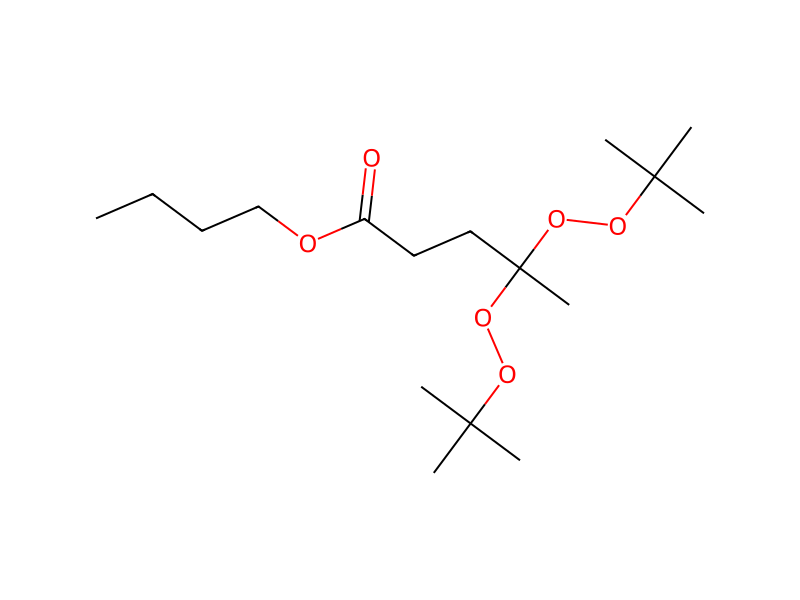
Basic information
- CAS
995-33-5- Standard SMILES
CCCCOC(=O)CCC(C)(OOC(C)(C)C)OOC(C)(C)C- InChIKey
BXIQXYOPGBXIEM-UHFFFAOYSA-N- Molecular formula
- C17H34O6
- Average molar mass
- 334.4 g/mol
- Monoisotopic mass
- 334.2355388
Names & identifiers
- Preferred name
- Pentanoic acid, 4,4-bis((1,1-dimethylethyl)dioxy)-, butyl ester
- IUPAC
- butyl 4,4-bis(tert-butylperoxy)pentanoate
- English name
- Butyl 4,4-bis(tert-butyldioxy)valerate
- Molecular formula
- C17H34O6
- Molecular weight
- 334.45
Names & synonyms
Butyl 4,4-bis(tert-butyldioxy)valerate995-33-5EINECS 213-626-6Pentanoic acid, 4,4-bis((1,1-dimethylethyl)dioxy)-, butyl esterPentanoic acid, 4,4-bis[(1,1-dimethylethyl)dioxy]-, butyl esterRefChem:859977213-626-6butyl 4,4-bis(tert-butylperoxy)pentanoatevarox dcp-40kevarox dcp-40cButyl 4,4-di(tert-butylperoxy)valeratevarox 230-xl
Show more names
rigonox 17Trigonox 17Perhexa V 40Luperox 230XLTrigonox 17/40butyl 4,4-di(butylperoxy)valerate
varox 118Butyl 4,4'-bis(tert-butylperoxy)valerate (Technical Grade)n-butyl 4,4-bis(t-butylperoxy) valerate4,4-bis[(1,1-dimethylethyl)dioxy]-pentanoicacibutylesterButyl 4,4-bis(tert-butylperoxy)pentanoate; Butyl 4,4-bis(tert-butylperoxy)valerate;Butyl 4,4-di-tert-butylperoxyvalerate; Butyl 4,4'-bis(tert-butylperoxy)valerate;SCHEMBL44038DTXSID1061366butyl-4,4-bis(tert.-butyl peroxy)valerate
Database identifiers
- CAS
995-33-5- PubChem CID
- 70447
- DTXSID
DTXSID1061366- EC Number
- 213-626-6
- Nikkaji
- J4.393A
Properties
Computed structural properties
- XLogP
- 3.8
- Topological polar surface area
- 63.2 Ų
- Hydrogen bond donors
- 0
- Hydrogen bond acceptors
- 6
- Rotatable bonds
- 13
- Heavy atoms
- 23
- Formal charge
- 0
- Complexity
- 322
Experimental & physicochemical properties
Physical Description
This solid peroxide is sensitive to heat. Storage of this material must be done so with stringent temperature control measures. Its explosion hazard is also mitigated by mixing the peroxide with an inert solid.
This solid peroxide is sensitive to heat. Storage of this material must be done so with stringent temperature control measures. Its explosion hazard is also mitigated by mixing the peroxide with an inert solid.
Dry Powder; CBI
Physicochemical properties
- Boiling point
- 363.9 · 363.9±37.0 °C(Predicted)
- Density
- 0.9669 g/cm3 · 0.9669 g/cm3
- vapor pressure
- 0.053 Pa · 0.053Pa at 25℃
- solubility
- Chloroform (Slightly), DMSO (Slightly), Ethyl Acetate (Slightly)
- form
- Oil
- color
- Colourless
- Water Solubility
- 2.16 mg/L · 2.16mg/L at 20.2℃
- Stability
- Possibly Shock Sensitive
- LogP
- 6.34 at · 6.34 at 55℃
- EPA Substance Registry System
- 4 · Butyl 4,4-di(tert-butylperoxy)valerate (995-33-5)
- Symbol(GHS)
- 2 · GHS02,GHS09
- Signal word
- Danger
- Hazard statements
- 242 · H242-H400-H411
- Precautionary statements
- 210 · P210-P234-P235-P240-P280-P273-P370+P378-P391-P403-P410-P411-P420-P501
- RIDADR
- 2140 · UN 2140/2141
- TSCA
- TSCA listed
- HazardClass
- 5.2 · 5.2
- PackingGroup
- II
- REACH Registrations
- Active
Safety & regulation
GHS classification
GHS Classification
Danger
H242 (100%): Heating may cause a fire [Danger Self-reactive substances and mixtures; Organic peroxides];H400 (77.3%): Very toxic to aquatic life [Warning Hazardous to the aquatic environment, acute hazard];H410 (59.1%): Very toxic to aquatic life with long lasting effects [Warning Hazardous to the aquatic environment, long-term hazard];H411 (77.3%): Toxic to aquatic life with long lasting effects [Hazardous to the aquatic environment, long-term hazard];H413 (22.7%): May cause long lasting harmful effects to aquatic life [Hazardous to the aquatic environment, long-term hazard]
P210, P234, P235, P240, P273, P280, P370+P378, P391, P403, P410, P411, P420, and P501 (click each P-code to see the statement)
Aggregated GHS information provided per 22 reports by companies from 4 notifications to the ECHA C&L Inventory. Each notification may be associated with multiple companies.;Information may vary between notifications depending on impurities, additives, and other factors. The percentage value in parenthesis indicates the notified classification ratio from companies that provide hazard codes. Only hazard codes with percentage values above 10% are shown. For more detailed information, please visit ECHA C&L website.
Hazard information
Regulatory Information
Chemical: Pentanoic acid, 4,4-bis[(1,1-dimethylethyl)dioxy]-, butyl ester
Pentanoic acid, 4,4-bis[(1,1-dimethylethyl)dioxy]-, butyl ester is listed on the EPA's Chemical Data Reporting (CDR) system. Manufacturers and importers of Pentanoic acid, 4,4-bis[(1,1-dimethylethyl)dioxy]-, butyl ester are required to report information about their production and use of this chemical to the EPA under the Toxic Substances Control Act (TSCA). (40 eCFR Part 711)
Status: Active Update: 15-06-2019 https://echa.europa.eu/registration-dossier/-/registered-dossier/21030
Butyl 4,4-bis(tert-butyldioxy)valerate: Does not have an individual approval but may be used as a component in a product covered by a group standard. It is not approved for use as a chemical in its own right.
DOT LabelOrganic Peroxide
Fire Hazards
Excerpt from ERG Guide 146 [Organic Peroxides (Heat, Contamination and Friction Sensitive)]:;May explode from heat, shock, friction or contamination. May ignite combustibles (wood, paper, oil, clothing, etc.). May be ignited by heat, sparks or flames. May burn rapidly with flare-burning effect. Containers may explode when heated. Runoff may create fire or explosion hazard. (ERG, 2024)
Health Hazards
Excerpt from ERG Guide 146 [Organic Peroxides (Heat, Contamination and Friction Sensitive)]:;Fire may produce irritating, corrosive and/or toxic gases. Ingestion or contact (skin, eyes) with substance may cause severe injury or burns. Runoff from fire control or dilution water may cause environmental contamination. (ERG, 2024)
Reactive Group
Peroxides, Organic;Acetals, Ketals, Hemiacetals, and Hemiketals
Peroxides, Organic;Acetals, Ketals, Hemiacetals, and Hemiketals
Reactivity Alerts
Strong Oxidizing Agent
Explosive;Strong Oxidizing Agent
Reactivity Profile
Peroxides, such as N-BUTYL-4,4-DI-(TERT-BUTYLPEROXY)VALERATE, are good oxidizing agents. Organic compounds can ignite on contact with concentrated peroxides. Strongly reduced material such as sulfides, nitrides, and hydrides may react explosively with peroxides. There are few chemical classes that do not at least produce heat when mixed with peroxides. Many produce explosions or generate gases (toxic and nontoxic). Generally, dilute solutions of peroxides (<70%) are safe, but the presence of a catalyst (often a transition metal such as cobalt, iron, manganese, nickel, or vanadium) as an impurity may even then cause rapid decomposition, a buildup of heat, and even an explosion. Solutions of peroxides often become explosive when evaporated to dryness or near-dryness. May explode from heat or contamination. May ignite combustibles (wood, paper, oil, clothing, etc.). May be ignited by heat, sparks or flames.
Peroxides, such as N-BUTYL-4,4-DI-(TERT-BUTYLPEROXY)VALERATE, are good oxidizing agents. Organic compounds can ignite on contact with concentrated peroxides. Strongly reduced material such as sulfides, nitrides, and hydrides may react explosively with peroxides. There are few chemical classes that do not at least produce heat when mixed with peroxides. Many produce explosions or generate gases (toxic and nontoxic). Generally, dilute solutions of peroxides (<70%) are safe, but the presence of a catalyst (often a transition metal such as cobalt, iron, manganese, nickel, or vanadium) as an impurity may even then cause rapid decomposition, a buildup of heat, and even an explosion. Solutions of peroxides often become explosive when evaporated to dryness or near-dryness. Danger of explosion when dry. May explode from heat, shock, friction or contamination. May ignite combustibles (wood, paper, oil, clothing, etc.). May be ignited by heat, sparks or flames.
Air and Water Reactions
No rapid reaction with air. No rapid reaction with water.
No rapid reaction with air. No rapid reaction with water.
Hazard Classes and CategoriesOrg. Perox. C (100%);Aquatic Acute 1 (77.3%);Aquatic Chronic 2 (77.3%);Aquatic Chronic 4 (22.7%)
Safety & protection
Fire Fighting
Excerpt from ERG Guide 146 [Organic Peroxides (Heat, Contamination and Friction Sensitive)]:;SMALL FIRE: Water spray or fog is preferred; if water not available use dry chemical, CO2 or regular foam.;LARGE FIRE: Flood fire area with water from a distance. Use water spray or fog; avoid aiming straight or solid streams directly onto the product. Do not move cargo or vehicle if cargo has been exposed to heat. If it can be done safely, move undamaged containers away from the area around the fire.;FIRE INVOLVING TANKS, RAIL TANK CARS OR HIGHWAY TANKS: Fight fire from maximum distance or use unmanned master stream devices or monitor nozzles. Cool containers with flooding quantities of water until well after fire is out. ALWAYS stay away from tanks in direct contact with flames. For massive fire, use unmanned master stream devices or monitor nozzles; if this is impossible, withdraw from area and let fire burn. (ERG, 2024)
First AidExcerpt from ERG Guide 146 [Organic Peroxides (Heat, Contamination and Friction Sensitive)]:;Refer to the "General First Aid" section. Specific First Aid: Contaminated clothing may be a fire risk when dry. (ERG, 2024)
Nonfire Spill Response
Excerpt from ERG Guide 146 [Organic Peroxides (Heat, Contamination and Friction Sensitive)]:;ELIMINATE all ignition sources (no smoking, flares, sparks or flames) from immediate area. Keep combustibles (wood, paper, oil, etc.) away from spilled material. Do not touch damaged containers or spilled material unless wearing appropriate protective clothing. Keep substance wet using water spray. Stop leak if you can do it without risk.;SMALL SPILL: Pick up with inert, damp, non-combustible material using clean, non-sparking tools and place into loosely covered plastic containers for later disposal.;LARGE SPILL: Wet down with water and dike for later disposal. Prevent entry into waterways, sewers, basements or confined areas. DO NOT CLEAN-UP OR DISPOSE OF, EXCEPT UNDER SUPERVISION OF A SPECIALIST. (ERG, 2024)
Isolation and Evacuation
Excerpt from ERG Guide 146 [Organic Peroxides (Heat, Contamination and Friction Sensitive)]:;IMMEDIATE PRECAUTIONARY MEASURE: Isolate spill or leak area in all directions for at least 50 meters (150 feet) for liquids and at least 25 meters (75 feet) for solids.;LARGE SPILL: Consider initial evacuation for at least 250 meters (800 feet) in all directions.;FIRE: If tank, rail tank car or highway tank is involved in a fire, ISOLATE for 800 meters (1/2 mile) in all directions; also, consider initial evacuation for 800 meters (1/2 mile) in all directions. (ERG, 2024)
Personal Protective Equipment (PPE)
Excerpt from ERG Guide 146 [Organic Peroxides (Heat, Contamination and Friction Sensitive)]:;Wear positive pressure self-contained breathing apparatus (SCBA). Wear chemical protective clothing that is specifically recommended by the manufacturer when there is NO RISK OF FIRE. Structural firefighters' protective clothing provides thermal protection but only limited chemical protection. (ERG, 2024)
Regulatory information
Regulatory Information
Chemical: Pentanoic acid, 4,4-bis[(1,1-dimethylethyl)dioxy]-, butyl ester
Pentanoic acid, 4,4-bis[(1,1-dimethylethyl)dioxy]-, butyl ester is listed on the EPA's Chemical Data Reporting (CDR) system. Manufacturers and importers of Pentanoic acid, 4,4-bis[(1,1-dimethylethyl)dioxy]-, butyl ester are required to report information about their production and use of this chemical to the EPA under the Toxic Substances Control Act (TSCA). (40 eCFR Part 711)
Status: Active Update: 15-06-2019 https://echa.europa.eu/registration-dossier/-/registered-dossier/21030
Butyl 4,4-bis(tert-butyldioxy)valerate: Does not have an individual approval but may be used as a component in a product covered by a group standard. It is not approved for use as a chemical in its own right.
Safety data
- tsca
- TSCA listed
- ridadr
- UN 2140/2141
- Signal word
- Danger
- Symbol(GHS)
- GHS02,GHS09
- hazard_class
- 5.2
- packing_group
- II
- Hazard statements
- H242-H400-H411
- REACH Registrations
- Active
- Precautionary statements
- P210-P234-P235-P240-P280-P273-P370+P378-P391-P403-P410-P411-P420-P501
Chemistry & industry
Uses & manufacturing
U.S. Production2023: <75,000 lb;2022: <75,000 lb;2021: <75,000 lb;2020: <75,000 lb
Consumer UsesNot Known or Reasonably Ascertainable
Industry UsesCBI;Processing aids not otherwise specified;Intermediate;Hardener
General Manufacturing Information
Rubber Product Manufacturing;CBI;All Other Basic Organic Chemical Manufacturing
Pentanoic acid, 4,4-bis[(1,1-dimethylethyl)dioxy]-, butyl ester: ACTIVE
Applications
UsesButyl 4,4'-bis(tert-butylperoxy)valerate acts as a crosslinker peroxide agent in the synthesis of polymers.
General DescriptionButyl 4,4-bis(tert-butyldioxy)valerate is sensitive to heat. Storage of Butyl 4,4-bis(tert-butyldioxy)valerate must be done so with stringent temperature control measures. It's explosion hazard is also mitigated by mixing the peroxide with an inert solid.
Suppliers22 total
Hebei Chuanghai Biotechnology Co., Ltd+86-17732866630 · [email protected]
湖南嘉航医药科技有限公司85521272 15200744171 · [email protected]
Baoji Guokang Healthchem co.,ltd+8615604608665 15604608665 · [email protected]
Dayang Chem (Hangzhou) Co.,Ltd.+86-0571-88938639 17705817739 · [email protected]
宝鸡缔都医药化工有限公司029-81145305 17791533577 · [email protected]
PT CHEM GROUP LIMITED+86-85511178; +86-85511178 · [email protected]
广东翁江化学试剂有限公司0751-2815987 13927875076 · [email protected]
厦门志信化学有限公司+86-5922680277 +86-13806087780 · [email protected]
陕西缔都医药化工有限公司+86-29-81139210 +86-17392587031 · [email protected]
南通市苏北化工原料有限公司0513-85290972 18762756250 · [email protected]
盼得(上海)国际贸易有限公司80159919 18662931292 · [email protected]
河南天孚化工有限公司+86-0371-55170693 +86-19937530512 · [email protected]
济南国辰泰富化工有限公司0531-88162029 13256661585 · [email protected]
XIAMEN AMITY INDUSTRY AND TRADE CO., LTD.+8618950047208 · [email protected]
武汉吉鑫益邦生物科技有限公司59768661 13297943853 · [email protected]
SUZHOU SENFEIDA CHEMICAL CO.,LTD+86-0512-83500002 +86-15195660023 · [email protected]
Henan Allgreen Chemical Co.,LTD+86-37155567971 +86-13633837469 · [email protected]
Hefei TNJ Chemical Industry Co.,Ltd.+86-0551-65418671 +86-189 4982 3763 · [email protected]
CD Chemical Group Limited+86-13651442114 · [email protected]
江苏雷恩环保科技有限公司66814573 16651336298 · [email protected]
南通润丰石油化工有限公司66814565 18912298907 · [email protected]
南通众合化工新材料有限公司0513-85666561 15950816326 · [email protected]
Related reactions
1 records
Compound notes
Loading…