

Basic information
- CAS
1121-37-5- Standard SMILES
O=C(C1CC1)C1CC1- InChIKey
BIPUHAHGLJKIPK-UHFFFAOYSA-N- Molecular formula
- C7H10O
- Average molar mass
- 110.15 g/mol
- Monoisotopic mass
- 110.07316494
Names & identifiers
- Preferred name
- Dicyclopropyl ketone
- IUPAC
- dicyclopropylmethanone
- English name
- Dicyclopropyl ketone
- Molecular formula
- C7H10O
- Molecular weight
- 110.15
Names & synonyms
Dicyclopropyl ketone1121-37-5DicyclopropylketoneCyclopropyl ketoneMethanone, dicyclopropyl-FGQ92KB360NSC-49148DTXSID70149910RefChem:133260DTXCID8072401214-331-5Dicyclopropylmethanone
Show more names
DICYLOPROPYL KETONEBicyclopropylKetoneDicyclopropylKetone>DICYCLOPROPYLMETHYLOXIMEDicyclopropyl ketone,95%Methanone,dicyclopropyl-Dicyclopropyl-methanoneNSC
dicyclopropyl-methanoneMFCD00001276dicyclopropylmethyloximeEINECS 214-331-5NSC 49148AI3-37701DICYCLOPROPYL-KETONDicyclopropylketone, 90%
Database identifiers
- CAS
1121-37-5- PubChem CID
- 70721
- DTXSID
DTXSID70149910- UNII
- FGQ92KB360
- EC Number
- 214-331-5
- Nikkaji
- J80.161E
Properties
Computed structural properties
- XLogP
- 0.9
- Topological polar surface area
- 17.1 Ų
- Hydrogen bond donors
- 0
- Hydrogen bond acceptors
- 1
- Rotatable bonds
- 2
- Heavy atoms
- 8
- Formal charge
- 0
- Complexity
- 106
Experimental & physicochemical properties
SpringerMaterials PropertiesSchoenflies notation
Physicochemical properties
- Melting point
- 44 · 44.0-44.5 °C
- Boiling point
- 160 · 160-162 °C(lit.)
- Density
- 0.977 g/mL · 0.977 g/mL at 25 °C(lit.)
- refractive index
- 20 · n20/D 1.467(lit.)
- Flash point
- 103 °F · 103 °F
- storage temp.
- 30 °C · Store below +30°C.
- form
- liquid
- Specific Gravity
- 0.957 · 0.957
- Appearance
- Colorless to light yellow Liquid
- Water Solubility
- Soluble in water.
- BRN
- 774172 · 774172
- Henry's Law Constant
- 3.1 · 3.1×100 mol/(m3Pa) at 25℃, Bagno et al. (1991)
Safety & regulation
GHS classification
GHS Classification
Warning
H226 (100%): Flammable liquid and vapor [Warning Flammable liquids]
P210, P233, P240, P241, P242, P243, P280, P303+P361+P353, P370+P378, P403+P235, and P501 (click each P-code to see the statement)
Aggregated GHS information provided per 103 reports by companies from 7 notifications to the ECHA C&L Inventory.
Hazard information
Hazard Classes and CategoriesFlam. Liq. 3 (100%)
Safety data
- wgk
- 3
- ridadr
- UN 1224 3/PG 3
- hs_code
- 29142900
- risk_code
- 10-36/37/38-20/21/22-5
- Signal word
- Warning
- Symbol(GHS)
- GHS02
- hazard_code
- F,Xn
- hazard_note
- Harmful/Flammable
- safety_code
- 16-36-26-3
- hazard_class
- 3
- Storage Class
- 3 - Flammable liquids
- packing_group
- III
- Hazard statements
- H226
- Limited Quantities
- 5.0 L (1.3 gallons) (liquid)
- Excepted Quantities
- Max Inner Pack (30g or 30ml) and Max Outer Pack (1Kg or 1L)
- REACH Registrations
- Active
- Hazard Classifications
- Flam. Liq. 3
Chemistry & industry
Applications
UsesDicyclopropyl Ketone is used as a reagent in the synthesis of a new class of potent and selective agonists of dimeric carbamoylguanidine-type histamine H2 receptor ligands. Also used in the preparation of chemical space analogs of PNU-282,987 and SSR180711, which have nicotinic receptor activity.
Preparation methods
PreparationPreparation of Dicyclopropyl ketoneReaction: To a one liter three-necked flask fitted with a reflux condenser and a metal Hershberg stirrer there was added 600 ml. of 20% sodium hydroxide and 165g . (0.9mole) of 1,7 -dichloro-4-heptanone. The mixture was refluxed for 30 minutes with vigorous stirring, then steam distilled until the characteristic odor of dicyclopropyl ketone was absent from the distillate. The distillate was then saturated with potassium carbonate, the upper layer separated and the water layer extracted once with ether. The combined organic layers were dried over potassium carbonate. after removal of the ether there was dist illed 69g. (70%) of dicyclopropyl ketone, b.p . 69° at 20 mm, nD25 1.4648-1.4654.
Upstream & downstream products
Upstream raw materials
Downstream products
Related reactions
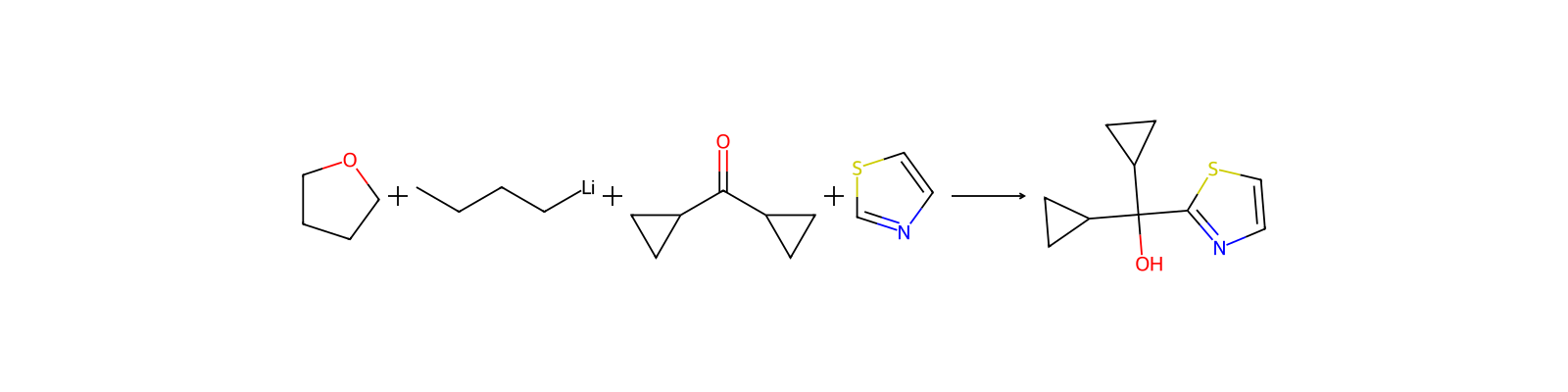
25 records



Compound notes
Loading…