
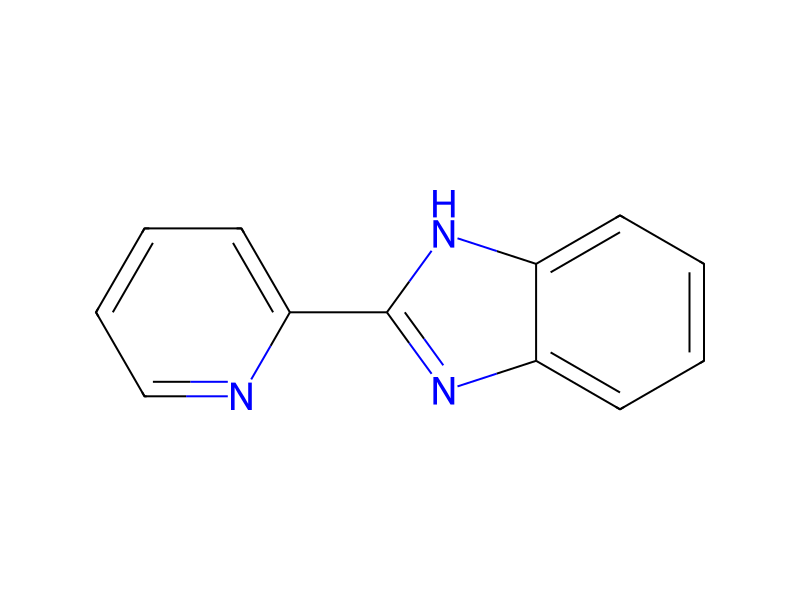
Basic information
- Standard SMILES
c1ccc(-c2nc3ccccc3[nH]2)nc1- InChIKey
YNFBMDWHEHETJW-UHFFFAOYSA-N- Molecular formula
- C12H9N3
- Average molar mass
- 195.22 g/mol
- Monoisotopic mass
- 195.07964729
Overview
structure in first source
Names & identifiers
- Preferred name
- 2-(2'-Pyridyl)benzimidazole
- IUPAC
- 2-pyridin-2-yl-1H-benzimidazole
- English name
- 2-(2-PYRIDYL)BENZIMIDAZOLE
- Molecular formula
- C12H9N3
- Molecular weight
- 195.22
Names & synonyms
2-(2-Pyridyl)benzimidazole1137-68-42-(2'-Pyridyl)benzimidazoleDTXSID50150529RefChem:454425DTXCID1073020214-508-72-(pyridin-2-yl)-1H-benzo[d]imidazole2-pyridin-2-yl-1H-benzimidazole1H-Benzimidazole, 2-(2-pyridinyl)-MFCD000055862-Pyridin-2-yl-1H-benzoimidazole
Show more names
DK74332-(2-Pyridinyl)2-(2-Pyridyl)benzimidazole,99%2-(2-Pyridyl)benzimidazole >2-(2-PYRIDYL)-BENZIMIDAZOLE 99%
2-(pyridin-2-yl)-1H-1,3-benzodiazole2-(pyridin-2-yl)-1H-benzimidazole2-(2-Pyridyl)-1H-benzimidazoleNSC 32814NSC 110942AI-4-88CHEMBL72683Benzimidazole, 2-(2-pyridyl)-
Database identifiers
- CAS
1137-68-4- PubChem CID
- 70821
- DTXSID
DTXSID50150529- ChEMBL
CHEMBL72683- EC Number
- 214-508-7
- Nikkaji
- J2.864.996G、J203.388G
Properties
Computed structural properties
- XLogP
- 2.4
- Topological polar surface area
- 41.6 Ų
- Hydrogen bond donors
- 1
- Hydrogen bond acceptors
- 2
- Rotatable bonds
- 1
- Heavy atoms
- 15
- Formal charge
- 0
- Complexity
- 219
Experimental & physicochemical properties
LogP2.5
Physicochemical properties
- Melting point
- 218 · 218-220 °C(lit.)
- Boiling point
- 321.89 °C · 321.89°C (rough estimate)
- Density
- 1.2142 · 1.2142 (rough estimate)
- refractive index
- 1.699 · 1.6990 (estimate)
- storage temp.
- Sealed in dry,Room Temperature
- form
- Powder
- pka
- 1 · pK1:5.58(+1) (25°C,μ=0.16)
- color
- Yellow to brown
- Water Solubility
- Insoluble in water.
- BRN
- 151411 · 151411
- InChI
- InChI=1S/C12H9N3/c1-2-6-10-9(5-1)14-12(15-10)11-7-3-4-8-13-11/h1-8H,(H,14,15)
- InChIKey
- YNFBMDWHEHETJW-UHFFFAOYSA-N
- SMILES
- C1(C2=NC=CC=C2)NC2=CC=CC=C2N=1
- CAS DataBase Reference
- 1137 · 1137-68-4(CAS DataBase Reference)
- UNSPSC Code
- 12352100 · 12352100
- NACRES
- 22 · NA.22
- Symbol(GHS)
- 7 · GHS07
- Signal word
- Warning
- Hazard statements
- 302 · H302-H315-H319-H335
- Precautionary statements
- 261 · P261-P264-P270-P301+P312-P302+P352-P305+P351+P338
- target organs
- Respiratory system
- Hazard Codes
- Xn
- Risk Statements
- 22 · 22-36/37/38
- Safety Statements
- 24 · 24/25-26
- WGK Germany
- 3 · 3
- HS Code
- 29333999 · 29333999
- Storage Class
- 11 · 11 - Combustible Solids
- Hazard Classifications
- 4 OralEye · Acute Tox. 4 OralEye Irrit. 2Skin Irrit. 2STOT SE 3
Safety & regulation
GHS classification
GHS Classification
This chemical does not meet GHS hazard criteria for 1.6% (1 of 63) of reports.
Warning
H302 (96.8%): Harmful if swallowed [Warning Acute toxicity, oral]
P261, P264, P264+P265, P270, P271, P280, P301+P317, P302+P352, P304+P340, P305+P351+P338, P319, P321, P330, P332+P317, P337+P317, P362+P364, P403+P233, P405, and P501 (click each P-code to see the statement)
Aggregated GHS information provided per 63 reports by companies from 5 notifications to the ECHA C&L Inventory. Each notification may be associated with multiple companies.
Hazard information
Hazard Classes and CategoriesAcute Tox. 4 (96.8%)
Safety data
- wgk
- 3
- hs_code
- 29333999
- risk_code
- 22-36/37/38
- Signal word
- Warning
- Symbol(GHS)
- GHS07
- hazard_code
- Xn
- safety_code
- 24/25-26
- Storage Class
- 11 - Combustible Solids
- target organs
- Respiratory system
- Hazard statements
- H302-H315-H319-H335
- Hazard Classifications
- Acute Tox. 4 OralEye Irrit. 2Skin Irrit. 2STOT SE 3
- Precautionary statements
- P261-P264-P270-P301+P312-P302+P352-P305+P351+P338
Chemistry & industry
Applications
Uses2-(2-Pyridyl)benzimidazole was used as a chelating fluorescent ligand in the synthesis of cobalt(II) complex. It was also used in the preparation of (H(2)L(1))(2)[Ru(III)Cl(4)(CH(3)CN)(2)](2)[Ru(IV)Cl(4)(CH(3)CN)(2)]·2Cl·6H(2)O complex.
Upstream & downstream products
Upstream raw materials
Suppliers50 total
梯希爱(上海)化成工业发展有限公司021-67121386 · [email protected]
上海阿拉丁生化科技股份有限公司400-6206333 13167063860 · [email protected]
杭州鸿喜生物医药科技有限公司18989489206 · [email protected]
武汉英诺医药科技有限公司+86-027-59232304 15387063101 · [email protected]
上海麦克林生化科技股份有限公司021-50706066 15221275939 · [email protected]
咸宁深蓝生物医药研发有限公司18171815831 · [email protected]
INTATRADE GmbH+49 3493/605464 · [email protected]
Dayang Chem (Hangzhou) Co.,Ltd.+86-0571-88938639 17705817739 · [email protected]
郑州鸿晟医药科技有限公司0371-55695890 15637198702 · [email protected]
Syntechem Co.,Ltd[email protected]
上海迈瑞尔生化科技有限公司4006356688 18621169109 · [email protected]
上海晶抗生物工程有限公司021-54721350 13524668266 · [email protected]
阿法埃莎(中国)化学有限公司400-6106006 · [email protected]
安耐吉化学&3A(安徽泽升科技股份有限公司)400-0056266 · [email protected]
上海瀚鸿科技股份有限公司021-54306202 13764082696 · [email protected]
上海钰康生物科技有限公司18939844854 · [email protected]
上海钰康生物科技有限公司+86-18930848214 +86-021-56762820 · [email protected]
郑州研德生物科技有限公司0371-63682289 15538176268 · [email protected]
河南利恩化工产品有限公司0371-63357898 15378766539 · [email protected]
玛雅试剂+86 (573) 82222445 (0)18006601000 452520369 · [email protected]
上海钰康生物科技有限公司15618758386 15618758386 · [email protected]
北京伊诺凯科技有限公司15652467323 · [email protected]
上海源叶生物科技有限公司13636370518 · [email protected]
赛默飞世尔科技(中国)有限公司800-810-5118 · [email protected]
北京伊诺凯科技有限公司400-810-7969 010-59572699 · [email protected]
上海纳谦化学科技有限公司13598610367 0373-7129549 · [email protected]
上海健超生物科技有限公司150-2103-5486 18017383231 · [email protected]
TCI AMERICA800-4238616 · [email protected]
TOKYO CHEMICAL INDUSTRY CO., LTD.03-36680489 · [email protected]
广东鑫钰新材料股份有限公司0757-82582588 · [email protected]
上海睿升化工科技有限公司+86-021-50935922
广州爱纯医药科技有限公司020-39119399 18927568969 · [email protected]
上海毕得医药科技股份有限公司400-164-7117 18317119277 · [email protected]
北京奥秘佳得医药科技有限公司+86-13522808617 · [email protected]
上海御略医药科技有限公司021-60345187 13671753212 · [email protected]
上海纳谦化学科技有限公司13598610367 13598610367 · [email protected]
吉林中科研伸科技有限公司0431-80534353 19917294565 · [email protected]
Sigma-Aldrich西格玛奥德里奇(上海)贸易有限公司021-61415566 800-8193336 · [email protected]
TargetMol中国(陶术生物)021-021-33632979 15002134094 · [email protected]
Alfa Chemistry1-516-6625404 · [email protected]
九鼎化学(上海)科技有限公司4009209199 · [email protected]
河南普赛化工产品有限公司0371-63357898 · [email protected]
上海谱振生物科技有限公司4001650900 13817534909 · [email protected]
嘉兴市德亿化工有限公司0573-85866609 13325730825 · [email protected]
上海玻尔化学试剂有限公司19102157732 · [email protected]
河南瑞斯奇新材料有限公司86-18903931531 18903931628 · [email protected]
上海大然化学有限公司021-64478606 15900664856 · [email protected]
箴德化工科技(上海)有限公司15601952568 · [email protected]
南京科晟祥科技有限公司18252089365 · [email protected]
上海玖巨化工科技有限公司021-54290889 18117093889;17717355955 · [email protected]
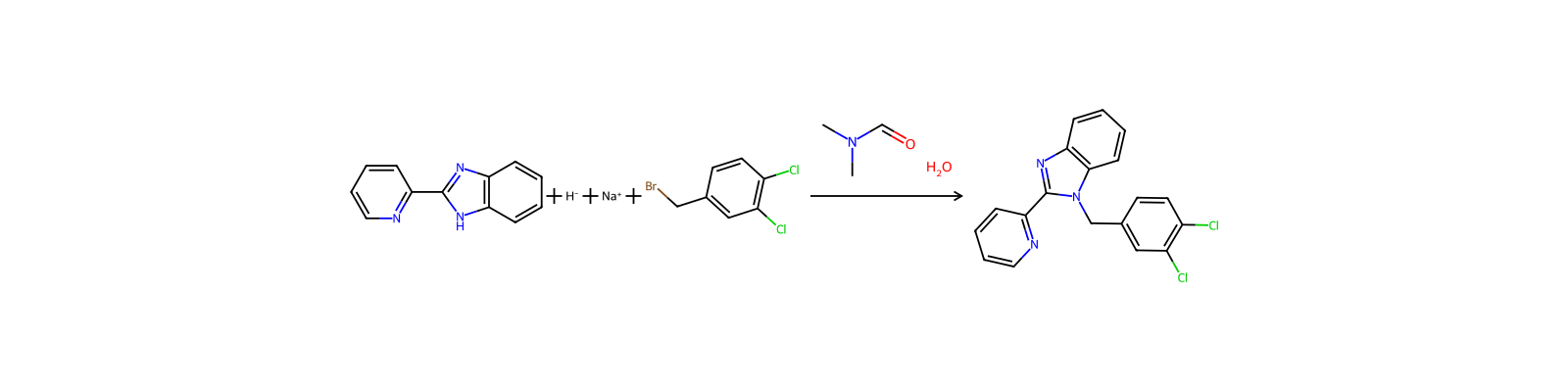
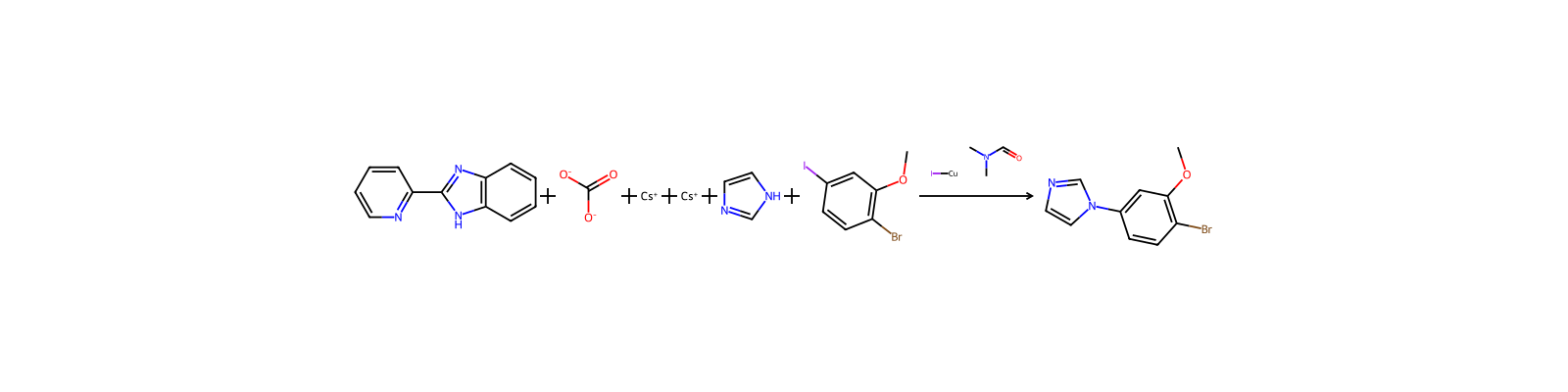
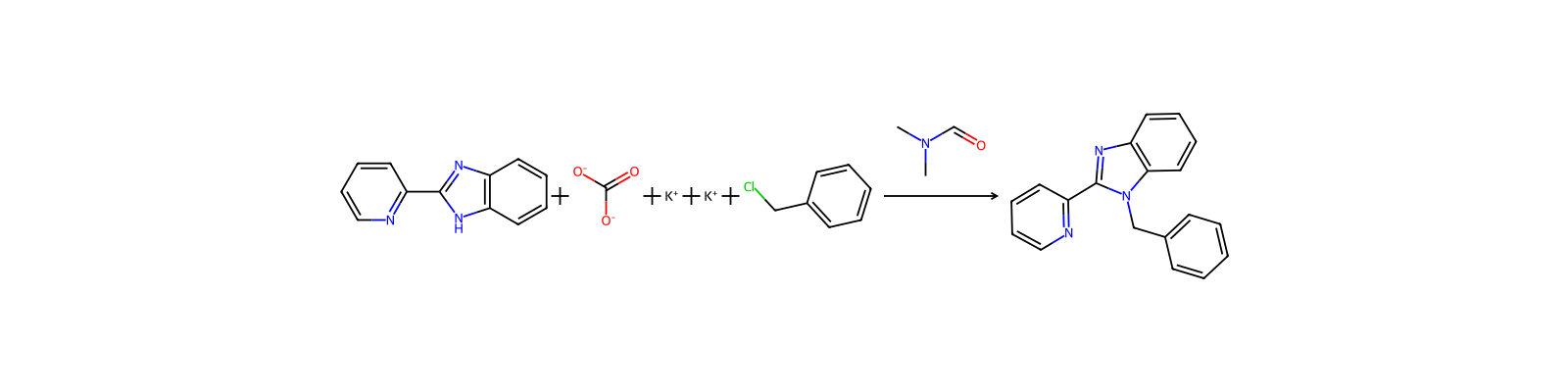
Related reactions
12 records




Linked notes
Loading…