

Basic information
- CAS
92-39-7- Standard SMILES
Clc1ccc2c(c1)Nc1ccccc1S2- InChIKey
KFZGLJSYQXZIGP-UHFFFAOYSA-N- Molecular formula
- C12H8ClNS
- Average molar mass
- 233.72 g/mol
- Monoisotopic mass
- 233.00659794
Names & identifiers
- Preferred name
- 2-Chlorophenothiazine
- IUPAC
- 2-chloro-10H-phenothiazine
- English name
- 2-Chlorophenothiazine
- Molecular formula
- C12H8ClNS
- Molecular weight
- 233.72
Names & synonyms
2-Chlorophenothiazine2-Chloro-10H-phenothiazine10H-Phenothiazine, 2-chloro-PHENOTHIAZINE, 2-CHLORO-NSC 174692-chloro-phenothiazineNSC 170953DTXSID3057854EINECS 202-152-5UNII-95H3AO2301NSC-17469NSC-67188
Show more names
ChlorophenothiazineChlorpromazine impurity E CRSNSC 67188orophenothiazineTIMTEC-BB SBB0032553-CHLOROPHENOTHIAZINE
95H3AO2301NSC-1709532-CL-PHDTXCID4031643PROCHLORPERAZINE MALEATE IMPURITY D [EP IMPURITY]CHLORPROMAZINE HYDROCHLORIDE IMPURITY E [EP IMPURITY]PROCHLORPERAZINE MALEATE IMPURITY D (EP IMPURITY)CHLORPROMAZINE HYDROCHLORIDE IMPURITY E (EP IMPURITY)
Database identifiers
- CAS
92-39-7- PubChem CID
- 7088
- DTXSID
DTXSID3057854- ChEMBL
CHEMBL1411769- UNII
- 95H3AO2301
- EC Number
- 202-152-5
- Nikkaji
- J50.183B
Properties
Computed structural properties
- XLogP
- 4.8
- Topological polar surface area
- 37.3 Ų
- Hydrogen bond donors
- 1
- Hydrogen bond acceptors
- 2
- Rotatable bonds
- 0
- Heavy atoms
- 15
- Formal charge
- 0
- Complexity
- 236
Physicochemical properties
- Melting point
- 195 · 195-200 °C (lit.)
- Boiling point
- 395.7 · 395.7±31.0 °C(Predicted)
- Density
- 1.235 · 1.2350 (rough estimate)
- refractive index
- 1.61 · 1.6100 (estimate)
- storage temp.
- 2 · 2-8°C
- solubility
- DMSO (Slightly), Methanol (Slightly, Sonicated)
- pka
- -2.28 · -2.28±0.20(Predicted)
- form
- crystals
- color
- Pale Beige to Beige
- BRN
- 176587 · 176587
- InChI
- InChI=1S/C12H8ClNS/c13-8-5-6-12-10(7-8)14-9-3-1-2-4-11(9)15-12/h1-7,14H
- InChIKey
- KFZGLJSYQXZIGP-UHFFFAOYSA-N
- SMILES
- C1=C2C(SC3=C(N2)C=CC=C3)=CC=C1Cl
- LogP
- 3.28 · 3.28
- CAS DataBase Reference
- 92 · 92-39-7(CAS DataBase Reference)
- EWG's Food Scores
Safety & regulation
GHS classification
GHS Classification
Warning
H315 (67.2%): Causes skin irritation [Warning Skin corrosion/irritation]
P203, P261, P264, P264+P265, P271, P272, P273, P280, P302+P352, P304+P340, P305+P351+P338, P318, P319, P321, P332+P317, P333+P317, P337+P317, P362+P364, P391, P403+P233, P405, and P501 (click each P-code to see the statement)
Aggregated GHS information provided per 67 reports by companies from 9 notifications to the ECHA C&L Inventory. Each notification may be associated with multiple companies.
Hazard information
Regulatory Information
Status: Active Update: 26-02-2021 https://echa.europa.eu/registration-dossier/-/registered-dossier/20669
10H-Phenothiazine, 2-chloro-: Does not have an individual approval but may be used under an appropriate group standard
Hazard Classes and CategoriesSkin Irrit. 2 (67.2%)
Safety data
- PPE
- dust mask type N95 (US), Eyeshields, Gloves
- wgk
- 3
- tsca
- TSCA listed
- rtecs
- SN7580000
- hs_code
- 2934300000
- risk_code
- 36/37/38
- Signal word
- Warning
- Symbol(GHS)
- GHS07
- hazard_code
- Xi
- safety_code
- 26-36-37/39
- Storage Class
- 11 - Combustible Solids
- Hazard statements
- H317
- REACH Registrations
- Active
Chemistry & industry
Uses & manufacturing
General Manufacturing Information10H-Phenothiazine, 2-chloro-: INACTIVE
Applications
UsesMetabolite of Chloropromazine
Uses2-Chlorophenothiazine may be used as starting reagent for the synthesis of N-(10H-phenothiazin-1-yl) benzene sulphonamide.
General Description2-Chlorophenothiazine is an methylene blue (MB) derivative. Transient resonance Raman and absorption spectra of the lowest excited triplet states T1 and the cation radicals of 2-chlorophenothiazine have been investigated. Molecular semiconductors based on the 1:1 charge-transfer complexes of 2-chlorophenothiazine with 2,3-dichloro-5,6-dicyano-p-benzoquinone (DDQ) have been investigated by X-ray powder diffraction.
Upstream & downstream products
Upstream raw materials
Related reactions
19 records
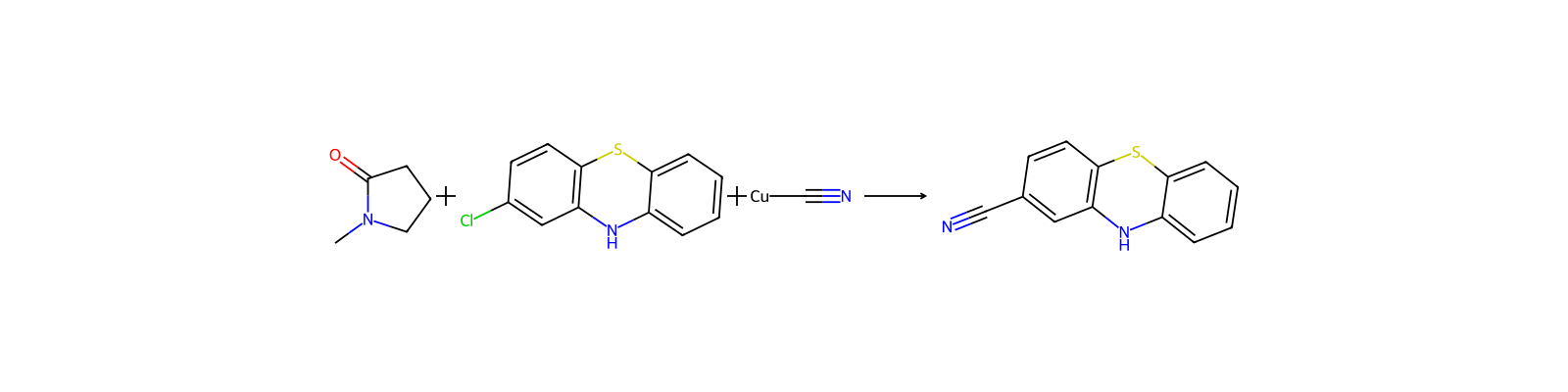


Compound notes
Loading…