
3-(4-Hydroxy-3-Methoxyphenyl)Prop-2-Enoic Acid
Completing data — refresh the page later to see the latest
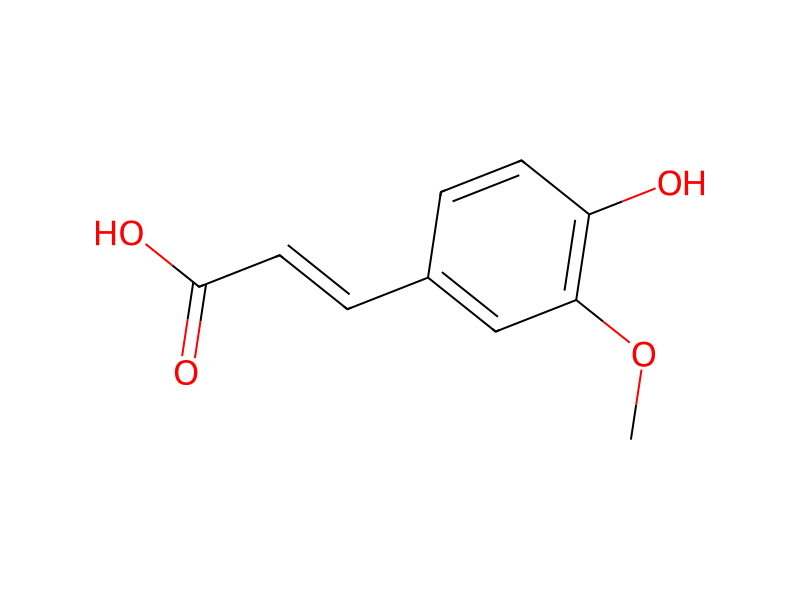
Basic information
- CAS
1135-24-6- Standard SMILES
COc1cc(C=CC(=O)O)ccc1O- InChIKey
KSEBMYQBYZTDHS-UHFFFAOYSA-N- Molecular formula
- C10H10O4
- Average molar mass
- 194.18 g/mol
- Monoisotopic mass
- 194.0579088
Overview
(E/Z)-ferulic acid has been reported in Camellia reticulata, Angelica gigas, and other organisms with data available.
Names & identifiers
- Preferred name
- 3-(4-Hydroxy-3-Methoxyphenyl)Prop-2-Enoic Acid
- IUPAC
- 3-(4-hydroxy-3-methoxyphenyl)prop-2-enoic acid
- English name
- Ferulic Acid
- Molecular formula
- C10H10O4
- Molecular weight
- 194.18
Names & synonyms
3-(4-hydroxy-3-methoxyphenyl)prop-2-enoic acidRefChem:1066861(E/Z)-ferulic acid(2E)-3-(4-Hydroxy-3-methoxyphenyl)acrylic acidTrans-3-(4-hydroxy-3-methoxyphenyl)acrylic acid3-(4-hydroxy-3-methoxy-phenyl)prop-2-enoic acidferulic acid (trans-4-hydroxy-3-methoxycinnamic acid)EINECS 214-490-0CIS-FERULICACIDbmse000587DTXSID70892035ferulasaur
Show more names
Ferulate4-HYDROXY-3-METHOXYCINNAMIC ACIDFerulic3-METHOXY-4-HYDROXYCINNAMIC ACIDFERULLIC ACIDferulaic aciderulic AcidForulic acidFERULIC ACID pureTIMTEC-BB SBB000326
4-Hydroxy-3-methoxy cinnamic acidBBL010345AC-7965Ferulic acid CRStrans-Ferulic Acid (purified by sublimation)Spectrum_001256SpecPlus_000547Spectrum2_001394
Database identifiers
Properties
Computed structural propertiesFilling in
- XLogP
- 1.5
- Topological polar surface area
- 66.8 Ų
- Hydrogen bond donors
- 2
- Hydrogen bond acceptors
- 4
- Rotatable bonds
- 3
- Heavy atoms
- 14
- Formal charge
- 0
- Complexity
- 224
Experimental & physicochemical properties
LogP1.87
Physicochemical properties
- Melting point
- 168 · 168-172 °C(lit.)
- Boiling point
- 250.62 °C · 250.62°C (rough estimate)
- Density
- 1.316 · 1.316(20.0000℃)
- vapor pressure
- 0 Pa · 0Pa at 25℃
- refractive index
- 1.5168 · 1.5168 (estimate)
- FLAVIS Number
- 8.089 · 08.089 | 4-Hydroxy-3-methoxycinnamic acid (mixture of isomers)
- storage temp.
- 2 · 2-8°C
- solubility
- DMSO (Slightly), Methanol (Slightly)
- pka
- 4.58 · 4.58±0.10(Predicted)
- form
- powder
- color
- slightly yellow
- Water Solubility
- soluble
Safety & regulation
Safety information is for reference only and does not replace the supplier’s Safety Data Sheet (SDS), applicable regulations, or professional assessment.
Safety data
- wgk
- 3
- tsca
- TSCA listed
- rtecs
- UD3365500
- hs_code
- 29162090
- Toxicity
- mouse,LD,intraperitoneal,> 350mg/kg (350mg/kg),BEHAVIORAL: CHANGES IN MOTOR ACTIVITY (SPECIFIC ASSAY)BEHAVIORAL: ATAXIABEHAVIORAL: REGIDITY,Indian Journal of Pharmaceutical Sciences. Vol. 49, Pg. 77, 1987.
- risk_code
- 36/37/38
- Signal word
- Warning
- Symbol(GHS)
- GHS07
- hazard_code
- Xi
- safety_code
- 26-36-37/39
- hazard_class
- IRRITANT
- Hazard statements
- H315-H319-H335
- REACH Registrations
- Active
- Precautionary statements
- P305+P351+P338
- Hazardous Substances Data
- 1135-24-6(Hazardous Substances Data)
Chemistry & industry
Applications
HistoryFerulic acid is a derivative of cinnamic acid with molecular formula C10H10O4. In 1886, Hlasiwetz Barth, an Austrian, isolated 3-methoxy-4-hydroxycinnamic acid from the genus Ferula foetida for structure determination. Ferulic acid together with dihydroferulic acid, is a component of lignocelluloses, conferring cell wall rigidity by cross linking lignin and polysaccharides. It is commonly found in seeds of plant such as rice, wheat and oats. Besides, Ferulic Acid exhibited biochemical role in the inhibition of seed germination, inhibition of indole-acetic acid and enzyme, inhibition of decarboxylation activity & other protective effect on micro-organisms and pets. The syntheis of Ferulic acid was established by Dutt in 1935 when ferulic acid was used as a precursor in the manufacturing of vanillin and malonic acid. There are vast numbers of studies documented on the bio-medical properties of ferulic acid such as antioxidant activity, UV-absorbing capacity & its effect of lignin as precursor in plants metabolic pathway. Ferulic acid, being highly abundant, is indeed difficult to synthesize, Oryza Oil & Fat Chemical has successfully developed an efficient method to extract ferulic acid from rice bran and suitable for applications in the health and beauty arena.
UsesIt can be used as a food preservative and a kind of organic chemicals. It can be used as the intermediates of cinametic acid. It can also be used as food preservative. It can also be applied to biochemical studies
DescriptionFerulic acid is widely found in plants, especially in artichoke, eggplant and corn bran. In addition, it is also present in a variety of Chinese herbal medicines, such as angelica, dome, motherwort, snow ganoderma lucidum and so on.
HistoryFerulic acid was first isolated from the medicinal plants ferulic in 1866. The biologi_x005fcal activity of ferulic acid was not revealed until 1957 when the pioneering study of Preziosi P in Italy showed for the first time the efficacy of ferulic acid in regulating blood lipids and diuretic . In 1979, Lin Mao and others isolated ferulic acid from the Chinese medicine angelica and reported that ferulic acid had the inhibitory effect on platelet aggregation . Since then, more and more medicinal efficacy of ferulic acid has gradually been recognized.
UsesWidely distributed in small amounts in plants. Used as an antioxidant and food preservative
antineoplastic, choleretic, food preservative
Related reactions
19 records


Compound notes
Loading…