HomeMCPWorkbenchSkills
HomeWorkbenchNotificationsMe
llms.txt · MCP GuidePrivacy Policy · Terms of Service · Supportv1.8.0
  1. Home
  2. /Compound

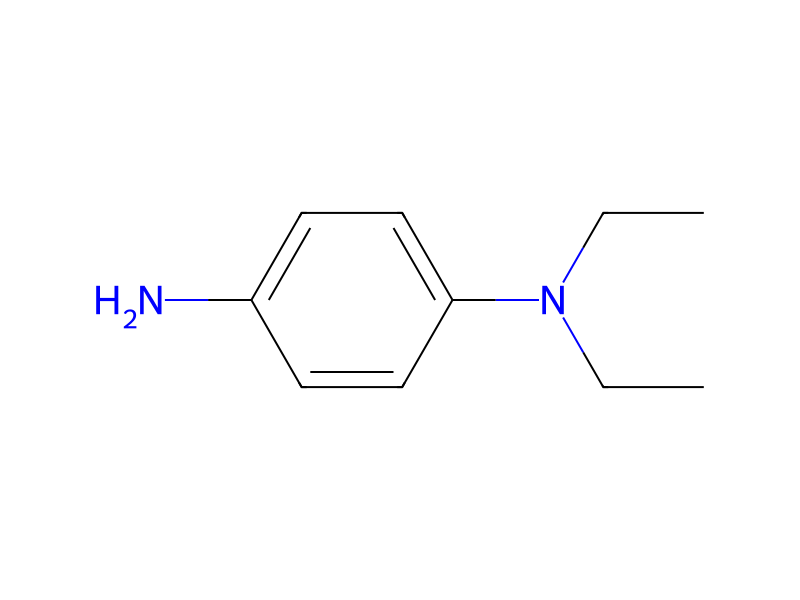
N,N-Diethyl-p-phenylenediamine

HCID 7120
New noteNew reactionRequest quotes
Print preview

Completing data — refresh the page later to see the latest
Basic informationOverviewNames & identifiersPropertiesSafety & regulationChemistry & industryRelated reactionsCompound notes
Substructure searchFind similar structures

Basic information

CAS
93-05-0
Standard SMILES
CCN(CC)c1ccc(N)cc1
InChIKey
QNGVNLMMEQUVQK-UHFFFAOYSA-N
Molecular formula
C10H16N2
Average molar mass
164.25 g/mol
Monoisotopic mass
164.13134851

Overview

Reddish brown or black liquid. (NTP, 1992)

Names & identifiers

Preferred name
N,N-Diethyl-p-phenylenediamine
IUPAC
4-N,4-N-diethylbenzene-1,4-diamine
English name
N,N-Diethyl-1,4-phenylenediamine
Molecular formula
C10H16N2
Molecular weight
164.25

Names & synonyms

93-05-0N,N-DIETHYL-P-PHENYLENEDIAMINEN,N-Diethyl-1,4-phenylenediamine4-Amino-N,N-diethylaniline4-(Diethylamino)anilinep-(Diethylamino)anilinep-Amino-N,N-diethylanilineN,N-Diethyl-4-aminoanilineDiethylaminoanilineN,N-Diethyl-1,4-benzenediamineDTXSID20250581,4-Benzenediamine, N1,N1-diethyl-
Show more names
DPDN1,N1-diethylbenzene-1,4-diamineHept-1-yn-3-ol1,4-Benzenediamine, N,N-diethyl-DPYD4-DiethylaminoanilineDiethyl-p-phenylenediamineDHPDHASE
p-Phenylenediamine, N,N-diethyl-Diethyl-para-phenylenediaminepara-AminodiethylanilineN,N-Diethyl 4-phenylenediamine0QQA4DFV2JN,N-Diethyl-para-phenylenediamineDTXCID205058NSC-147488

Database identifiers

CAS
93-05-0
PubChem CID
7120
DTXSID
DTXSID2025058
ChEMBL
CHEMBL1452158
UNII
0QQA4DFV2J
EC Number
202-214-1
Nikkaji
J28.419J

Properties

Computed structural propertiesFilling in

XLogP
2.2
Topological polar surface area
29.3 Ų
Hydrogen bond donors
1
Hydrogen bond acceptors
2
Rotatable bonds
3
Heavy atoms
12
Formal charge
0
Complexity
113

Experimental & physicochemical properties

Chemical ClassesNitrogen Compounds -> Amines, Aromatic
Density · 2 items

0.988 (NTP, 1992) - Less dense than water; will float

0.988

Color/Form · 2 items

Liquid

Pale yellow liquid

Solubility · 3 items

less than 1 mg/mL at 66 °F (NTP, 1992)

Insol in water; sol in alcohol and ether

Very soluble in benzene

Flash Pointgreater than 230 °F (NTP, 1992)
Boiling Point · 2 items

500 to 504 °F at 760 mmHg (NTP, 1992)

260-262 °C

Melting Point79 to 82 °F (NTP, 1992)
Vapor Pressure0.00298 [mmHg]
Refractive IndexIndex of refraction: 1.5710 @ 20 °C/D

Safety & regulation

Safety information is for reference only and does not replace the supplier’s Safety Data Sheet (SDS), applicable regulations, or professional assessment.

GHS classification

GHS Classification · 6 items

Danger

H301: Toxic if swallowed [Danger Acute toxicity, oral]

P260, P264, P270, P280, P301+P316, P301+P330+P331, P302+P361+P354, P304+P340, P305+P354+P338, P316, P321, P330, P363, P405, and P501 (click each P-code to see the statement)

Danger

H301 (100%): Toxic if swallowed [Danger Acute toxicity, oral]

P260, P264, P270, P280, P301+P316, P301+P330+P331, P302+P361+P354, P304+P340, P305+P354+P338, P316, P321, P330, P363, P405, and P501 (click each P-code to see the statement)

Hazard information

Regulatory Information · 3 items

Chemical: 1,4-Benzenediamine, N,N-diethyl-

Status: Active Update: 02-06-2015 https://echa.europa.eu/registration-dossier/-/registered-dossier/7727

4-Amino-N,N-diethylaniline: Does not have an individual approval but may be used under an appropriate group standard

Other Safety InformationIMAP assessments - Chemicals with limited data availability that may be used in hair dyes overseas: Human health tier II assessment
DOT LabelPoison
Fire HazardsThis chemical is probably combustible. (NTP, 1992)
Health HazardsSYMPTOMS: Symptoms of exposure to this compound may include skin irritation, dermatitis, and hemorrhaging.
Hazards Summary · 1 item

May cause allergic dermatitis, irritation, and hemorrhage on skin contact; May induce methemoglobinemia; [HSDB] A severe eye irritant, based on animal studies; May cause skin sensitization after prolonged contact, based on a related compound; [CHEMINFO] Can cause burns; [eChemPortal: ESIS] A severe eye irritant; Causes general anesthesia, convulsions, and cyanosis in dermal lethal-dose study of rabbits; Causes convulsions in oral lethal-dose study of cats; [RTECS] Causes burns; Toxic if ingested; May be harmful if absorbed through skin; [Aldrich MSDS]

Chemistry & industry

Pharmacology

Metabolism/MetabolitesAN AZOTOBACTER VINELANDII ELECTRON TRANSPORT-ACTIVE 0 R3 FRACTION RAPIDLY OXIDIZED N,N-DIETHYL-P-PHENYLENEDIAMINE.
Absorption, Distribution and ExcretionFOLLOWING IN VIVO APPLICATION OF 1-(14)C-LABELED 4-AMINO-N,N-DIETHYLANILINE TO GUINEA PIG SKIN, BINDING TO EPIDERMAL PROTEINS WAS DEMONSTRATED, ALTHOUGH IT WAS RELATIVELY LABILE, & NO HAPTEN-AMINO ACID ADDUCT COULD BE ISOLATED.

Uses & manufacturing

Uses · 4 items

Used as a dye intermediate and in diazo copying processes; [Hawley] Used as an antioxidant/antiozonant, as a developing agent in color photography, and in organic synthesis; [CHEMINFO]

Photographic Processing [Category: Other]

Dye intermediate; source of diazonium compd in diazo copying process

Color photography /Hydrochloride/

Methods of Manufacturing · 2 items

Treatment of diethylaniline with nitrous acid and subsequent reduction.

Reduction of p-nitro-N,N-dimethylaniline

General Manufacturing Information1,4-Benzenediamine, N1,N1-diethyl-: ACTIVE
Applications · 4 items

DescriptionDPD is a clear liquid. Molecularweight=164-28; Boiling point=260-262℃; Flash point$110℃.

UsesDye intermediate, source of diazonium compounds in diazo copying process.

UsesN,N-Diethyl-p-phenylenediamine has been employed as a reference probe to investigate rapid chlorination rate constants by a stopped-flow spectrophotometric competition kinetics method.

General DescriptionReddish brown or black liquid.

Related reactions

45 records
New reaction record
HRID 16125 reaction equation
HRID 16125As reactantuspto-grants-2010_06
HRID 16127 reaction equation
HRID 16127As reactantuspto-grants-2010_06
HRID 16129 reaction equation
HRID 16129As reactantuspto-grants-2010_06
HRID 153920 reaction equation
HRID 153920As reactantTraining data from https://doi.org/10.1039/C8SC04228D (9/10)
HRID 162938 reaction equation
HRID 162938As reactantTraining data from https://doi.org/10.1039/C8SC04228D (9/10)
HRID 193408 reaction equation
HRID 193408As reactantTraining data from https://doi.org/10.1039/C8SC04228D (6/10)
HRID 244525 reaction equation
HRID 244525As reactantuspto-grants-2014_02
HRID 268251 reaction equation
HRID 268251As reactantuspto-grants-1976_03
Page 1 of 6

Compound notes

Loading…

On this pageBasic informationOverviewNames & identifiersPropertiesSafety & regulationChemistry & industryRelated reactionsCompound notes
More actions
New noteNew reactionRequest quotes
Physical Description · 2 items

Reddish brown or black liquid. (NTP, 1992)

Pale yellow liquid; [HSDB] Reddish-brown or black liquid; [CAMEO] Pale yellow liquid; Turns dark brown on exposure to light and air; [CHEMINFO] Clear very deep brown liquid; [MSDSonline]

Dissociation ConstantspKa= 7.96 (conjugate acid)
Other Experimental PropertiesColorless needles; soluble in water, alcohol; insoluble in ether /Hydrochloride/

Physicochemical properties

Melting point
18 °C · 18 °C
Boiling point
262 °C · 262 °C
Density
0.988 g/mL · 0.988 g/mL at 25 °C (lit.)
refractive index
20 · n 20/D 1.571 (lit.)
Flash point
139 °C · 139 °C
storage temp.
2 · Keep in dark place,Sealed in dry,2-8°C
solubility
water: insoluble
pka
8.21 · 8.21±0.32(Predicted)
form
powder to lump to clear liquid
color
White or Colorless to Brown
biological source
rabbit
Water Solubility
0.1 g/100 · <0.1 g/100 mL at 19 ºC
BRN
879361 · 879361
Henry's Law Constant
1.9 · 1.9×102 mol/(m3Pa) at 25℃, HSDB (2015)
Stability
Stability Air and light sensitive. Incompatible with strong oxidizing agents, strong acids.
InChI
1S/C10H16N2/c1-3-12(4-2)10-7-5-9(11)6-8-10/h5-8H,3-4,11H2,1-2H3
InChIKey
QNGVNLMMEQUVQK-UHFFFAOYSA-N
SMILES
CCN(CC)c1ccc(N)cc1
CAS DataBase Reference
93 · 93-05-0(CAS DataBase Reference)
EWG's Food Scores
1 · 1-4
FDA UNII
0 QQA4DFV2J · 0QQA4DFV2J
NIST Chemistry Reference
1 · 1,4-Benzenediamine, N,N-diethyl-(93-05-0)
EPA Substance Registry System
N,N-Diethyl-p-phenylenediamine (93-05-0)
UNSPSC Code
12352203 · 12352203
NACRES
41 · NA.41
Symbol(GHS)
5 · GHS05,GHS06
Signal word
Danger
Hazard statements
301 · H301-H314
Precautionary statements
270 · P270-P280-P303+P361+P353-P304+P340+P310-P305+P351+P338-P363
PPE
Faceshields, Gloves, Goggles, type ABEK (EN14387) respirator filter
Hazard Codes
T
Risk Statements
25 · 25-34
Safety Statements
26 · 26-36-45
RIDADR
2922 · UN 2922 8/PG 2
WGK Germany
1 · 1
RTECS
9275000 · SS9275000
TSCA
TSCA listed
HazardClass
6.1 · 6.1(b)
PackingGroup
III
HS Code
29215190 · 29215190
Storage Class
6.1 A · 6.1A - Combustible acute toxic Cat. 1 and 2very toxic hazardous materials
Hazard Classifications
3 OralEye · Acute Tox. 3 OralEye Dam. 1Skin Corr. 1B
Hazardous Substances Data
93 · 93-05-0(Hazardous Substances Data)
REACH Registrations
Active
Limited Quantities
1 Kg · 1 Kg (2.2 lbs) (solid)
Excepted Quantities
Max Inner Pack (30g or 30ml) and Max Outer Pack (500g or 500ml)
Reactive GroupAmines, Aromatic
Reactivity Profile · 1 item

N,N-DIETHYL-P-PHENYLENEDIAMINE neutralizes acids in exothermic reactions to form salts plus water. May be incompatible with isocyanates, halogenated organics, peroxides, phenols (acidic), epoxides, anhydrides, and acid halides. Flammable gaseous hydrogen may be generated in combination with strong reducing agents, such as hydrides.

Air and Water ReactionsInsoluble in water.
Hazard Classes and Categories · 4 items

Acute Tox. 3 (100%)

Acute toxicity - category 3

Acute toxicity (Oral) - Category 3

Acute Tox. 3 *

Safety & protection

Fire FightingFires involving this material can be controlled with a dry chemical, carbon dioxide or Halon extinguisher. (NTP, 1992)
First Aid · 1 item

EYES: First check the victim for contact lenses and remove if present. Flush victim's eyes with water or normal saline solution for 20 to 30 minutes while simultaneously calling a hospital or poison control center. Do not put any ointments, oils, or medication in the victim's eyes without specific instructions from a physician. IMMEDIATELY transport the victim after flushing eyes to a hospital even if no symptoms (such as redness or irritation) develop.

Nonfire Spill Response · 1 item

SMALL SPILLS AND LEAKAGE: If you spill this chemical, FIRST REMOVE ALL SOURCES OF IGNITION. Then, use absorbent paper to pick up all liquid spill material. Your contaminated clothing and absorbent paper should be sealed in a vapor-tight plastic bag for eventual disposal. Solvent wash all contaminated surfaces with 60-70% ethanol followed by washing with a soap and water solution. Do not reenter the contaminated area until the Safety Officer (or other responsible person) has verified that the area has been properly cleaned.

Disposal Methods · 1 item

SRP: At the time of review, criteria for land treatment or burial (sanitary landfill) disposal practices are subject to significant revision. Prior to implementing land disposal of waste residue (including waste sludge), consult with environmental regulatory agencies for guidance on acceptable disposal practices.

Isolation and EvacuationExcerpt from ERG Guide 153 [Substances - Toxic and/or Corrosive (Combustible)]:
Personal Protective Equipment (PPE) · 1 item

RECOMMENDED RESPIRATOR: Where the neat test chemical is weighed and diluted, wear a NIOSH-approved half face respirator equipped with an organic vapor/acid gas cartridge (specific for organic vapors, HCl, acid gas and SO2) with a dust/mist filter. (NTP, 1992)

Toxicology

Environmental Fate · 3 items

TERRESTRIAL FATE: Based on a classification scheme(1), an estimated Koc value of 470(SRC), determined from a structure estimation method(2), indicates that the non-protonated form of N,N-diethyl-p-phenylenediamine is expected to have moderate mobility in soil(SRC). Volatilization of N,N-diethyl-p-phenylenediamine from moist soil surfaces is not expected to be an important fate process(SRC) given an estimated Henry's Law constant of 5.3X10⁻⁸ atm-cu m/mole(3), using a fragment constant estimation method(3). A pKa of 7.96(5) indicates N,N-diethyl-p-phenylenediamine will exist primarily in the protonated form at pH values of 5 to 9.Cations generally adsorb to organic carbon and clay more strongly than their neutral counterparts. N,N-Diethyl-p-phenylenediamine is not expected to volatilize from dry soil surfaces(SRC) based upon an estimated vapor pressure of 3.0X10⁻³ mm Hg(SRC), determined from a fragment constant method(4).

AQUATIC FATE: Based on a classification scheme(1), an estimated Koc value of 470(SRC), determined from an estimation method(2), indicates that the non-protonated form of N,N-diethyl-p-phenylenediamine is expected to adsorb to suspended solids and sediment(SRC). Volatilization from water surfaces is not expected(3) based upon an estimated Henry's Law constant of 5.3X10⁻⁸ atm-cu m/mole(4), developed using a fragment constant estimation method(4). A pKa of 7.96(5) indicates N,N-diethyl-p-phenylenediamine will exist primarily in the ionized form at pH values of 5 to 9. According to a classification scheme(6), an estimated BCF of 11(SRC), from an estimated log Kow of 2.2(7),and a regression-derived equation(8), suggests the potential for bioconcentration in aquatic organisms is low.

ATMOSPHERIC FATE: According to a model of gas/particle partitioning of semivolatile organic compounds in the atmosphere(1), N,N-diethyl-p-phenylenediamine, which has an estimated vapor pressure of 3.0X10⁻³ mm Hg at 25 °C(SRC), determined from a fragment constant method(2), is expected to exist solely in the vapor-phase in the ambient atmosphere. Vapor-phase N,N-diethyl-p-phenylenediamine is degraded in the atmosphere by reaction with photochemically-produced hydroxyl radicals(SRC); the half-life for this reaction in air is estimated to be 2 hours(SRC), calculated from its rate constant of 2.2X10⁻¹⁰ cu cm/molecule-sec at 25 °C(SRC) determined using a structure estimation method(3). N,N-Diethyl-p-phenylenediamine absorbs light in the environmental spectrum and has the potential for direct photolysis(4).

Adverse EffectsMethemoglobinemia - The presence of increased methemoglobin in the blood; the compound is classified as secondary toxic effect
Soil Adsorption/Mobility · 1 item

Using a structure estimation method based on molecular connectivity indices(1), the Koc for N,N-diethyl-p-phenylenediamine can be estimated to be 470(SRC). According to a classification scheme(2), this estimated Koc value suggests that the non-protonated form of N,N-diethyl-p-phenylenediamine is expected to have moderate mobility in soil. The pKa of N,N-diethyl-p-phenylenediamine is 7.96(3), indicating that this compound will exist in the cation form. Cations generally adsorb to organic carbon and clay more strongly than their neutral counterparts. Volatilization from moist soil surfaces is not expected to be an important fate process because the cation is not expected to volatilize(SRC).

Artificial Pollution SourcesN,N-Diethyl-p-phenylenediamine's production and use as a dye(1) may result in its release to the environment through various waste streams(SRC).
Environmental Bioconcentration · 1 item

An estimated BCF of 11 was calculated for N,N-diethyl-p-phenylenediamine(SRC), using an estimated log Kow of 2.2(1) and a regression-derived equation(2). According to a classification scheme(3), this BCF suggests the potential for bioconcentration in aquatic organisms is low(SRC).

Volatilization from Water/Soil · 1 item

The Henry's Law constant for N,N-diethyl-p-phenylenediamine is estimated as 5.3X10⁻⁸ atm-cu m/mole(SRC) using a fragment constant estimation method(1). This Henry's Law constant indicates that N,N-diethyl-p-phenylenediamine is expected to be essentially nonvolatile from water surfaces(2). N,N-Diethyl-p-phenylenediamine is not expected to volatilize from dry soil surfaces(SRC) based upon an estimated vapor pressure of 3.0X10⁻³ mm Hg(SRC) determined from a fragment constant method(3).

Environmental Abiotic Degradation · 1 item

The rate constant for the vapor-phase reaction of N,N-diethyl-p-phenylenediamine with photochemically-produced hydroxyl radicals has been estimated as 2.2X10⁻¹⁰ cu cm/molecule-sec at 25 °C(SRC) using a structure estimation method(1). This corresponds to an atmospheric half-life of approximately 2 hours at an atmospheric concentration of 5X10+5 hydroxyl radicals per cu cm(1).

Probable Routes of Human ExposureOccupational exposure to N,N-diethyl-p-phenylenediamine may occur through inhalation and dermal contact with this compound at workplaces where N,N-diethyl-p-phenylenediamine is produced or used.(SRC)
Environmental Fate/Exposure Summary · 1 item

N,N-Diethyl-p-phenylenediamine's production and use as a dye may result in its release to the environment through various waste streams. If released to air, an estimated vapor pressure of 3.0X10⁻³ mm Hg at 25 °C indicates N,N-diethyl-p-phenylenediamine will exist solely in the vapor-phase. Vapor-phase N,N-diethyl-p-phenylenediamine will be degraded in the atmosphere by reaction with photochemically-produced hydroxyl radicals; the half-life for this reaction in air is estimated to be 2 hours. N,N-Diethyl-p-phenylenediamine absorbs light in the environmental UV spectrum and has the potential for direct photolysis. If released to soil, N,N-diethyl-p-phenylenediamine is expected to have moderate mobility based upon an estimated Koc of 470. Volatilization from moist soil surfaces is not expected to be an important fate process based upon an estimated Henry's Law constant of 5.3X10⁻⁸ atm-cu m/mole. The pKa of N,N-diethyl-p-phenylenediamine is 7.96, indicating that this compound will exist in the cation form. Cations generally adsorb to organic carbon and clay more strongly than their neutral counterparts. Volatilization from moist soil surfaces is not expected to be an important fate process because the cation is not expected to volatilize. If released into water, N,N-diethyl-p-phenylenediamine is expected to adsorb to suspended solids and sediment based upon the estimated Koc. Volatilization from water surfaces is not expected to be an important fate process based upon this compound's estimated Henry's Law constant. An estimated BCF of 11 suggests the potential for bioconcentration in aquatic organisms is low. The general population may be exposed to N,N-diethyl-p-phenylenediamine via dermal contact with this compound and consumer products containing N,N-diethyl-p-phenylenediamine. (SRC)

Safety data

PPE
Faceshields, Gloves, Goggles, type ABEK (EN14387) respirator filter
wgk
1
tsca
TSCA listed
rtecs
SS9275000
ridadr
UN 2922 8/PG 2
hs_code
29215190
risk_code
25-34
Signal word
Danger
Symbol(GHS)
GHS05,GHS06
hazard_code
T
safety_code
26-36-45
hazard_class
6.1(b)
Storage Class
6.1A - Combustible acute toxic Cat. 1 and 2very toxic hazardous materials
packing_group
III
Hazard statements
H301-H314
Limited Quantities
1 Kg (2.2 lbs) (solid)
Excepted Quantities
Max Inner Pack (30g or 30ml) and Max Outer Pack (500g or 500ml)
REACH Registrations
Active
Hazard Classifications
Acute Tox. 3 OralEye Dam. 1Skin Corr. 1B
Precautionary statements
P270-P280-P303+P361+P353-P304+P340+P310-P305+P351+P338-P363
Hazardous Substances Data
93-05-0(Hazardous Substances Data)

Upstream & downstream products

Upstream raw materials

NitroSodium chlorideWaterN,N-Diethyl-4-nitrosoanilineIronN,N-Diethyl-4-nitroaniline4,4'-Bis(diethylamino)azobenzenePropanedioic acid, 2-[[[4-(diethylamino)phenyl]amino]methylene]-, 1,3-diethyl esterN,N-DiethylanilineN,N-Diethyl-1,4-phenylenediamine4-Bromochlorobenzene4-Fluoronitrobenzene

Downstream products

N,N-Diethyl-p-phenylenediamine sulfatePropanedinitrile, 2-[2-[2-(4-aminophenyl)ethenyl]-4H-1-benzopyran-4-ylidene]-4-Amino-benzenesulfonic acid monosodium saltAnilineN,N-Diethyl-1,4-phenylenediamineN,N-Diethyl-p-phenylenediamine monohydrochlorideBASIC BLUE 41 (C.I. 11105)Benzo[a]phenazinium, 9-(diethylamino)-5-[[4-(diethylamino)phenyl]amino]-7-phenyl-, chloride4-[[4-(diethylamino)phenyl]imino]naphthalen-1(4H)-one