
HRID 23581As reactant
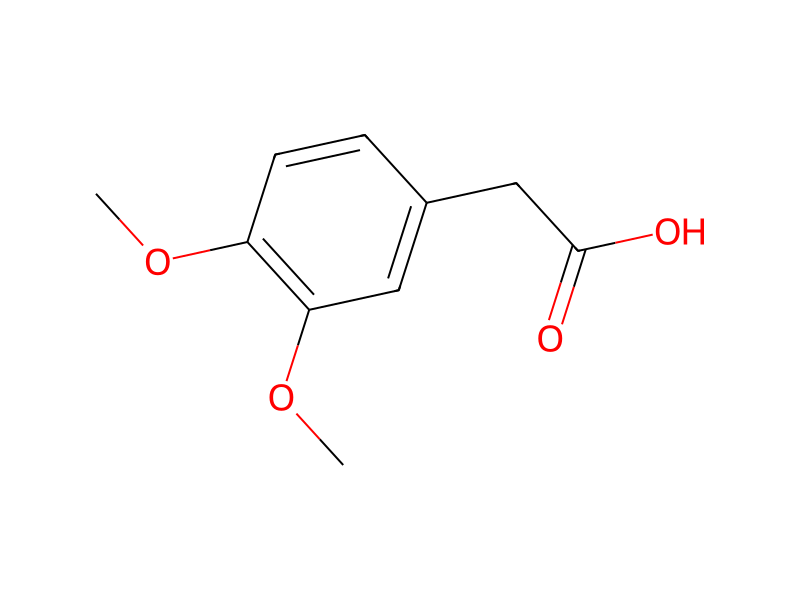
93-40-3COc1ccc(CC(=O)O)cc1OCWUAXWQRULBZETB-UHFFFAOYSA-NHomoveratric acid is a phenylacetic acid substituted at positions 3 and 4 by methoxy groups. It has a role as a human xenobiotic metabolite and a human urinary metabolite. It is a member of phenylacetic acids and a dimethoxybenzene.
93-40-3DTXSID5059086CHEBI:86655Safety information is for reference only and does not replace the supplier’s Safety Data Sheet (SDS), applicable regulations, or professional assessment.
This chemical does not meet GHS hazard criteria for 7.8% (4 of 51) of reports.
Warning
H315 (15.7%): Causes skin irritation [Warning Skin corrosion/irritation]
P261, P264, P264+P265, P271, P280, P302+P352, P304+P340, P305+P351+P338, P319, P321, P332+P317, P337+P317, P362+P364, P403+P233, P405, and P501 (click each P-code to see the statement)
Aggregated GHS information provided per 51 reports by companies from 7 notifications to the ECHA C&L Inventory. Each notification may be associated with multiple companies.
REACH registered substance: 3,4-dimethoxyphenylacetic acid (EC: 202-244-5)
3,4-Dimethoxyphenylacetic acid: Does not have an individual approval but may be used under an appropriate group standard
UsesHomoveratric Acid is a dopamine metabolite that inhibits brain mitochondrial respiration via monoamine oxidase/H2O2-dependent or non-dependent pathway.
UsesIt reacts with formaldehyde in the presence of acid to give an isochromanone.


DefinitionChEBI: Homoveratric acid is a phenylacetic acid substituted at positions 3 and 4 by methoxy groups. It has a role as a human urinary metabolite and a human xenobiotic metabolite. It is a dimethoxybenzene and a member of phenylacetic acids.