HomeMCPWorkbenchSkills
HomeWorkbenchNotificationsMe
llms.txt · MCP GuidePrivacy Policy · Terms of Service · Supportv1.8.3
  1. Home
  2. /Compound

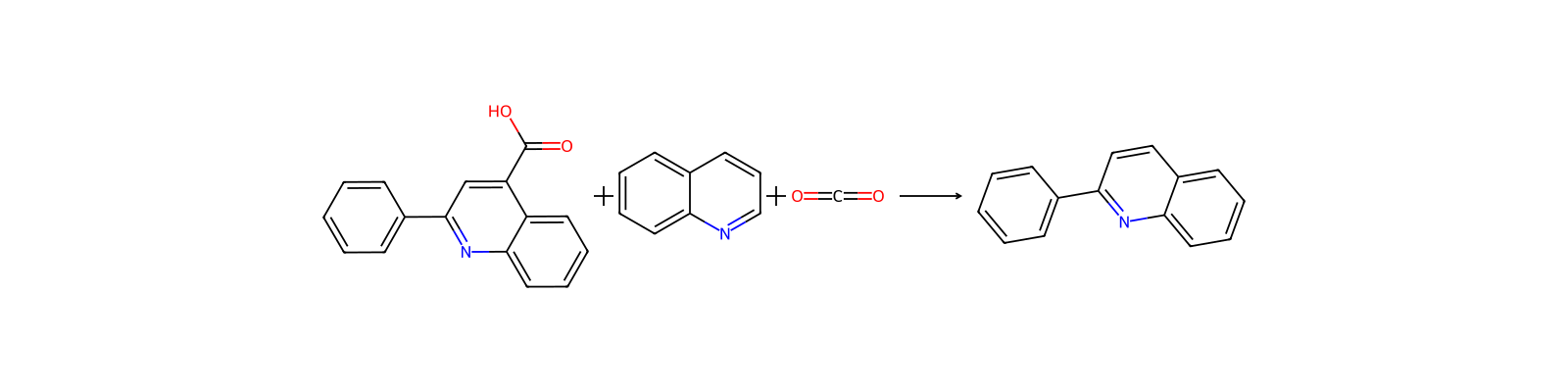
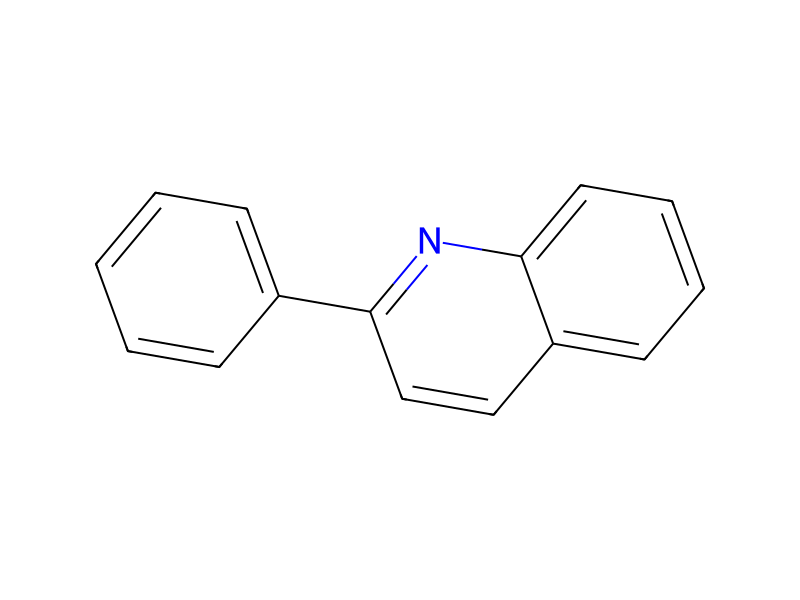
2-Phenylquinoline

HCID 71545
New reaction
Print
Basic informationOverviewNames & identifiersPropertiesSafety & regulationChemistry & industryRelated reactionsCompound notes
Substructure searchFind similar structures

Basic information

CAS
612-96-4
Standard SMILES
c1ccc(-c2ccc3ccccc3n2)cc1
InChIKey
FSEXLNMNADBYJU-UHFFFAOYSA-N
Molecular formula
C15H11N
Average molar mass
205.25 g/mol
Monoisotopic mass
205.08914936

Overview

structure in first source

Names & identifiers

Preferred name
2-Phenylquinoline
IUPAC
2-phenylquinoline
English name
2-Phenylquinoline
Molecular formula
C15H11N
Molecular weight
205.25

Names & synonyms

2-Phenylquinoline612-96-4DTXSID30210115RefChem:89109DTXCID30132606210-326-7Quinoline, 2-phenyl-Quinoline, phenyl-.alpha.-PhenylquinolineMFCD000115682-Phenyl-chinolin2-Phenyl-quinoline
Show more names
830ga-PhenylquinolinePhenylquinoline,99%2-Phenylquinoline>Phenylquinoline, 99%2-Phenylquinoline 99%alpha-Phenylquinoline2-Phenylquinoline, 99+%
612-73-7Bionet2_001089PHENYLQUINOLINE2-Phenylquinoline, 99%CHEMBL89786P20572-phenyl quinolineAE-562/43460146

Database identifiers

CAS
612-96-4
PubChem CID
71545
DTXSID
DTXSID30210115
ChEMBL
CHEMBL89786
EC Number
210-326-7
Nikkaji
J101.652K

Properties

Computed structural properties

XLogP
3.9
Topological polar surface area
12.9 Ų
Hydrogen bond donors
0
Hydrogen bond acceptors
1
Rotatable bonds
1
Heavy atoms
16
Formal charge
0
Complexity
219

Experimental & physicochemical properties

SpringerMaterials PropertiesLuminescence
LogP3.9

Physicochemical properties

Melting point
84 · 84-85 °C (lit.)
Boiling point
363 °C · 363 °C
Density
1.1155 · 1.1155 (rough estimate)
refractive index
1.655 · 1.6550 (estimate)
storage temp.
Sealed in dry,Room Temperature
pka
4.52 · 4.52±0.10(Predicted)
form
Crystalline Powder
color
White to light yellow
Water Solubility
SLIGHTLY SOLUBLE
λmax
258 nm · 258nm(lit.)
InChI
1S/C15H11N/c1-2-6-12(7-3-1)15-11-10-13-8-4-5-9-14(13)16-15/h1-11H
InChIKey
FSEXLNMNADBYJU-UHFFFAOYSA-N
SMILES
c1ccc(cc1)-c2ccc3ccccc3n2
CAS DataBase Reference
612 · 612-96-4(CAS DataBase Reference)
NIST Chemistry Reference
2 · Quinoline, 2-phenyl-(612-96-4)
Comptox DTXSID
30210115 · DTXSID30210115
UNSPSC Code
12352100 · 12352100
NACRES
22 · NA.22
Symbol(GHS)
7 · GHS07
Signal word
Warning
Hazard statements
315 · H315-H319-H335
Precautionary statements
261 · P261-P264-P271-P280-P302+P352-P305+P351+P338
target organs
Respiratory system
PPE
95 · dust mask type N95 (US), Eyeshields, Gloves
Hazard Codes
Xi
Risk Statements
36 · 36/37/38
Safety Statements
26 · 26-37/39
WGK Germany
3 · 3
HS Code
2933490090 · 2933490090
Storage Class
11 · 11 - Combustible Solids
Hazard Classifications
2 Skin · Eye Irrit. 2Skin Irrit. 2STOT SE 3

Safety & regulation

Safety information is for reference only and does not replace the supplier’s Safety Data Sheet (SDS), applicable regulations, or professional assessment.

GHS classification

GHS Classification · 4 items

Warning

H315 (100%): Causes skin irritation [Warning Skin corrosion/irritation]

P261, P264, P264+P265, P271, P280, P302+P352, P304+P340, P305+P351+P338, P319, P321, P332+P317, P337+P317, P362+P364, P403+P233, P405, and P501 (click each P-code to see the statement)

Aggregated GHS information provided per 41 reports by companies from 4 notifications to the ECHA C&L Inventory. Each notification may be associated with multiple companies.

Hazard information

Hazard Classes and CategoriesSkin Irrit. 2 (100%)

Safety data

PPE
dust mask type N95 (US), Eyeshields, Gloves
wgk
3
hs_code
2933490090
risk_code
36/37/38
Signal word
Warning
Symbol(GHS)
GHS07
hazard_code
Xi
safety_code
26-37/39
Storage Class
11 - Combustible Solids
target organs
Respiratory system
Hazard statements
H315-H319-H335
Hazard Classifications
Eye Irrit. 2Skin Irrit. 2STOT SE 3
Precautionary statements
P261-P264-P271-P280-P302+P352-P305+P351+P338

Chemistry & industry

Applications · 2 items

Description2-Phenylquinoline is the major quinoline alkaloid of Galipea iongiflora, a Bolivian plant used as treatment for cutaneous leishmaniasis. Antinociceptive properties of 2-phenylquinoline isolated from the bark of Galipea iongiflora against different models of pain in mice were evaluated.

Uses2-Phenylquinoline was used in quantitative structure-activity relationship (QSAR) analyses of estrogen receptor β-selective ligands.

Preparation methods · 1 item

PreparationSynthesis of 2-phenylquinoline: Quinoline (1.0 g, 7.742 mmol) and phenyl lithium (2.30 mL, 2 M, 23.22 mmol) were reacted according to general procedure. Purification of the residue by silica gel column chromatography (EtOAc:MeOH:Et3N; 10-30:1:1 or PhMe:MeOH:Et3N; 10:1:1) gave 2-phenylquinoline (0.66 g, 42%) as an orange solid.Aniline (0.140 g, 1.50 mmol) and cinnamaldehyde (0.132 g, 1.00 mmol) were dissolved in toluene in a reaction vial equipped with a magnetic stirrer bar, followed by the addition of K10 (0.50 g). The reaction mixture was heated at a temperature of 110 C for 3 hours. After completion of the reaction, the crude product was purified by column chromatography over silica gel eluting with a mixture of Hexane : Ethyl acetate (20:1) to produce 2-Phenylquinoline as a yellow solid (0.044 g, 21%); (m.p. 82-84 C) (lit. 84-85 °C); Rf 0.67 (20:1 hexane:ethyl acetate);1H NMR (400 MHz, CDCl3) δH 7.46-7.51 (1H, m, H-4’), 7.53-7.56 (3H, m, H-6, 3’, 5’), 7.73- 7.77 (1H, m, H-7), 7.85 (1H, d, J = 8.31 Hz, H-5), 7.88-7.91 (1H, d, J = 8.31 Hz, H-3), 8.18- 8.27 (4H, m, H-4, 8, 2’, 6’)13C NMR(400 MHz, CDCl3) δC 119.2 (C-3), 126.7 (C-6), 127.2 (C-4a), 127.5 (C-2’, 6’), 127.9 (C-5), 128.4 (C-3’, 5’), 128.7 (C-4’), 128.9 (C-7, 8), 129.8 (C-4), 130.3 (C-1’), 137.9 (C-8a), 157.2 (C-2)

Upstream & downstream products

Upstream raw materials

Phenylmagnesium bromideQuinolinePhenyllithiumBromobenzene1,4-Dioxane

Related reactions

14 records
New reaction record
HRID 351159 reaction equation
HRID 351159As reactant
HRID 353361 reaction equation
HRID 353361As reactant
HRID 463501 reaction equation
HRID 463501As product
HRID 589088 reaction equation
HRID 589088As reactant
HRID 589096 reaction equation
HRID 589096As reactant
HRID 932507 reaction equation
HRID 932507As product
HRID 1062581 reaction equation
HRID 1062581As reactant
HRID 1495743 reaction equation
HRID 1495743As product
PreviousPage 1 of 2

Compound notes

On this pageBasic informationOverviewNames & identifiersPropertiesSafety & regulationChemistry & industryRelated reactionsCompound notes