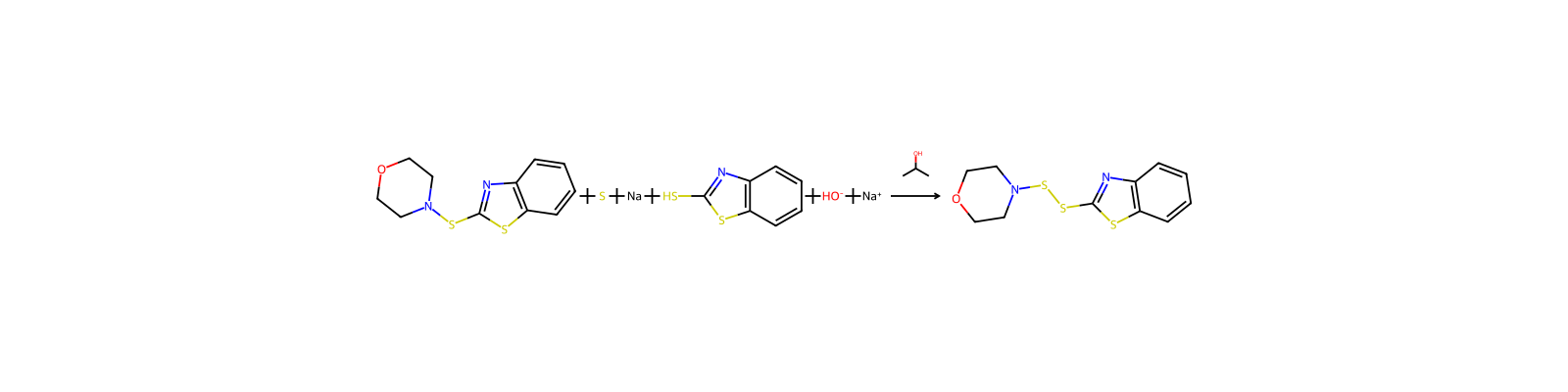
HRID 918035As product
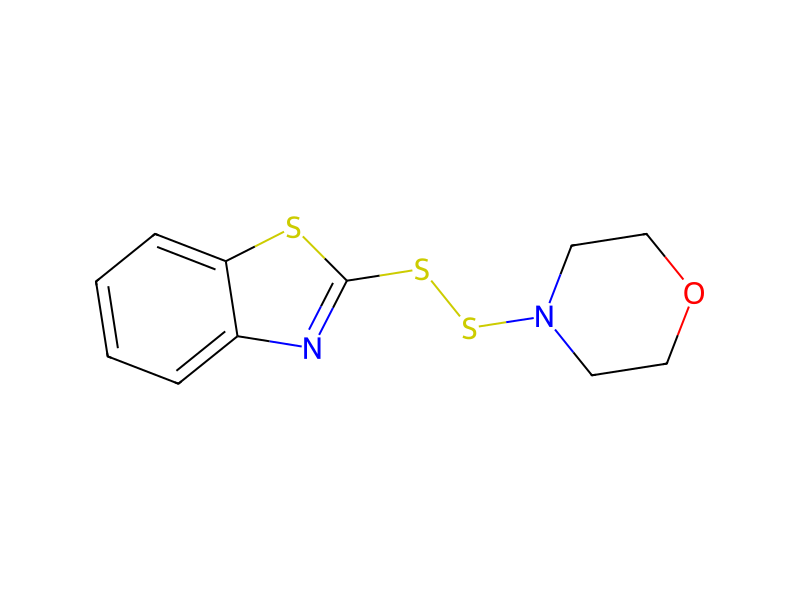
95-32-9c1ccc2sc(SSN3CCOCC3)nc2c1QRYFCNPYGUORTK-UHFFFAOYSA-N95-32-9DTXSID2026573CHEMBL3186081Dry Powder; Large Crystals
Cream to light yellow powder; [MSDSonline]
Safety information is for reference only and does not replace the supplier’s Safety Data Sheet (SDS), applicable regulations, or professional assessment.
This chemical does not meet GHS hazard criteria for 4.3% (1 of 23) of reports.
Warning
H317 (91.3%): May cause an allergic skin reaction [Warning Sensitization, Skin]
P261, P264+P265, P272, P280, P302+P352, P305+P351+P338, P321, P333+P317, P337+P317, P362+P364, and P501 (click each P-code to see the statement)
Aggregated GHS information provided per 23 reports by companies from 5 notifications to the ECHA C&L Inventory. Each notification may be associated with multiple companies.
Not Classified
Chemical: Benzothiazole, 2-(4-morpholinyldithio)-
Benzothiazole, 2-(4-morpholinyldithio)- is listed on the EPA's Chemical Data Reporting (CDR) system. Manufacturers and importers of Benzothiazole, 2-(4-morpholinyldithio)- are required to report information about their production and use of this chemical to the EPA under the Toxic Substances Control Act (TSCA). (40 eCFR Part 711)
Benzothiazole, 2-(4-morpholinyldithio)-: Does not have an individual approval but may be used as a component in a product covered by a group standard. It is not approved for use as a chemical in its own right.
Skin Sens. 1 (91.3%)
Hazardous to the aquatic environment (Acute) - Category 1
Used as an accelerator and sulfur donor for natural and synthetic rubber; [HSDB]
Metal Machining [Category: Heat or Machine]
ACCELERATOR & SULFUR DONOR FOR NATURAL & SYNTHETIC RUBBER
(1979) No Data
(1981) No Data
(1979) No Data
(1981) No Data
2023: 75,000 - <500,000 lb
(1979) PROBABLY GREATER THAN 9.08X10+5 GRAMS
(1981) PROBABLY GREATER THAN 4.54X10+5 GRAMS
>450,000 kg in 1977.
Rubber Product Manufacturing
Benzothiazole, 2-(4-morpholinyldithio)-: ACTIVE
Uses4-(2-BENZOTHIAZOLYLDITHIO)MORPHOLINE is a post-curing accelerator for rubber and can also be used as a vulcanizing agent. When used as an accelerator, its performance in natural rubber is similar to that of accelerator CZ, but with slightly greater retardation. In 54-1(W) type chloroprene rubber, when combined with accelerator PZ, it accelerates the vulcanization speed, improves scorch resistance, and results in excellent physical properties of the finished product. In styrene-butadiene rubber, its scorch resistance is poor; it can be combined with stearic acid to accelerate scorch and improve tensile strength. When used as a vulcanizing agent, it is advisable to add a small amount of thiuram or dithiocarbamate accelerators to increase the rate of vulcanization and improve the aging resistance of the finished product. This product is easily dispersed in rubber and has almost no pollution. It is mainly used in the manufacture of tires, rubber shoes, sponges, and industrial products. When used as a vulcanizing agent, the dosage is 2.5-5 parts, combined with about 1 part of accelerator PZ. When used as an accelerator, the general dosage is 0.4-1.5 parts.
SRP: At the time of review, criteria for land treatment or burial (sanitary landfill) disposal practices are subject to significant revision. Prior to implementing land disposal of waste residue (including waste sludge), consult with environmental regulatory agencies for guidance on acceptable disposal practices.
ENVIRON SAMPLING & MEDICAL EVALUATIONS WERE CONDUCTED ON WORKERS IN DRYING & BAGGING DEPT TO KAGARAX-A. WHEAL TYPE LESIONS WERE FOUND DUE TO SKIN CONTACT, & SOME SENSITIZATION TO THE ALLERGENIC COMPONENT, 2-MERCAPTOBENZOTHIAZOLE, OF KAGARAX-A WAS FOUND.