
3-Phosphoglyceraldehyde
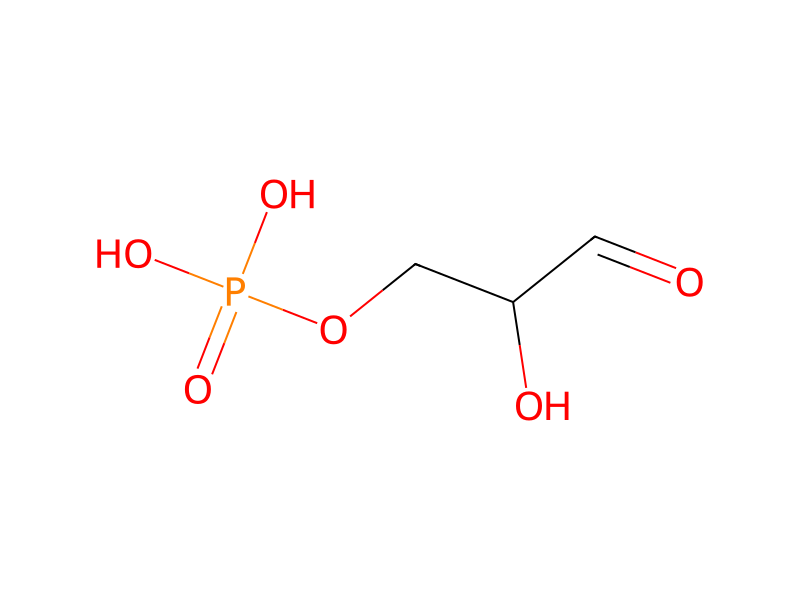
Basic information
- CAS
591-59-3- Standard SMILES
O=CC(O)COP(=O)(O)O- InChIKey
LXJXRIRHZLFYRP-UHFFFAOYSA-N- Molecular formula
- C3H7O6P
- Average molar mass
- 170.06 g/mol
- Monoisotopic mass
- 169.99802494
Overview
Glyceraldehyde 3-phosphate is an aldotriose phosphate that is the 3-phospho derivative of glyceraldehyde. It is an important metabolic intermediate in several central metabolic pathways in all organisms. It has a role as a plant metabolite, an Escherichia coli metabolite and a human metabolite. It is an aldehyde and an aldotriose phosphate. It is functionally related to a glyceraldehyde. It is a conjugate acid of a glyceraldehyde 3-phosphate(2-).
Names & identifiers
- Preferred name
- 3-Phosphoglyceraldehyde
- IUPAC
- (2-hydroxy-3-oxopropyl) dihydrogen phosphate
- English name
- DL-Glyceraldehyde 3-phosphate
- Molecular formula
- C3H7O6P
- Molecular weight
- 170.06
Names & synonyms
DL-Glyceraldehyde 3-phosphate591-59-33-phosphoglyceraldehyde(2-hydroxy-3-oxopropyl) dihydrogen phosphateEINECS 209-721-77466PL1110DTXSID80349247RefChem:505003DTXCID40300319209-721-710030-19-0GLYCERALDEHYDE 3-PHOSPHATE
Show more names
5G1000g,5kgLXJXRIRHZLFYRP-UHFFFAOYSA-NPropal,2-hydroxy-3-(phosphonooxy)-DL-GLYCERALDEHYDE 3-PHOSPHATE FREE Adl-glyceraldehyde 3-phosphate solutiondl-glyceraldehyde 3-phosphate free acidDL-Glyceraldehyde 3-Phosphate DISCONTINUED.
glyceraldehyde-3-phosphate2-hydroxy-3-(phosphonooxy)propanal2-hydroxy-3-oxopropyl dihydrogen phosphate142-10-9Glycerinaldehyd-3-phosphatPropanal, 2-hydroxy-3-(phosphonooxy)-Glyceraldehyde 3 PhosphateDL-Glyceraldehyde 3-phosphate - 45-55 mg/mL aqueous solution
Database identifiers
- CAS
591-59-3- PubChem CID
- 729
- DTXSID
DTXSID40861814- ChEBI
CHEBI:17138- UNII
- 7466PL1110
- EC Number
- 209-721-7
- Nikkaji
- J228.059K
Properties
Computed structural properties
- XLogP
- -2.7
- Topological polar surface area
- 104 Ų
- Hydrogen bond donors
- 3
- Hydrogen bond acceptors
- 6
- Rotatable bonds
- 4
- Heavy atoms
- 10
- Formal charge
- 0
- Complexity
- 149
Physicochemical properties
- Boiling point
- 399.2 · 399.2±52.0 °C(Predicted)
- Density
- 1.721 · 1.721±0.06 g/cm3(Predicted)
- storage temp.
- -20 °C · -20°C
- solubility
- 50 mg/ml · Water: 50 mg/ml
- pka
- 1.8 · 1.80±0.10(Predicted)
- form
- Liquid
- color
- Colorless to light yellow
- biological source
- synthetic (organic)
- InChI
- InChI=1S/C3H7O6P/c4-1-3(5)2-9-10(6,7)8/h1,3,5H,2H2,(H2,6,7,8)
- InChIKey
- LXJXRIRHZLFYRP-UHFFFAOYSA-N
- SMILES
- C(=O)C(O)COP(O)(O)=O
- FDA UNII
- 7466 PL1110 · 7466PL1110
- UNSPSC Code
- 12352201 · 12352201
- NACRES
- 25 · NA.25
- Symbol(GHS)
- 5 · GHS05
- Signal word
- Danger
- Hazard statements
- 314 · H314
- Precautionary statements
- 280 · P280-P305+P351+P338-P310
- PPE
- Faceshields, Gloves, Goggles, type ABEK (EN14387) respirator filter
- Hazard Codes
- C
- Risk Statements
- 34 · 34
- Safety Statements
- 26 · 26-27-36/37/39-45
- RIDADR
- 1760 · UN 1760 8/PG 2
- WGK Germany
- 3 · 3
- HazardClass
- 8 · 8
- PackingGroup
- II
- Storage Class
- 8 A · 8A - Combustible corrosive hazardous materials
- Hazard Classifications
- 1 Skin · Eye Dam. 1Skin Corr. 1B
Safety & regulation
Safety information is for reference only and does not replace the supplier’s Safety Data Sheet (SDS), applicable regulations, or professional assessment.
GHS classification
GHS Classification
Danger
H314 (100%): Causes severe skin burns and eye damage [Danger Skin corrosion/irritation]
P260, P264, P264+P265, P280, P301+P330+P331, P302+P361+P354, P304+P340, P305+P354+P338, P316, P317, P321, P363, P405, and P501 (click each P-code to see the statement)
Aggregated GHS information provided per 39 reports by companies from 2 notifications to the ECHA C&L Inventory. Each notification may be associated with multiple companies.
Hazard information
Hazard Classes and CategoriesSkin Corr. 1B (100%)
Safety data
- PPE
- Faceshields, Gloves, Goggles, type ABEK (EN14387) respirator filter
- wgk
- 3
- ridadr
- UN 1760 8/PG 2
- risk_code
- 34
- Signal word
- Danger
- Symbol(GHS)
- GHS05
- hazard_code
- C
- safety_code
- 26-27-36/37/39-45
- hazard_class
- 8
- Storage Class
- 8A - Combustible corrosive hazardous materials
- packing_group
- II
- Hazard statements
- H314
- Hazard Classifications
- Eye Dam. 1Skin Corr. 1B
- Precautionary statements
- P280-P305+P351+P338-P310
Chemistry & industry
Applications
DescriptionDL-Glyceraldehyde-3-phosphate (GADP) is an intermediate in several metabolic pathways, including glycolysis and gluconeogenesis. In glycolysis, it can be derived from fructose 1,6-bisphosphate by fructose bisphosphate aldolase in a reaction that also produces dihydroxyacetone phosphate (DHAP). Triose phosphate isomerase reversibly converts DHAP to GADP. GADP is processed to 1,3-bisphosphoglycerate by glyceraldehyde phosphate dehydrogenase and NAD+.
UsesThe level of Glyceraldehyde 3-phosphate dehydrogenase (GAPDH) activity in HEK 293 cells was aβeβed by measuring the reduction of NAD+ by DL-Glyceraldehyde 3-phosphate.
Additional notes
DefinitionChEBI: Glyceraldehyde 3-phosphate is an aldotriose phosphate that is the 3-phospho derivative of glyceraldehyde. It is an important metabolic intermediate in several central metabolic pathways in all organisms. It has a role as a human metabolite, a plant metabolite and an Escherichia coli metabolite. It is an aldotriose phosphate and an aldehyde. It is functionally related to a glyceraldehyde. It is a conjugate acid of a glyceraldehyde 3-phosphate(2-).
Related reactions
1 records
Compound notes
Loading…