
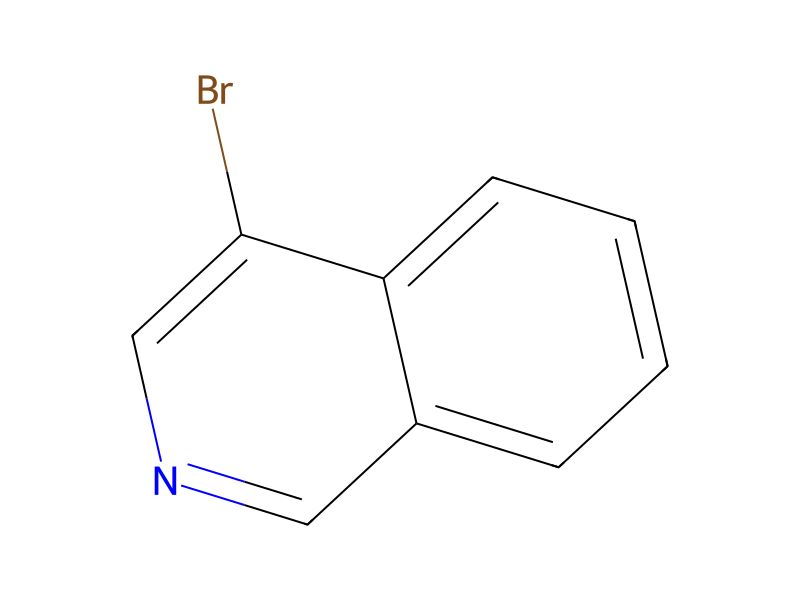
Basic information
- CAS
1532-97-4- Standard SMILES
Brc1cncc2ccccc12- InChIKey
SCRBSGZBTHKAHU-UHFFFAOYSA-N- Molecular formula
- C9H6BrN
- Average molar mass
- 208.05 g/mol
- Monoisotopic mass
- 206.96836129
Names & identifiers
- Preferred name
- 4-Bromoisoquinoline
- IUPAC
- 4-bromoisoquinoline
- English name
- 4-Bromoisoquinoline
- Molecular formula
- C9H6BrN
- Molecular weight
- 208.05
Names & synonyms
4-Bromoisoquinoline1532-97-4Isoquinoline, 4-bromo-4-bromo-isoquinolineNSC 56333EINECS 216-244-8AI3-61891DTXSID00165284RefChem:98199DTXCID6087775216-244-8InChI=1/C9H6BrN/c10-9-6-11-5-7-3-1-2-4-8(7)9/h1-6
Show more names
4-BromoisoquinoL4-Bromoisoquinoli4-Bromoisquinoline4-bromoisoqunolineLABOTEST-BB LT011433534-Bromoisoquinoline >4-Isoquinolinyl Bromide
SCRBSGZBTHKAHU-UHFFFAOYSA-NMFCD000069044bromoisoquinolineCS-D1707AB00815BP-10040SY003110B0930
Database identifiers
- CAS
1532-97-4- PubChem CID
- 73743
- DTXSID
DTXSID00165284- EC Number
- 216-244-8
- Nikkaji
- J148.033B
Properties
Computed structural properties
- XLogP
- 2.8
- Topological polar surface area
- 12.9 Ų
- Hydrogen bond donors
- 0
- Hydrogen bond acceptors
- 1
- Rotatable bonds
- 0
- Heavy atoms
- 11
- Formal charge
- 0
- Complexity
- 138
Physicochemical properties
- Melting point
- 40 · 40-43 °C (lit.)
- Boiling point
- 280 · 280-285 °C (lit.)
- Density
- 1.5617 · 1.5617 (rough estimate)
- refractive index
- 1.6641 · 1.6641 (estimate)
- Flash point
- 230 °F · >230 °F
- storage temp.
- 2 · 2-8°C
- solubility
- Chloroform, Methanol
- pka
- 3.3 · 3.30±0.10(Predicted)
- form
- Crystalline Solid
- color
- White to light beige
- BRN
- 114431 · 114431
- InChI
- InChI=1S/C9H6BrN/c10-9-6-11-5-7-3-1-2-4-8(7)9/h1-6H
- InChIKey
- SCRBSGZBTHKAHU-UHFFFAOYSA-N
- SMILES
- C1C2=C(C=CC=C2)C(Br)=CN=1
- CAS DataBase Reference
- 1532 · 1532-97-4(CAS DataBase Reference)
- NIST Chemistry Reference
- 4 · Isoquinoline, 4-bromo-(1532-97-4)
- UNSPSC Code
- 12352100 · 12352100
- NACRES
- 22 · NA.22
- Symbol(GHS)
- 7 · GHS07
- Signal word
- Warning
- Hazard statements
- 315 · H315-H319-H335
- Precautionary statements
- 261 · P261-P264-P271-P280-P302+P352-P305+P351+P338
- target organs
- Respiratory system
- PPE
- 95 · dust mask type N95 (US), Eyeshields, Gloves
- Hazard Codes
- Xi,Xn
- Risk Statements
- 36 · 36/37/38-21/22-20/21/22
- Safety Statements
- 26 · 26-37/39-36/37/39-22-36
- WGK Germany
- 3 · 3
- HS Code
- 29339900 · 29339900
- Storage Class
- 11 · 11 - Combustible Solids
- Hazard Classifications
- 2 Skin · Eye Irrit. 2Skin Irrit. 2STOT SE 3
Safety & regulation
GHS classification
GHS Classification
Warning
H315 (100%): Causes skin irritation [Warning Skin corrosion/irritation]
P261, P264, P264+P265, P271, P280, P302+P352, P304+P340, P305+P351+P338, P319, P321, P332+P317, P337+P317, P362+P364, P403+P233, P405, and P501 (click each P-code to see the statement)
Aggregated GHS information provided per 47 reports by companies from 7 notifications to the ECHA C&L Inventory. Each notification may be associated with multiple companies.
Hazard information
Hazard Classes and CategoriesSkin Irrit. 2 (100%)
Safety data
- PPE
- dust mask type N95 (US), Eyeshields, Gloves
- wgk
- 3
- hs_code
- 29339900
- risk_code
- 36/37/38-21/22-20/21/22
- Signal word
- Warning
- Symbol(GHS)
- GHS07
- hazard_code
- Xi,Xn
- safety_code
- 26-37/39-36/37/39-22-36
- Storage Class
- 11 - Combustible Solids
- target organs
- Respiratory system
- Hazard statements
- H315-H319-H335
- Hazard Classifications
- Eye Irrit. 2Skin Irrit. 2STOT SE 3
- Precautionary statements
- P261-P264-P271-P280-P302+P352-P305+P351+P338
Chemistry & industry
Applications
UsesShows selective inhibition of cAMP-dependent protein kinase
Preparation methods
Preparation2-Alkynyl benzyl azides could smoothly undergo an electrocyclic reaction catalyzed by palladium to afford either 4-bromoisoquinoline or 4-bromoisquinolones selectively under different conditions. 4-Bromoisoquinoline was synthesised in the presence of PdBr2/CuBr2/LiBr in MeCN, and 4-bromoisoquinolone was selectively produced with PdBr2/CuBr2/HOAc in CH2ClCH2Cl[1].
Upstream & downstream products
Upstream raw materials
Downstream products
Suppliers100 total
国药集团化学试剂有限公司86-21-63210123 · [email protected]
梯希爱(上海)化成工业发展有限公司021-67121386 · [email protected]
上海阿拉丁生化科技股份有限公司400-6206333 13167063860 · [email protected]
北京安司莫森技术有限公司010-82954736 13391601435 · [email protected]
韶远科技(上海)有限公司021-50795510 4000665055 · [email protected]
科瑞迪化学400-821-5857 021-64326257 · [email protected]
Syntechem Co.,Ltd[email protected]
上海迈瑞尔生化科技有限公司4006356688 18621169109 · [email protected]
北京华威锐科化工有限公司0757-86329057 18934348241 · [email protected]
武汉易泰科技有限公司上海分公司18930552037 · [email protected]
上海拓克化学科技有限公司+86-021-69895597 13776836200 +86-13776836200 · [email protected]
阿法埃莎(中国)化学有限公司400-6106006 · [email protected]
太原市瑞和丰科贸有限公司+86 351 7031519 · [email protected]
安耐吉化学&3A(安徽泽升科技股份有限公司)400-0056266 · [email protected]
上海瀚鸿科技股份有限公司021-54306202 13764082696 · [email protected]
嘉兴市艾森化工有限公司0573-85285100 18627885956 · [email protected]
南京哈柏医药科技有限公司13376080562 13376090521 · [email protected]
Pure Chemistry Scientific Inc.001-857-928-2050 or 1-888-588-9418 · [email protected]
北京零式京安科技有限责任公司10-61256048 13810278579 · [email protected]
上海冷泉生物科技有限公司13918064236 · [email protected]
武汉丰泰威远科技有限公司027-87465837 19945049750 · [email protected]
杭州东帆化学有限公司86-0571-85151182
山东西亚化学有限公司13355009207 13355009207 · [email protected]
玛雅试剂+86 (573) 82222445 (0)18006601000 452520369 · [email protected]
四川库利南科技有限公司400-1166-196 18981987031 · [email protected]
天津希恩思生化科技有限公司400 638 7771 · [email protected]
上海楷石化工有限公司021-50273253 13641951838 · [email protected]
同创医药(苏州)有限公司0512-63263366 18912765016 · [email protected]
武汉海正工贸发展有限公司027-8866 0053/88660577/88660578
上海思域化工科技有限公司86-21-34053660 · [email protected]
赛默飞世尔科技(中国)有限公司800-810-5118 · [email protected]
北京伊诺凯科技有限公司400-810-7969 010-59572699 · [email protected]
TCI AMERICA800-4238616 · [email protected]
TOKYO CHEMICAL INDUSTRY CO., LTD.03-36680489 · [email protected]
TCI Europe320-37350700 · [email protected]
上海贤鼎生物科技有限公司4009209199 · [email protected]
越林试剂021-62960152 · [email protected]
上海将来实业股份有限公司400-0066400 13621662912 · [email protected]
上海将来实业股份有限公司021-61552785 · [email protected]
上海毕得医药科技股份有限公司400-164-7117 18317119277 · [email protected]
郑州鸿晟医药科技有限公司0371-0371-13526885213 15637198702 · [email protected]
美岚实业(上海)有限公司021-58958189 · [email protected]
上海爱蝶实业有限公司021-58957966 18930537195 · [email protected]
广拓化学(上海)有限公司021-60899189-8001 18918189673 · [email protected]
凯方医药科技(上海)有限公司021-67220633 021-54824098 · [email protected]
上海马氏化学科技有限公司19916721580 · [email protected]
杭州杰恒化工有限公司0571-87396432 · [email protected]
上海洽凡生化科技有限公司+86-021-61654350 · [email protected]
上海嵩爰化工科技有限公司010-1234567 18521000990 · [email protected]
上海有朋化工有限公司021-69005955 13701776567 · [email protected]
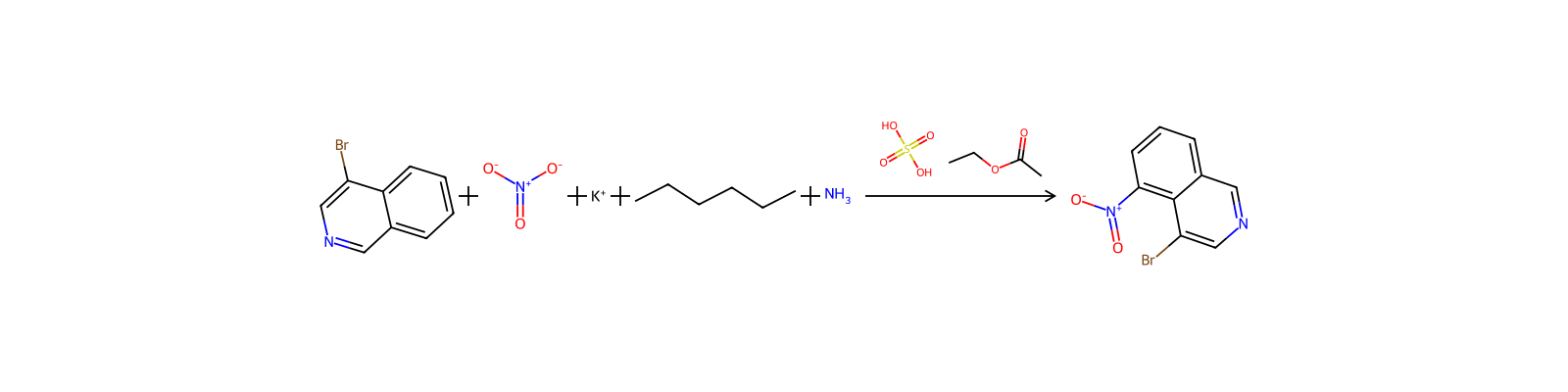
Related reactions
87 records


Compound notes
Loading…