
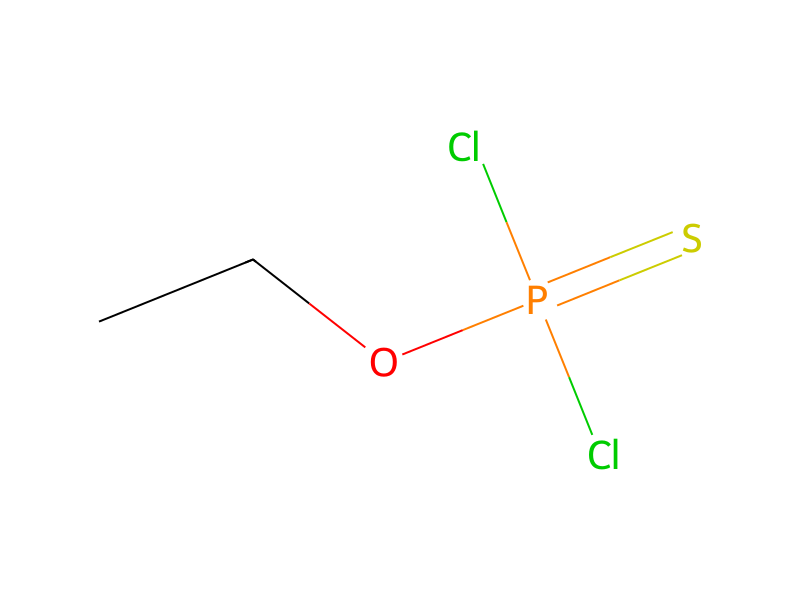
Basic information
- Standard SMILES
CCOP(=S)(Cl)Cl- InChIKey
SMODMOZAUKBGGM-UHFFFAOYSA-N- Molecular formula
- C2H5Cl2OPS
- Average molar mass
- 179 g/mol
- Monoisotopic mass
- 177.9175783
Names & identifiers
- Preferred name
- Phosphorodichloridothioic acid, O-ethyl ester
- IUPAC
- dichloro-ethoxy-sulfanylidene-lambda5-phosphane
- English name
- Ethyl dichlorothiophosphate
- Molecular formula
- C2H5Cl2OPS
- Molecular weight
- 179.01
Names & synonyms
Ethyl dichlorothiophosphate1498-64-2O-Ethyl dichlorothiophosphateO-Ethyl phosphorodichloridothioateEthyl phosphorodichloridothionateEthylphosphorothioic dichlorideEthyl thiophosphorodichloridateEthyl phosphonodichloridothionateO-Ethylthiophosphoryl dichlorideO-Ethyl phosphorothiodichloridatePhosphorodichloridothioic acid, O-ethyl esterPhosphine sulfide, dichloroethoxy-
Show more names
tl429O-EthyldichlorothiophosphatEthoxythiophosphorylchloridedichloroethoxy-phosphinesulfidethylphosphorothioicdichlorideEthoxydichlorophosphine sulfide
EthyldichlorthiofosfatMonoethyldichlorothiophosphateEthyldichlorthiofosfat [Czech]EINECS 216-100-4NSC 91481TL 429BRN 1702237O-Ethylester kyseliny dichlorthiofosforecne [Czech]
Database identifiers
- CAS
1498-64-2- PubChem CID
- 73907
- DTXSID
DTXSID6061733- UNII
- H7Z6CJ9J7N
- EC Number
- 216-100-4
- Nikkaji
- J206.703J
Properties
Computed structural properties
- XLogP
- 3.1
- Topological polar surface area
- 41.3 Ų
- Hydrogen bond donors
- 0
- Hydrogen bond acceptors
- 2
- Rotatable bonds
- 2
- Heavy atoms
- 7
- Formal charge
- 0
- Complexity
- 89
Physicochemical properties
- Boiling point
- 55 · 55-68 °C10 mm Hg(lit.)
- Density
- 1.353 g/mL · 1.353 g/mL at 25 °C(lit.)
- vapor pressure
- 10 mm · 10 mm Hg ( 55 °C)
- refractive index
- 20 · n20/D 1.504(lit.)
- Flash point
- 230 °F · >230 °F
- solubility
- Chloroform (Soluble), Methanol (Sparingly)
- form
- Oil
- color
- Colourless
- Stability
- Moisture Sensitive
- EWG's Food Scores
- 1 · 1
- EPA Substance Registry System
- O-Ethyl dichlorothiophosphate (1498-64-2)
- Symbol(GHS)
- 5 · GHS05,GHS06
- Signal word
- Danger
- Hazard statements
- 302 · H302-H311+H331-H314
- Precautionary statements
- 261 · P261-P280-P301+P312-P303+P361+P353-P304+P340+P310-P305+P351+P338
- Hazard Codes
- T
- Risk Statements
- 23 · 23/24/25-34-23/24-22
- Safety Statements
- 22 · 22-26-36/37/39-45
- RIDADR
- 3390 · UN 3390 6.1/PG 1
- WGK Germany
- 3 · 3
- RTECS
- 4400000 · TD4400000
- TSCA
- TSCA listed
- HazardClass
- 6.1 · 6.1(a)
- PackingGroup
- II
Safety & regulation
GHS classification
GHS Classification
Danger
H302 (100%): Harmful if swallowed [Warning Acute toxicity, oral];H311 (100%): Toxic in contact with skin [Danger Acute toxicity, dermal];H314 (100%): Causes severe skin burns and eye damage [Danger Skin corrosion/irritation];H331 (100%): Toxic if inhaled [Danger Acute toxicity, inhalation]
P260, P261, P262, P264, P270, P271, P280, P301+P317, P301+P330+P331, P302+P352, P302+P361+P354, P304+P340, P305+P354+P338, P316, P321, P330, P361+P364, P363, P403+P233, P405, and P501 (click each P-code to see the statement)
Aggregated GHS information provided per 39 reports by companies from 1 notifications to the ECHA C&L Inventory. Each notification may be associated with multiple companies.;Information may vary between notifications depending on impurities, additives, and other factors. The percentage value in parenthesis indicates the notified classification ratio from companies that provide hazard codes. Only hazard codes with percentage values above 10% are shown. For more detailed information, please visit ECHA C&L website.
Hazard information
Hazard Classes and CategoriesAcute Tox. 4 (100%);Acute Tox. 3 (100%);Skin Corr. 1B (100%);Acute Tox. 3 (100%)
Safety data
- wgk
- 3
- tsca
- TSCA listed
- rtecs
- TD4400000
- ridadr
- UN 3390 6.1/PG 1
- risk_code
- 23/24/25-34-23/24-22
- Signal word
- Danger
- Symbol(GHS)
- GHS05,GHS06
- hazard_code
- T
- safety_code
- 22-26-36/37/39-45
- hazard_class
- 6.1(a)
- packing_group
- II
- Hazard statements
- H302-H311+H331-H314
- Precautionary statements
- P261-P280-P301+P312-P303+P361+P353-P304+P340+P310-P305+P351+P338
Chemistry & industry
Uses & manufacturing
General Manufacturing InformationPhosphorodichloridothioic acid, O-ethyl ester: INACTIVE
Applications
UsesEthyl Dichlorothiophosphate is used in the preparation of polyclonal antibody for insecticide chlorpyrifos. It is also used in the mutagenicity study of new organophosphorus pesticides.
Upstream & downstream products
Upstream raw materials
Suppliers17 total
郑州阿尔法化工有限公司+86-18530059196 · [email protected]
Career Henan Chemica Co+86-0371-86658258 +86-13203830695 · [email protected]
Aladdin Scientific[email protected]
湖北成海化工有限公司027-59220433 18327245847 · [email protected]
上海耐士化工科技有限公司400-188-0725 +86 21 34310725 13611771617
深圳振强药物研发有限公司0755-66853366 13670046396 · [email protected]
HANGZHOU LEAP CHEM CO., LTD.+86-571-87711850 +86-15355479329 · [email protected]
上海超岚化工科技中心(原宁波市超明生物科技有限公司)13301662590 · [email protected]
上海阿拉丁生化科技股份有限公司6206333 13167063860 · [email protected]
深圳市大物科技有限责任公司0752-5555973 13923768523 · [email protected]
陕西缔都医药化工有限公司029-029-81120477 17792793610 · [email protected]
湖北万业众诚化学试剂有限责任公司18671296875 · [email protected]
天津康利欣科技有限公司18622939839
上海源叶生物科技有限公司13636370518 · [email protected]
天津希恩思生化科技有限公司400-6387771-6039 18920764717 · [email protected]
爆牛贸易重庆有限公司+86-023-6139-8061 +86-86-13650506873 · [email protected]
Hefei TNJ Chemical Industry Co.,Ltd.+86-0551-65418671 +86-189 4982 3763 · [email protected]
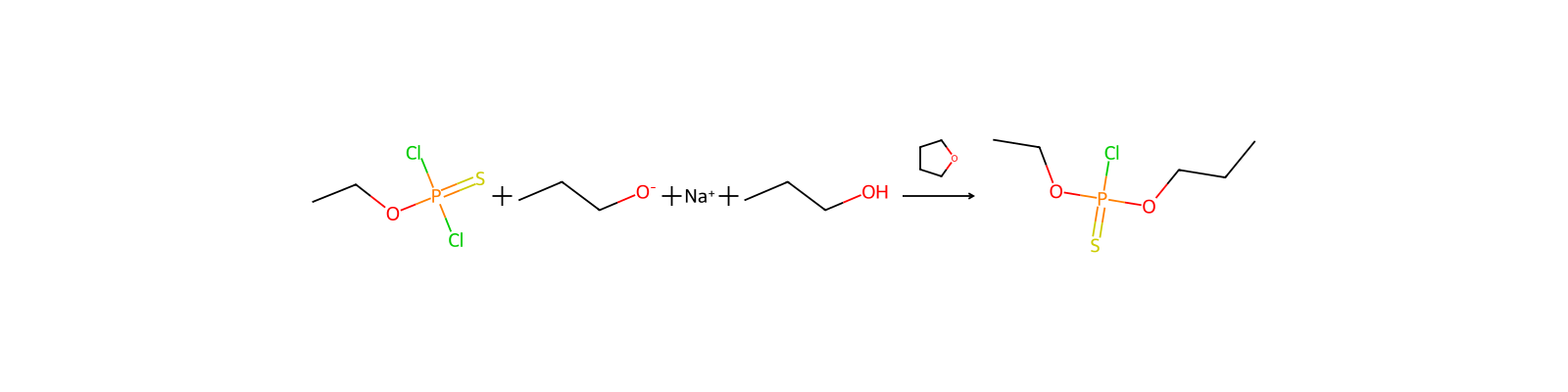
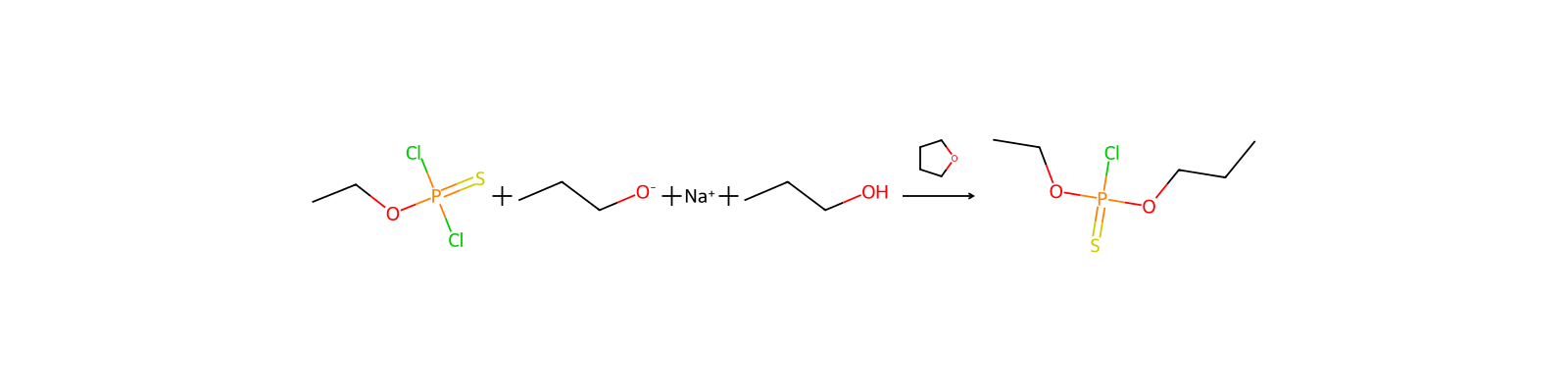
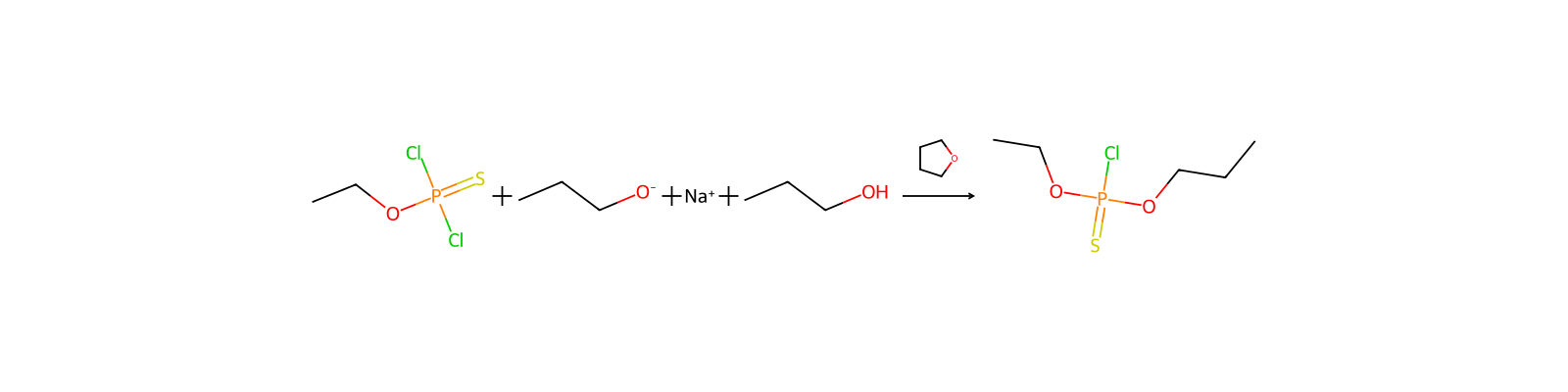
Related reactions
7 records


Linked notes
Loading…