HomeMCPWorkbenchSkills
HomeWorkbenchNotificationsMe
llms.txt · MCP GuidePrivacy Policy · Terms of Service · Supportv1.8.0
  1. Home
  2. /Compound

Sodium oxide

HCID 73971
New noteNew reactionRequest quotes
Print preview
Basic informationNames & identifiersPropertiesSafety & regulationChemistry & industryRelated reactionsCompound notes
Substructure searchFind similar structures

Basic information

CAS
1313-59-3
Standard SMILES
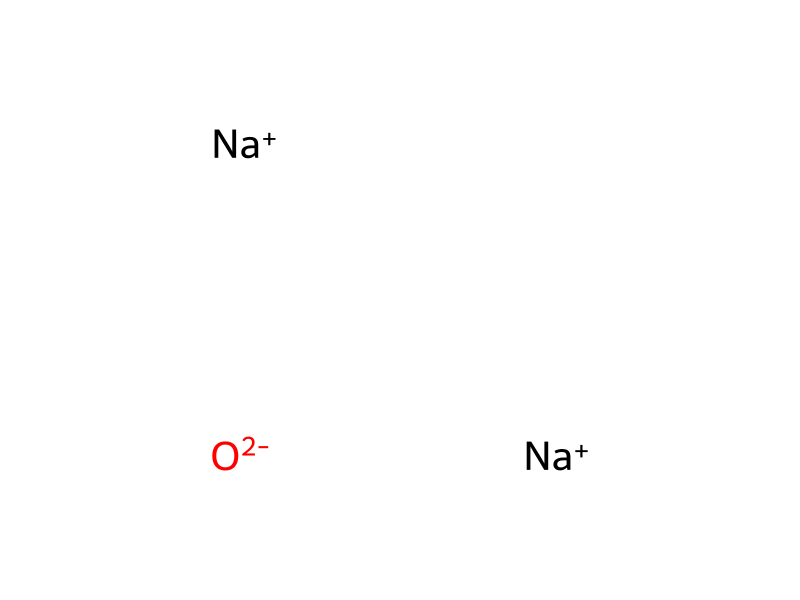
[Na+].[Na+].[O-2]
InChIKey
KKCBUQHMOMHUOY-UHFFFAOYSA-N
Molecular formula
Na2O
Average molar mass
61.979 g/mol
Monoisotopic mass
61.97445318

Names & identifiers

Preferred name
Sodium oxide
IUPAC
disodium;oxygen(2-)
English name
Sodium oxide
Molecular formula
Na2O
Molecular weight
61.98

Names & synonyms

Sodium oxide1313-59-3Disodium monoxideNa2OSodium oxide (Na2O)Natrum Oxydatum3075U8R23DDTXSID0049781RefChem:6243DTXCID00820245215-208-9235-641-7
Show more names
SODIUM MONOXIDENatriumoxidOxybissodiumSodiuM oxide 80%Sodium oxide 80%sodiumoxide(na2o)disodium oxygen(2-)
Disodium oxidedisodium;oxygen(2-)MFCD00046201UNII-3075U8R23DEINECS 215-208-9Sodium oxide, 80%SODIUM OXIDE [MI]SCHEMBL29233

Database identifiers

CAS
1313-59-3
PubChem CID
73971
DTXSID
DTXSID0049781
UNII
3075U8R23D
EC Number
215-208-9

Properties

Computed structural properties

Topological polar surface area
1 Ų
Hydrogen bond donors
0
Hydrogen bond acceptors
1
Rotatable bonds
0
Heavy atoms
3
Formal charge
0
Complexity
0

Experimental & physicochemical properties

SpringerMaterials Propertiesdielectric constant
Density · 2 items

2.3 g/cm³

2.27 @25 °C

SolubilitySolubility in water: reaction
Animal DrugsPharmaceuticals -> UK Veterinary Medicines Directorate List
Decomposition>400 °C. This produces sodium peroxide and sodium. Attacks many metals in the presence of water.
Melting Point1275 °C (sublimes)
Physical Description · 2 items

CBI; Large Crystals; Other Solid; Dry Powder; Dry Powder; Other Solid; Liquid; Dry Powder; Large Crystals

WHITE LUMPS OR POWDER.

Physicochemical properties

Melting point
400 °C · >400°C
Boiling point
1274 ℃ · sublimes at 1274℃ [HAW93]

Safety & regulation

Safety information is for reference only and does not replace the supplier’s Safety Data Sheet (SDS), applicable regulations, or professional assessment.

GHS classification

GHS Classification · 5 items

This chemical does not meet GHS hazard criteria for 11.4% (81 of 711) of reports.

Danger

H314 (86.9%): Causes severe skin burns and eye damage [Danger Skin corrosion/irritation]

P260, P264, P264+P265, P280, P301+P330+P331, P302+P361+P354, P304+P340, P305+P354+P338, P316, P317, P321, P363, P405, and P501 (click each P-code to see the statement)

Aggregated GHS information provided per 711 reports by companies from 17 notifications to the ECHA C&L Inventory. Each notification may be associated with multiple companies.

Hazard information

Regulatory Information · 4 items

Chemical: Sodium oxide (Na2O)

Sodium oxide (Na2O) is listed on the EPA's Chemical Data Reporting (CDR) system. Manufacturers and importers of Sodium oxide (Na2O) are required to report information about their production and use of this chemical to the EPA under the Toxic Substances Control Act (TSCA). (40 eCFR Part 711)

REACH registered substance: Disodium oxide (EC: 215-208-9)

Sodium oxide (Na2O): Does not have an individual approval but may be used as a component in a product covered by a group standard. It is not approved for use as a chemical in its own right.

Fire HazardsNot combustible but enhances combustion of other substances.
UN ClassificationUN Hazard Class: 8; UN Pack Group: II
Chemical Dangers · 1 item

The solution in water is a strong base. It reacts violently with acid and is corrosive. Reacts violently with water. This produces sodium hydroxide. Decomposes at >400 °C. This produces sodium peroxide and sodium. Attacks many metals in the presence of water.

Packaging and Labelling

Chemistry & industry

Pharmacology

FDA Pharmacological Classification · 2 items

NATRUM OXYDATUM

Increased Large Intestinal Motility [PE]; Osmotic Activity [MoA]; Osmotic Laxative [EPC]; Inhibition Large Intestine Fluid/Electrolyte Absorption [PE]

Uses & manufacturing

U.S. Production2023: 25,000,000 - <40,000,000 lb
Consumer UsesFiller
Industry UsesOther
Household ProductsInformation on 1 consumer products that contain Sodium oxide in the following categories is provided:
General Manufacturing Information · 2 items

Industrial Gas Manufacturing

Sodium oxide (Na2O): ACTIVE

Applications · 4 items

UsesAs a dehydrating agent; in certain chemical reactions as a polymerizing or condensing agent.

UsesSodium oxide is used in chemical manufacturing, ceramics and glasses. Ethylbenzene dehydrogenation and carbon dioxide shift-reaction occurs using a sodium oxide/alumina catalyst. It is employed as catalyzing gasification of CO2 on carbon.

UsesSodium oxide has been used as a coating precursor on organic polymer films during the plasma modification to analyze its antimicrobial properties.

General DescriptionSodium oxide is a strong alkaline oxide, commonly used as an active flux in ceramic glazes.

Upstream & downstream products

Related reactions

4 records
New reaction record
HRID 614193 reaction equation
HRID 614193As reactantuspto-grants-1979_03
HRID 1632930 reaction equation
HRID 1632930As reactantuspto-grants-1984_10
HRID 1632932 reaction equation
HRID 1632932As reactantuspto-grants-1984_10
HRID 2309070 reaction equation
HRID 2309070As reactantuspto-grants-1987_09

Compound notes

Loading…

On this pageBasic informationNames & identifiersPropertiesSafety & regulationChemistry & industryRelated reactionsCompound notes
More actions
New noteNew reactionRequest quotes
Density
2.27 g/mL · 2.27 g/mL at 25 °C (lit.)
vapor pressure
0 Pa · 0Pa at 20℃
solubility
2 O · reacts with H2O
form
Beads
color
White to gray
Specific Gravity
2.27 · 2.27
Water Solubility
Soluble in water.
Specific Heat Capacity
1.11 J/ · Cp(crystal): 1.11 J/(g·K), at 25℃
Sensitive
Air & Moisture Sensitive
Crystal Structure
2 type · Reverse CaF2 type
crystal system
Cube
Merck
14 · 14,8651
Space group
3 m · Fm3m
Lattice constant
a/nm
Symbol(GHS)
5 · GHS05
Signal word
Danger
Hazard statements
314 · H314
Precautionary statements
260 · P260-P264-P280-P301+P330+P331-P303+P361+P353-P363-P304+P340-P310-P305+P351+P338-P405-P501
PPE
3 · Eyeshields, Faceshields, Gloves, type P3 (EN 143) respirator cartridges
Hazard Codes
O,C
Risk Statements
8 · 8-14-35-34
Safety Statements
8 · 8-27-39-43-45-36/37/39-26
RIDADR
1825 · UN 1825
WGK Germany
1 · 1
TSCA
TSCA listed
HazardClass
8 · 8
PackingGroup
II
Storage Class
5.1 A · 5.1A - Strongly oxidizing hazardous materials
Hazard Classifications
1 Ox · Eye Dam. 1Ox. Sol. 1Skin Corr. 1A
REACH Registrations
Active
Do not transport with food and feedstuffs.
Hazard Classes and CategoriesSkin Corr. 1B (86.9%)

Safety & protection

Fire FightingNO water. Use dry powder, dry sand.
First Aid Measures · 4 items

Fresh air, rest. Half-upright position. Artificial respiration may be needed. Refer immediately for medical attention.

Remove contaminated clothes. Rinse skin with plenty of water or shower. Refer immediately for medical attention.

Rinse with plenty of water for several minutes (remove contact lenses if easily possible). Refer immediately for medical attention.

Rinse mouth. Do NOT induce vomiting. Refer immediately for medical attention.

Safe StorageSeparated from strong acids and food and feedstuffs. Dry.
Spillage DisposalPersonal protection: chemical protection suit including self-contained breathing apparatus. Sweep spilled substance into covered dry, plastic containers. Wash away remainder with plenty of water.
Eye PreventionWear face shield or eye protection in combination with breathing protection if powder.
Inhalation RiskA harmful concentration of airborne particles can be reached quickly when dispersed, especially if powdered.
Skin PreventionProtective gloves. Protective clothing.
Exposure PreventionAVOID ALL CONTACT! PREVENT DISPERSION OF DUST! IN ALL CASES CONSULT A DOCTOR!
Ingestion PreventionDo not eat, drink, or smoke during work.
Inhalation PreventionUse local exhaust. Use breathing protection.
Effects of Short Term ExposureThe substance is corrosive to the eyes, skin and respiratory tract. Corrosive on ingestion. Inhalation of the aerosol may cause lung oedema. Medical observation is indicated.
Protective Action Criteria (PAC) · 3 items

0.50 [mg/m3]

5.0 [mg/m3]

50 [mg/m3]

Toxicology

Exposure RoutesSerious by all routes of exposure.
Signs and Symptoms · 4 items

Sore throat. Cough. Burning sensation. Laboured breathing. Shortness of breath.

Redness. Pain. Serious skin burns.

Redness. Pain. Burns.

Sore throat. Burning sensation in the throat and chest. Shock or collapse.

Safety data

PPE
Eyeshields, Faceshields, Gloves, type P3 (EN 143) respirator cartridges
wgk
1
tsca
TSCA listed
ridadr
UN 1825
risk_code
8-14-35-34
Signal word
Danger
Symbol(GHS)
GHS05
hazard_code
O,C
safety_code
8-27-39-43-45-36/37/39-26
hazard_class
8
Storage Class
5.1A - Strongly oxidizing hazardous materials
packing_group
II
Hazard statements
H314
REACH Registrations
Active
Hazard Classifications
Eye Dam. 1Ox. Sol. 1Skin Corr. 1A
Precautionary statements
P260-P264-P280-P301+P330+P331-P303+P361+P353-P363-P304+P340-P310-P305+P351+P338-P405-P501

Downstream products

1,4,5,8-Naphthalenetetracarboxylic acidEthyl benzoylacetate2-ThiophenecarboxaldehydeMethylthiouracilSodium percarbonateBromelainBenzamide, 4-methoxy-N-[2-[2-(1-methyl-2-piperidinyl)ethyl]phenyl]-Sodium formate1-Hexadecylamine
Additional notes · 2 items

DefinitionA white solid formed by burning sodium in a deficiency of oxygen or alternatively by reducing sodium peroxide or sodium hydroxide with the requisite amount of sodium. It reacts violently with water to form sodium hydroxide and with acids to form solutions of their salts. Sodium monoxide forms cubic crystals. It dissolves in liquid ammonia to give a mixture of sodamide and sodium hydroxide.

Definitionsodium monoxide: A whitish-greydeliquescent solid, Na2O; r.d. 2.27;sublimes at 1275°C. It is manufacturedby oxidation of the metal in alimited supply of oxygen and purifiedby sublimation. Reaction with waterproduces sodium hydroxide. Its commercialapplications are similar tothose of sodium hydroxide.