HomeMCPWorkbenchSkills
HomeWorkbenchNotificationsMe
llms.txt · MCP GuidePrivacy Policy · Terms of Service · Supportv1.8.3
  1. Home
  2. /Compound

5-Chlorovaleryl chloride

HCID 74089
New reaction
Print
Basic informationOverviewNames & identifiersPropertiesSafety & regulationChemistry & industryRelated reactionsCompound notes
Substructure searchFind similar structures

Basic information

CAS
1575-61-7
Standard SMILES
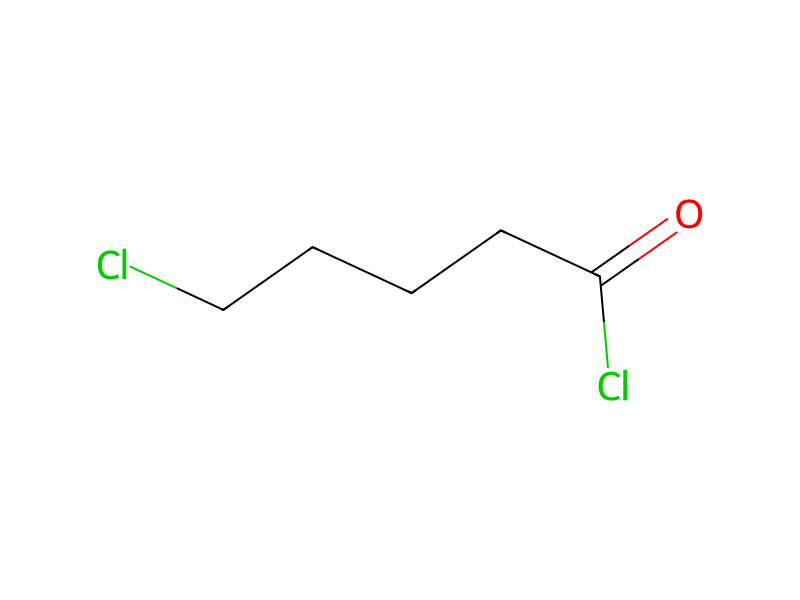
O=C(Cl)CCCCCl
InChIKey
SVNNWKWHLOJLOK-UHFFFAOYSA-N
Molecular formula
C5H8Cl2O
Average molar mass
155.02 g/mol
Monoisotopic mass
153.9952203

Overview

an alkylating agent; structure in first source

Names & identifiers

Preferred name
5-Chlorovaleryl chloride
IUPAC
5-chloropentanoyl chloride
English name
5-Chlorovaleryl chloride
Molecular formula
C5H8Cl2O
Molecular weight
155.02

Names & synonyms

5-Chlorovaleryl chloride1575-61-7Valeryl chloride, 5-chloro-5-CVC cpdDTXSID60166272RefChem:102413DTXCID4088763216-403-15-Chloropentanoyl chloride5-Chlorovaleroyl chloridePentanoyl chloride, 5-chloro-5-Chlorovalerylchloride
Show more names
5-ChlorvalerylchloridorovaL5-Chlorovaleryl5-Cl-valeryl ClApixaban Impurity 565-chloro aMyl chloride5 - chlorine e chloride5-chloro-valerylchlorid
5-chlorovaleric acid chlorideMFCD00000758chlorovaleryl chlorideWLN: GV4Gdelta-chlorovaleryl chloride5-chloro-pentanoyl chloride4-02-00-00881 (Beilstein Handbook Reference)NSC-84182

Database identifiers

CAS
1575-61-7
PubChem CID
74089
DTXSID
DTXSID60166272
UNII
MA49NLR6V9
EC Number
216-403-1
Nikkaji
J40.784D

Properties

Computed structural properties

XLogP
2
Topological polar surface area
17.1 Ų
Hydrogen bond donors
0
Hydrogen bond acceptors
1
Rotatable bonds
4
Heavy atoms
8
Formal charge
0
Complexity
72.8

Experimental & physicochemical properties

SpringerMaterials PropertiesOptical coefficient

Physicochemical properties

Boiling point
38 · 38-39 °C0.15 mm Hg(lit.)
Density
1.206 g/mL · 1.206 g/mL at 20 °C
refractive index
20 · n20/D 1.464(lit.)
Flash point
195 °F · 195 °F
storage temp.
30 °C · Store below +30°C.
solubility
Acetonitrile (Slightly), Chloroform (Sparingly)
form
Liquid
color
Clear colorless to slightly yellow
Specific Gravity
1.2 · 1.200
PH
7 · <7 (H2O, 20℃)
explosive limit
2 · 2.0-10.2%(V)
Water Solubility
reacts

Safety & regulation

Safety information is for reference only and does not replace the supplier’s Safety Data Sheet (SDS), applicable regulations, or professional assessment.

GHS classification

GHS Classification · 4 items

Danger

H290 (72.9%): May be corrosive to metals [Warning Corrosive to Metals]

P234, P260, P261, P264, P264+P265, P270, P271, P280, P301+P317, P301+P330+P331, P302+P361+P354, P304+P340, P305+P354+P338, P316, P317, P321, P330, P363, P390, P403+P233, P405, P406, and P501 (click each P-code to see the statement)

Aggregated GHS information provided per 155 reports by companies from 6 notifications to the ECHA C&L Inventory. Each notification may be associated with multiple companies.

Hazard information

Regulatory InformationREACH registered substance: 5-chlorovaleryl chloride (EC: 216-403-1)
Hazard Classes and CategoriesMet. Corr. 1 (72.9%)

Safety data

F
10-19-21
PPE
Faceshields, Gloves, Goggles, type ABEK (EN14387) respirator filter
wgk
1
rtecs
YV9108000
ridadr
UN 3265 8/PG 2
hs_code
2915900090
risk_code
22-34-23-23/34
Signal word
Danger
Symbol(GHS)
GHS05,GHS07
hazard_code
C,T
safety_code
26-36/37/39-45
hazard_class
8
Storage Class

Chemistry & industry

Applications · 3 items

Description5-Chlorovaleryl chloride is an important synthetic intermediate of pyrazole herbicides. 5-Chloropentanoyl chloride is used as the raw material of 1,1,7-trichloro-1-hepten-3-one, and then the third-generation pyrazole herbicides can be synthesized. Pyrazole herbicides have the characteristics of ultra-efficient herbicidal activity, high selectivity, extremely low mammalian toxicity and good environmental characteristics, and have become a hot spot in the research and development of herbicides in the world in recent years.

Uses5-Chlorovaleroyl chloride (5-CVC) has been used in the development and validation of a GC-FID method for the analysis of low level impurities present in 5-CVC. It has been used in the synthesis of anion-exchange resins by acylation of polystyrene/divinylbenzene and subsequent amination with trimethylamine. It is commonly used as alkylating agent in the synthesis of pharmaceutical intermediates and other specialty chemicals.

General Description5-Chlorovaleroyl chloride is commonly used as alkylating agent in the synthesis of pharmaceutical intermediates and other specialty chemicals.

Upstream & downstream products

Upstream raw materials

2-Imidazolidinone,1,3,4-trimethyl-Mepiquat chloride5-Chlorovaleric aciddelta-Valerolactone5-Chlorovaleronitrilesodium:cyanide3-PicolineAdipoyl chloride1,4-Dichlorobutane

Related reactions

230 records
New reaction record
HRID 10183 reaction equation
HRID 10183As reactant
HRID 41090 reaction equation
HRID 41090As reactant
HRID 52102 reaction equation
HRID 52102As reactant
HRID 68478 reaction equation
HRID 68478As reactant
HRID 92893 reaction equation
HRID 92893As reactant
HRID 99238 reaction equation
HRID 99238As reactant
HRID 117096 reaction equation
HRID 117096As reactant
HRID 122688 reaction equation
HRID 122688As reactant
PreviousPage 1 of 29

Compound notes

On this pageBasic informationOverviewNames & identifiersPropertiesSafety & regulationChemistry & industryRelated reactionsCompound notes
Sensitive
Moisture Sensitive
BRN
1745182 · 1745182
Stability
Corrosive, Moisture Sensitive
InChI
1S/C5H8Cl2O/c6-4-2-1-3-5(7)8/h1-4H2
InChIKey
SVNNWKWHLOJLOK-UHFFFAOYSA-N
SMILES
ClCCCCC(Cl)=O
CAS DataBase Reference
1575 · 1575-61-7(CAS DataBase Reference)
Comptox DTXSID
60166272 · DTXSID60166272
UNSPSC Code
12352100 · 12352100
NACRES
22 · NA.22
Symbol(GHS)
5 · GHS05,GHS07
Signal word
Danger
Hazard statements
302 · H302-H314
Precautionary statements
270 · P270-P280-P301+P312-P303+P361+P353-P304+P340+P310-P305+P351+P338
PPE
Faceshields, Gloves, Goggles, type ABEK (EN14387) respirator filter
Hazard Codes
C,T
Risk Statements
22 · 22-34-23-23/34
Safety Statements
26 · 26-36/37/39-45
RIDADR
3265 · UN 3265 8/PG 2
WGK Germany
1 · 1
RTECS
9108000 · YV9108000
F
10 · 10-19-21
HazardClass
8 · 8
PackingGroup
III
HS Code
2915900090 · 2915900090
Storage Class
8 A · 8A - Combustible corrosive hazardous materials
Hazard Classifications
4 OralSkin · Acute Tox. 4 OralSkin Corr. 1B
REACH Registrations
Active
Limited Quantities
1 L · 1.0 L (0.3 gallons) (liquid) or 1 Kg (2.2 lbs) (solid)
Excepted Quantities
Max Inner Pack (30g or 30ml) and Max Outer Pack (500g or 500ml)
8A - Combustible corrosive hazardous materials
packing_group
III
Hazard statements
H302-H314
Limited Quantities
1.0 L (0.3 gallons) (liquid) or 1 Kg (2.2 lbs) (solid)
Excepted Quantities
Max Inner Pack (30g or 30ml) and Max Outer Pack (500g or 500ml)
REACH Registrations
Active
Hazard Classifications
Acute Tox. 4 OralSkin Corr. 1B
Precautionary statements
P270-P280-P301+P312-P303+P361+P353-P304+P340+P310-P305+P351+P338
Phosgene

Downstream products

N-(3-bromophenyl)-5-chloropentanamide1-Chloro-5-(3,4-dimethoxyphenyl)-5-oxopentane5-Chloro-1-(3-methylphenyl)-1-oxopentaneCilostazol