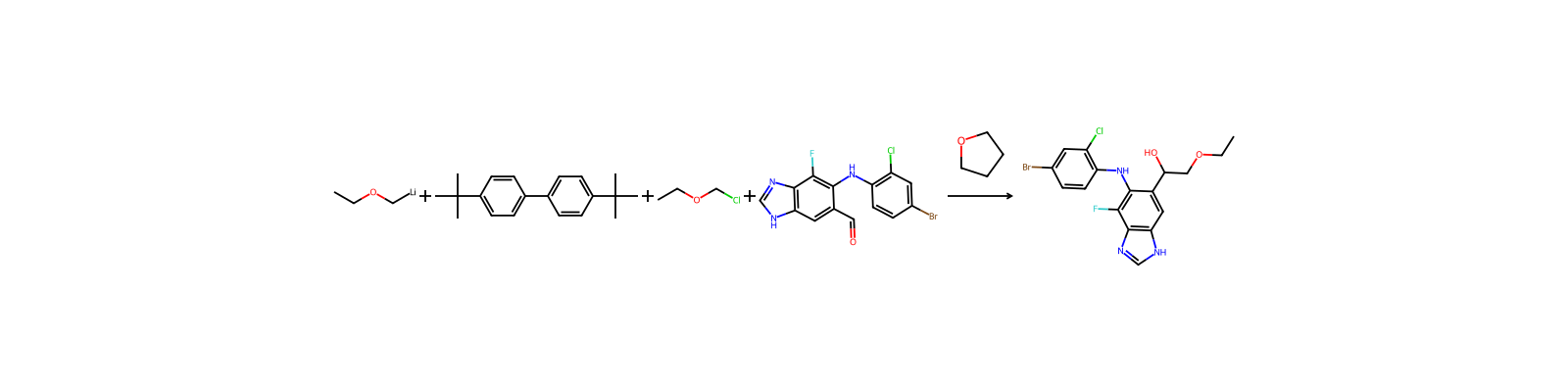
HRID 32015As reactant

1625-91-8CC(C)(C)c1ccc(-c2ccc(C(C)(C)C)cc2)cc1CDKCEZNPAYWORX-UHFFFAOYSA-Nused in ammonia-free reductions
1625-91-8DTXSID4048193Safety information is for reference only and does not replace the supplier’s Safety Data Sheet (SDS), applicable regulations, or professional assessment.
Warning
H315 (100%): Causes skin irritation [Warning Skin corrosion/irritation]
P261, P264, P264+P265, P271, P280, P302+P352, P304+P340, P305+P351+P338, P319, P321, P332+P317, P337+P317, P362+P364, P403+P233, P405, and P501 (click each P-code to see the statement)
The GHS information provided by 1 company from 1 notification to the ECHA C&L Inventory.
UsesIt is used in the generation of 1,2-di(lithiomethyl)benzene. It is found to accept electrons from Li metal to give a radical anion which is highly effective in the conversion of alkyl halides to alkyllithiums. 4,4-Di-tert-butylbiphenyl is used in production of homoallylic amine derivatives. It is also used in the preparation of lithium di-tert-butylbiphenylide, a radical anion, superior to sodium or lithium naphthalenides for metalation reactions. Along with lithium, 4,4-Di-tert-butylbiphenyl catalyzes; reaction of chloromethyl ethyl ether and different carbonyl compounds to yield corresponding hydroxyethers and reductive opening of N-phenylazetidine.
General Description4,4′-Di-tert-butylbiphenyl along with lithium catalyzes:reaction of chloromethyl ethyl ether and different carbonyl compounds to yield corresponding hydroxyethersreductive opening of N-phenylazetidine
CHEMBL3187007


