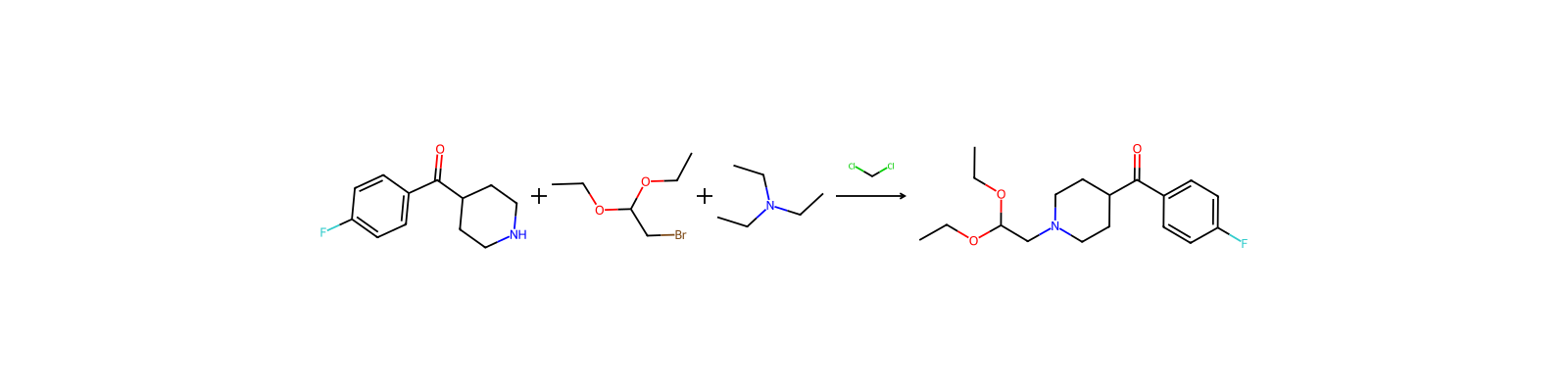

Basic information
- CAS
2032-35-1- Standard SMILES
CCOC(CBr)OCC- InChIKey
LILXDMFJXYAKMK-UHFFFAOYSA-N- Molecular formula
- C6H13BrO2
- Average molar mass
- 197.07 g/mol
- Monoisotopic mass
- 196.00989176
Names & identifiers
- Preferred name
- Ethane, 2-bromo-1,1-diethoxy-
- IUPAC
- 2-bromo-1,1-diethoxyethane
- English name
- Bromoacetaldehyde diethyl acetal
- Molecular formula
- C6H13BrO2
- Molecular weight
- 197.07
Names & synonyms
Bromoacetaldehyde diethyl acetal2032-35-12-Bromo-1,1-diethoxyethaneEthane, 2-bromo-1,1-diethoxy-1-Bromo-2,2-diethoxyethane2,2-Diethoxyethyl bromide1,1-Diethoxy-2-bromoethaneBromacetalDiethyl bromoacetal2-Bromoacetaldehyde diethyl acetalDiethyl bromoacetaldehyde acetalAcetaldehyde, bromo-, diethyl acetal
Show more names
BROMOACETALBADEA-Bromodiethylacetal
M4DGX2BMU9NSC 8036NSC-8036EINECS 217-989-1.alpha.-Bromoacetaldehyde diethyl acetalAI3-28195DTXSID2062111RefChem:591656
Database identifiers
- CAS
2032-35-1- PubChem CID
- 74852
- DTXSID
DTXSID2062111- ChEMBL
CHEMBL2251333- UNII
- M4DGX2BMU9
- EC Number
- 217-989-1
- Nikkaji
- J24.192J
Properties
Computed structural properties
- XLogP
- 1.6
- Topological polar surface area
- 18.5 Ų
- Hydrogen bond donors
- 0
- Hydrogen bond acceptors
- 2
- Rotatable bonds
- 5
- Heavy atoms
- 9
- Formal charge
- 0
- Complexity
- 53
Experimental & physicochemical properties
SpringerMaterials PropertiesOptical coefficient
Density1.31 @25 °C
Physicochemical properties
- Boiling point
- 66 · 66-67 °C18 mm Hg(lit.)
- Density
- 1.31 g/mL · 1.31 g/mL at 25 °C(lit.)
- refractive index
- 20 · n20/D 1.439(lit.)
- Flash point
- 125 °F · 125 °F
- storage temp.
- 2 · 2-8°C
- solubility
- Chloroform (Slightly), Methanol (Slightly)
- form
- Oil
- color
- Clear Colourless
- Specific Gravity
- 1.31 · 1.310
- Water Solubility
- immiscible
- Sensitive
- Moisture Sensitive
- BRN
- 635754 · 635754
- InChI
- 1S/C6H13BrO2/c1-3-8-6(5-7)9-4-2/h6H,3-5H2,1-2H3
- InChIKey
- LILXDMFJXYAKMK-UHFFFAOYSA-N
- SMILES
- CCOC(CBr)OCC
- CAS DataBase Reference
- 2032 · 2032-35-1(CAS DataBase Reference)
- FDA UNII
- 4 DGX2BMU9 · M4DGX2BMU9
- NIST Chemistry Reference
- 2 · Ethane, 2-bromo-1,1-diethoxy-(2032-35-1)
- EPA Substance Registry System
- 2 · Ethane, 2-bromo-1,1-diethoxy- (2032-35-1)
- UNSPSC Code
- 12352100 · 12352100
- NACRES
- 22 · NA.22
- Symbol(GHS)
- 6 · GHS06
- Signal word
- Danger
- Hazard statements
- 301 · H301-H315-H319-H330
- Precautionary statements
- 301 · P301+P310+P330-P302+P352-P304+P340+P310-P305+P351+P338
- PPE
- Eyeshields, Faceshields, Gloves, type ABEK (EN14387) respirator filter
- Hazard Codes
- Xi,T
- Risk Statements
- 10 · 10-36-36/38-23-22
- Safety Statements
- 16 · 16-26-45-38-37/39-28A-36/37
- RIDADR
- 1993 · UN 1993 3/PG 3
- WGK Germany
- 3 · 3
- F
- 8 · 8-9-21
- Hazard Note
- Toxic/Irritant
- TSCA
- TSCA listed
- HazardClass
- 6.1 · 6.1
- PackingGroup
- III
- HS Code
- 29110000 · 29110000
- Storage Class
- 6.1 A · 6.1A - Combustible acute toxic Cat. 1 and 2very toxic hazardous materials
- Hazard Classifications
- 2 InhalationAcute · Acute Tox. 2 InhalationAcute Tox. 3 OralEye Irrit. 2Skin Irrit. 2
- REACH Registrations
- Active
- Limited Quantities
- 5 L · 5.0 L (1.3 gallons) (liquid) or 5.0 kg (11 lbs) (solid)
- Excepted Quantities
- Max Inner Pack (30g or 30ml) and Max Outer Pack (1Kg or 1L)
Safety & regulation
GHS classification
GHS Classification
Danger
H226 (13.2%): Flammable liquid and vapor [Warning Flammable liquids]
P210, P233, P240, P241, P242, P243, P260, P261, P264, P264+P265, P270, P271, P280, P284, P301+P316, P302+P352, P303+P361+P353, P304+P340, P305+P351+P338, P316, P319, P320, P321, P330, P332+P317, P337+P317, P362+P364, P370+P378, P403+P233, P403+P235, P405, and P501 (click each P-code to see the statement)
Aggregated GHS information provided per 106 reports by companies from 12 notifications to the ECHA C&L Inventory. Each notification may be associated with multiple companies.
Hazard information
Regulatory Information
Chemical: Ethane, 2-bromo-1,1-diethoxy-
Status: Active Update: 08-05-2017 https://echa.europa.eu/registration-dossier/-/registered-dossier/19580
Bromoacetaldehyde diethyl acetal: Does not have an individual approval but may be used under an appropriate group standard
Hazard Classes and CategoriesFlam. Liq. 3 (13.2%)
Safety & protection
Protective Action Criteria (PAC)
12 [mg/m3]
130 [mg/m3]
790 [mg/m3]
Safety data
- F
- 8-9-21
- PPE
- Eyeshields, Faceshields, Gloves, type ABEK (EN14387) respirator filter
- wgk
- 3
- tsca
- TSCA listed
- ridadr
- UN 1993 3/PG 3
- hs_code
- 29110000
- risk_code
- 10-36-36/38-23-22
- Signal word
- Danger
- Symbol(GHS)
- GHS06
- hazard_code
- Xi,T
- hazard_note
- Toxic/Irritant
- safety_code
- 16-26-45-38-37/39-28A-36/37
- hazard_class
- 6.1
- Storage Class
- 6.1A - Combustible acute toxic Cat. 1 and 2very toxic hazardous materials
- packing_group
- III
- Hazard statements
- H301-H315-H319-H330
- Limited Quantities
- 5.0 L (1.3 gallons) (liquid) or 5.0 kg (11 lbs) (solid)
- Excepted Quantities
- Max Inner Pack (30g or 30ml) and Max Outer Pack (1Kg or 1L)
- REACH Registrations
- Active
- Hazard Classifications
- Acute Tox. 2 InhalationAcute Tox. 3 OralEye Irrit. 2Skin Irrit. 2
- Precautionary statements
- P301+P310+P330-P302+P352-P304+P340+P310-P305+P351+P338
Chemistry & industry
Uses & manufacturing
General Manufacturing InformationEthane, 2-bromo-1,1-diethoxy-: ACTIVE
Applications
UsesSynthetic building block1,2
UsesBromoacetaldehyde diethyl acetal, is used as a synthetic building block. It is mainly used for synthesis of antibiotics such as erythromycin and cephalosporins and to other drugs. It also can be used as pharmaceutical intermediates. Besides, this chemical can be used to pruduce drugs such as methylthio imidazole, chlorpheniramine and others for thyroid. It also acts as a Useful intermediate for the preparation of other -heterosubstituted acetaldehyde acetals.
General DescriptionMay darken in storage
Preparation methods
PreparationTo a flask containing 118.0 gm (1.0 mole) of diethyl acetal and 55 gm (0.55 mole) of calcium carbonate is dropwise added 55 ml (1.0 mole) of bromine over a 30-45 min period while keeping the reaction temperature at 5°-10°C. The reaction mixture is allowed to stand 24 hr, steam is introduced to dissolve the salts, the oil separated, dried over potassium carbonate, and distilled to afford 61-83 gm (31-42%), b.p. 167°-170°C. The product is further purified by shaking with potassium carbonate and distilling it under reduced pressure, b.p. 48°-49°C (3 mm Hg). The pure acetal is unstable and becomes colored in a few hours and black after several days. However, the crude acetal boiling at 167°-170°C is stable for several months.
Upstream & downstream products
Upstream raw materials
Downstream products
Suppliers100 total
国药集团化学试剂有限公司86-21-63210123 · [email protected]
梯希爱(上海)化成工业发展有限公司021-67121386 · [email protected]
衢州润东化工有限公司0570-8789886 18892685668 · [email protected]
上海阿拉丁生化科技股份有限公司400-6206333 13167063860 · [email protected]
南京精维化工有限公司13270709979 · [email protected]
山东银晟医药科技有限公司18865947357
爱斯特(成都)生物制药股份有限公司+86-28-85122536 85324413 · [email protected]
韶远科技(上海)有限公司021-50795510 4000665055 · [email protected]
科瑞迪化学400-821-5857 021-64326257 · [email protected]
上海迈瑞尔生化科技有限公司4006356688 18621169109 · [email protected]
阿法埃莎(中国)化学有限公司400-6106006 · [email protected]
太原市瑞和丰科贸有限公司+86 351 7031519 · [email protected]
安耐吉化学&3A(安徽泽升科技股份有限公司)400-0056266 · [email protected]
上海瀚鸿科技股份有限公司021-54306202 13764082696 · [email protected]
上海柯维化学技术有限公司021-64609169 18901607656 · [email protected]
上海景颜化工科技有限公司13817811078 · [email protected]
嘉兴市艾森化工有限公司0573-85285100 18627885956 · [email protected]
Pure Chemistry Scientific Inc.001-857-928-2050 or 1-888-588-9418 · [email protected]
杭州明苏科技有限公司571-88199336 18957129209 · [email protected]
孝感深远化工有限公司15527621225; 15527621225 · [email protected]
苏州施亚生物科技有限公司86(512)5235 8471 17715136450 · [email protected]
山东西亚化学有限公司13355009207 13355009207 · [email protected]
玛雅试剂+86 (573) 82222445 (0)18006601000 452520369 · [email protected]
四川库利南科技有限公司400-1166-196 18981987031 · [email protected]
上海耐士化工科技有限公司400-188-0725 +86 21 34310725 13611771617
天津希恩思生化科技有限公司400 638 7771 · [email protected]
南京维奥化工有限公司Please Send Email 18652950785 · [email protected]
河南多贝化工有限公司0370-2785118 17550508557 · [email protected]
北京泰亚杰科技有限公司021-33690831-8001 13552411790;18616022633 · [email protected]
艾科试剂4008-755-333 18080918076 · [email protected]
上海思域化工科技有限公司86-21-34053660 · [email protected]
赛默飞世尔科技(中国)有限公司800-810-5118 · [email protected]
北京伊诺凯科技有限公司400-810-7969 010-59572699 · [email protected]
上海遐瑞医药科技有限公司+86 21 61551611
江苏艾康生物医药研发有限公司025-66113011 13913916777 · [email protected]
上海健超生物科技有限公司150-2103-5486 18017383231 · [email protected]
TCI AMERICA800-4238616 · [email protected]
TOKYO CHEMICAL INDUSTRY CO., LTD.03-36680489 · [email protected]
TCI Europe320-37350700 · [email protected]
上海贤鼎生物科技有限公司4009209199 · [email protected]
深圳振强药物研发有限公司0755-66853366 13670046396 · [email protected]
深圳康特腾科技有限公司86-0755-86635001 · [email protected]
越林试剂021-62960152 · [email protected]
上海睿升化工科技有限公司+86-021-50935922
上海汇凯化学科技有限公司021-61995394 18916691159 · [email protected]
上海洪创医药科技有限公司18151128828 · [email protected]
北京环宇世纪化学科技有限公司hysj_bj.com
湖北鑫源顺医药化工有限公司13971561712, 13995564702, 027-50664929 · [email protected]
上海将来实业股份有限公司400-0066400 13621662912 · [email protected]
上海将来实业股份有限公司021-61552785 · [email protected]
Related reactions
605 records






Compound notes
Loading…