HomeMCPWorkbenchSkills
HomeWorkbenchNotificationsMe
llms.txt · MCP GuidePrivacy Policy · Terms of Service · Supportv1.8.3
  1. Home
  2. /Compound

Hydroxylamine, O-((4-nitrophenyl)methyl)-, hydrochloride (1:1)

HCID 74967
New reaction
Print
Basic informationOverviewNames & identifiersPropertiesSafety & regulationChemistry & industryRelated reactionsCompound notes
Substructure searchFind similar structures

Basic information

CAS
2086-26-2
Standard SMILES
Cl.NOCc1ccc([N+](=O)[O-])cc1
InChIKey
LKCAFSOYOMFQSL-UHFFFAOYSA-N
Molecular formula
C7H9ClN2O3
Average molar mass
204.61 g/mol
Monoisotopic mass
204.03016983

Overview

RN given refers to HCl; RN for parent cpd not in Chemline 8/1/83; structure given in first source

Names & identifiers

Preferred name
Hydroxylamine, O-((4-nitrophenyl)methyl)-, hydrochloride (1:1)
IUPAC
O-[(4-nitrophenyl)methyl]hydroxylamine;hydrochloride
English name
O-(4-Nitrobenzyl)hydroxylamine hydrochloride
Molecular formula
C7H9ClN2O3
Molecular weight
204.61

Names & synonyms

2086-26-24-NitrobenzyloxyamineO-nitrobenzylhydroxylaminePara-nitrobenzyloxyamineDTXSID2062169Hydroxylamine, O-[(4-nitrophenyl)methyl]-, hydrochloride (1:1)Hydroxylamine, O-((4-nitrophenyl)methyl)-, hydrochloride (1:1)RefChem:100061DTXCID5036393218-228-6NBHAO-(4-Nitrobenzyl)hydroxylamine hydrochloride
Show more names
PNBApNBz-HATIMTEC-BB SBB003507O-(4-Nitrobenzyl)hydroxylamineHCl4-NITROBENZYLOXYAMINE HYDROCHLORIDE4-Nitrobenzylhydroxylamine hydrochlorideO-(4-NITROBENZYL)-HYDROXYLAMMONIUM CHLORIDE
O-4-Nitrobenzylhydroxylamine HydrochlorideMFCD00012954O-[(4-nitrophenyl)methyl]hydroxylamine hydrochlorideEINECS 218-228-6Hydroxylamine, O-[(4-nitrophenyl)methyl]-, monohydrochloridep-Nitrobenzyloxyamine hydrochlorideo-(4-nitrobenzyl) hydroxylamine hydrochlorideO-(4-NITROBENZYL)HYDROXYLAMINEHYDROCHLORIDE

Database identifiers

CAS
2086-26-2
PubChem CID
74967
DTXSID
DTXSID2062169
ChEMBL
CHEMBL3765123
EC Number
218-228-6

Properties

Computed structural properties

Topological polar surface area
81.1 Ų
Hydrogen bond donors
2
Hydrogen bond acceptors
4
Rotatable bonds
2
Heavy atoms
13
Formal charge
0
Complexity
149

Physicochemical properties

Melting point
215 °C · 215 °C (dec.)(lit.)
Boiling point
226 °C · 226°C
storage temp.
Keep in dark place,Inert atmosphere,Room temperature
solubility
DMSO (Slightly), Methanol (Slightly)
form
Solid
color
White to Off-White
Sensitive
Moisture & Light Sensitive
BRN
3709565 · 3709565
InChI
1S/C7H8N2O3.ClH/c8-12-5-6-1-3-7(4-2-6)9(10)11;/h1-4H,5,8H2;1H
InChIKey
LKCAFSOYOMFQSL-UHFFFAOYSA-N
SMILES
Cl.NOCc1ccc(cc1)[N+]([O-])=O
CAS DataBase Reference
2086 · 2086-26-2(CAS DataBase Reference)
EPA Substance Registry System
Hydroxylamine, O-[(4-nitrophenyl)methyl]-, monohydrochloride (2086-26-2)
UNSPSC Code
12352100 · 12352100
NACRES
22 · NA.22
Symbol(GHS)
7 · GHS07
Signal word
Warning
Hazard statements
315 · H315-H319-H335
Precautionary statements
264 · P264-P280-P305+P351+P338-P337+P313P-P264-P280-P302+P352-P321-P332+P313-P362
PPE
95 · Eyeshields, Gloves, type N95 (US)
Risk Statements
36 · 36/37/38
Safety Statements
22 · 22-24/25
WGK Germany
3 · 3
RTECS
4400050 · NC4400050
F
3 · 3-8-9
TSCA
TSCA listed
HazardClass
IRRITANT
HS Code
29280000 · 29280000
Storage Class
11 · 11 - Combustible Solids

Safety & regulation

Safety information is for reference only and does not replace the supplier’s Safety Data Sheet (SDS), applicable regulations, or professional assessment.

GHS classification

GHS Classification · 4 items

Warning

H315 (100%): Causes skin irritation [Warning Skin corrosion/irritation]

P261, P264, P264+P265, P271, P280, P302+P352, P304+P340, P305+P351+P338, P319, P321, P332+P317, P337+P317, P362+P364, P403+P233, P405, and P501 (click each P-code to see the statement)

The GHS information provided by 1 company from 1 notification to the ECHA C&L Inventory.

Hazard information

Hazard Classes and CategoriesSkin Irrit. 2 (100%)

Safety data

F
3-8-9
PPE
Eyeshields, Gloves, type N95 (US)
wgk
3
tsca
TSCA listed
rtecs
NC4400050
hs_code
29280000
risk_code
36/37/38
Signal word
Warning
Symbol(GHS)
GHS07
safety_code
22-24/25
hazard_class
IRRITANT
Storage Class
11 - Combustible Solids
Hazard statements
H315-H319-H335
Precautionary statements
P264-P280-P305+P351+P338-P337+P313P-P264-P280-P302+P352-P321-P332+P313-P362

Chemistry & industry

Uses & manufacturing

General Manufacturing InformationHydroxylamine, O-[(4-nitrophenyl)methyl]-, hydrochloride (1:1): ACTIVE

Applications

UsesA strong UV chromophore used in derivatization of reducing sugars for ultraviolet absorption detection in HPLC analyses.

UsesAs a strong UV chromophore, O-(4-Nitrobenzyl)hydroxylamine hydrochloride can be used in derivatization of reducing sugars for ultraviolet absorption detection in HPLC analyses.

Preparation methods · 1 item

PreparationTo a solution of 25 gm (0.183 mole) of benzohydroxamic acid in 28 ml of ethanol and 10.2 gm (0.184 mole) of potassium hydroxide in 40 ml of water is added a hot solution of 39.4 gm (0.184 mole) of p-nitrobenzyl bromide in ethanol. The mixture is then heated under a reflux condenser for 45 min and cooled. The precipitated crystals are separated and crystallized from ethanol. (No yield reported.) A solution of 15 gm (0.055 mole) of the above o-p-nitrobenzylbenzohy-droxamic acid (p-nitrobenzyl benzohydroxamate) in 125 ml of hot ethanol is heated to reflux for 25 min with 150 ml of cone, hydrochloric acid. To prevent the precipitation of the final product during the work-up, the following steps are carried out rapidly. The clear solution is diluted with 150 ml of water and while still warm benzoic acid and other by-products are separated by extraction with 200 ml of chloroform. The aqueous layer is evaporated to dryness under reduced pressure to afford a crude yield of 10.75 gm (96%). The residue is recrys­tallized from hot 2 Ν hydrochloric acid and washed in turn with ethanol and with ether to afford a solid, m.p. 217°C. The free base may be produced by neutralizing the salt with sodium carbonate solution; O-p-nitrobenzylhydroxylamine, m.p. 56°C (recrystal­lized from petroleum ether). By a similar technique, O-allylhydroxylamine hydrochloride, m.p. 172°C (dec.) was also prepared. An examination of the product of butylating benzohydroxamic acid showed that a nonacidic fraction and an equal weight of an acidic fraction were readily isolated. The nonacidic fraction contained mainly Ο, Ο '-dibutyl benzohydroxi-mate (b.p. 175-180°C/13 mm Hg) and some aniline (probably formed during the reaction by a Lossen rearrangement). On hydrolysis with eth-anolic hydrochloric acid, the hydroximate produced ethyl benzoate and O-butylhydroxylamine hydrobromide (m.p. 159-161°C; hydrochloride, m.p. 156-157°C). The acidic fraction contained mainly O-butylbenzohydroxamic acid (butyl benzohydroxamate) which on hydrolysis formed O-butylhydrox­ylamine hydrochloride and benzoic acid. It has been contended that in this particular work, the presence of an Ν,Ο-dibutylbenzohy-droxamic acid had been overlooked. The major source of O-butylhy­droxylamine hydrochloride is from the acidic fraction, although the yield is not particularly high. The initial preparation of the butylated benzohydroxamic acid deriva­tives has been repeated recently. The analysis of the reaction products by vapor-phase chromatography showed it to contain 43% of O-butyl­benzohydroxamic acid (butyl benzohydroxamate), 17% of iV,0-dibutyl-benzohydroxamic acid, and 8% of n-butyl(Z)-0-n-buty

Upstream & downstream products

Upstream raw materials

2-[(4-Nitrobenzyl)oxy]-1H-isoindole-1,3(2H)-dioneWaterHydrochloric acidEthanol

Related reactions

12 records
New reaction record
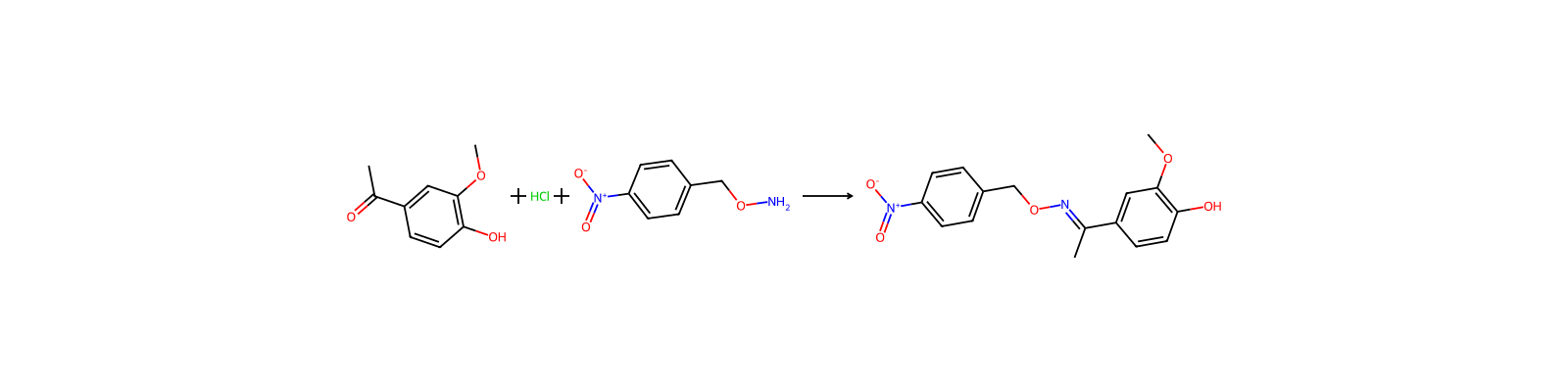
HRID 41926 reaction equation
HRID 41926As reactant
HRID 41927 reaction equation
HRID 41927As reactant
HRID 41928 reaction equation
HRID 41928As reactant
HRID 41929 reaction equation
HRID 41929As reactant
HRID 41930 reaction equation
HRID 41930As reactant
HRID 41931 reaction equation
HRID 41931As reactant
HRID 41932 reaction equation
HRID 41932As reactant
HRID 41933 reaction equation
HRID 41933As reactant
PreviousPage 1 of 2

Compound notes

On this pageBasic informationOverviewNames & identifiersPropertiesSafety & regulationChemistry & industryRelated reactionsCompound notes