
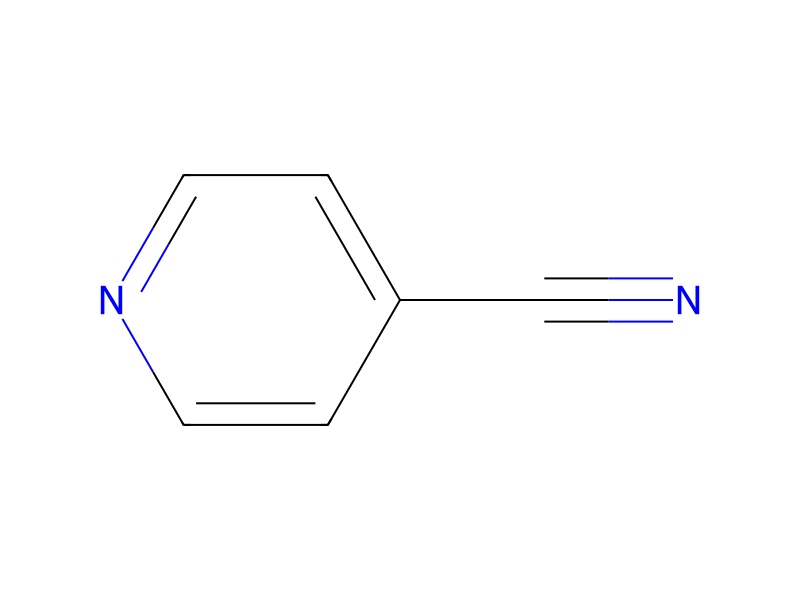
Basic information
- Standard SMILES
N#Cc1ccncc1- InChIKey
GPHQHTOMRSGBNZ-UHFFFAOYSA-N- Molecular formula
- C6H4N2
- Average molar mass
- 104.11 g/mol
- Monoisotopic mass
- 104.03744813
Overview
4-cyanopyridine is a cyanopyridine carrying the cyano group at position 4.
Names & identifiers
- Preferred name
- 4-Cyanopyridine
- IUPAC
- pyridine-4-carbonitrile
- English name
- 4-Cyanopyridine
- Molecular formula
- C6H4N2
- Molecular weight
- 104.11
Names & synonyms
4-CYANOPYRIDINEIsonicotinonitrile100-48-14-Pyridinecarbonitrilepyridine-4-carbonitrileIsonicotinic acid nitrileDTXSID9041528NSC-60681BY3226D010DTXCID7021528RefChem:526619202-856-2
Show more names
4-cyanopyridinCyanopyridine,4-AKOS BBS-00004486IsonicotinonitrilTIMTEC-BB SBB008923
4-Pyridinenitrilegamma-Cyanopyridinep-cyanopyridineMFCD00006417.gamma.-CyanopyridineEINECS 202-856-2GPHQHTOMRSGBNZ-UHFFFAOYSA-NSC60681
Database identifiers
- CAS
100-48-1- PubChem CID
- 7506
- DTXSID
DTXSID9041528- ChEMBL
CHEMBL504918- ChEBI
CHEBI:28020- UNII
- BY3226D010
- EC Number
- 202-856-2
- Nikkaji
- J39.102F
Properties
Computed structural properties
- XLogP
- 0.5
- Topological polar surface area
- 36.7 Ų
- Hydrogen bond donors
- 0
- Hydrogen bond acceptors
- 2
- Rotatable bonds
- 0
- Heavy atoms
- 8
- Formal charge
- 0
- Complexity
- 105
Experimental & physicochemical properties
Chemical ClassesNitrogen Compounds -> Nitriles
SpringerMaterials PropertiesCoriolis coupling
Vapor Pressure0.31 [mmHg]
Physical Description
Other Solid
Off-white crystals with a pungent odor; [Alfa Aesar MSDS]
Physicochemical properties
- Melting point
- 76 · 76-79 °C(lit.)
- Boiling point
- 196 °C · 196 °C
- Density
- 1.1145 · 1.1145 (rough estimate)
- vapor pressure
- 41.9 Pa · 41.9Pa at 25℃
- refractive index
- 1.5242 · 1.5242 (estimate)
- Flash point
- 88 °C · 88 °C
- storage temp.
- Sealed in dry,Room Temperature
- solubility
- 40 g/l · 40g/l
- pka
- 1 · pK1:1.90(+1) (25°C)
- form
- Crystals or Powder
- color
- White to off-white
- Water Solubility
- 3.2 g/100ml · 3.2 g/100ml (16.4 ºC)
- BRN
- 107712 · 107712
- Henry's Law Constant
- 1.1 · 1.1×101 mol/(m3Pa) at 25℃, Abraham et al. (1994)
- Exposure limits
- 25 mg/m3 · NIOSH: IDLH 25 mg/m3
- Stability
- Stable. Incompatible with strong bases, strong oxidizing agents, strong acids.
- InChI
- 1S/C6H4N2/c7-5-6-1-3-8-4-2-6/h1-4H
- InChIKey
- GPHQHTOMRSGBNZ-UHFFFAOYSA-N
- SMILES
- N#Cc1ccncc1
- LogP
- 0.46 at · 0.46 at 25℃
- CAS DataBase Reference
- 100 · 100-48-1(CAS DataBase Reference)
- FDA UNII
- 3226 D010 · BY3226D010
- NIST Chemistry Reference
- 4 · 4-Pyridinecarbonitrile(100-48-1)
- EPA Substance Registry System
- 4 · 4-Pyridinecarbonitrile (100-48-1)
- UNSPSC Code
- 12352100 · 12352100
- NACRES
- 22 · NA.22
- Symbol(GHS)
- 7 · GHS07
- Signal word
- Warning
- Hazard statements
- 302 · H302+H312+H332
- Precautionary statements
- 261 · P261-P264-P280-P301+P312-P302+P352+P312-P304+P340+P312
- PPE
- 95 · dust mask type N95 (US), Eyeshields, Gloves
- Hazard Codes
- Xn
- Risk Statements
- 20 · 20/21/22
- Safety Statements
- 36 · 36/37-24/25
- RIDADR
- 3276 · 3276
- WGK Germany
- 3 · 3
- TSCA
- TSCA listed
- PackingGroup
- III
- HS Code
- 29333999 · 29333999
- Storage Class
- 11 · 11 - Combustible Solids
- Hazard Classifications
- 4 DermalAcute · Acute Tox. 4 DermalAcute Tox. 4 InhalationAcute Tox. 4 Oral
- REACH Registrations
- Active
Safety & regulation
GHS classification
GHS Classification
Warning
H302 (94.9%): Harmful if swallowed [Warning Acute toxicity, oral]
P261, P264, P264+P265, P270, P271, P280, P301+P317, P302+P352, P304+P340, P305+P351+P338, P317, P321, P330, P337+P317, P362+P364, and P501 (click each P-code to see the statement)
Aggregated GHS information provided per 79 reports by companies from 10 notifications to the ECHA C&L Inventory. Each notification may be associated with multiple companies.
Hazard information
Regulatory Information
Chemical: 4-Pyridinecarbonitrile
4-Pyridinecarbonitrile is listed on the EPA's Chemical Data Reporting (CDR) system. Manufacturers and importers of 4-Pyridinecarbonitrile are required to report information about their production and use of this chemical to the EPA under the Toxic Substances Control Act (TSCA). (40 eCFR Part 711)
Status: Active Update: 03-04-2018 https://echa.europa.eu/registration-dossier/-/registered-dossier/23645
4-Pyridinecarbonitrile: Does not have an individual approval but may be used under an appropriate group standard
Hazards SummaryA strong eye irritant; Harmful by ingestion; [Alfa Aesar MSDS] See m-Phthalodinitrile. See Pyridine.
Hazard Classes and CategoriesAcute Tox. 4 (94.9%)
Safety data
- PPE
- dust mask type N95 (US), Eyeshields, Gloves
- wgk
- 3
- tsca
- TSCA listed
- ridadr
- 3276
- hs_code
- 29333999
- risk_code
- 20/21/22
- Signal word
- Warning
- Symbol(GHS)
- GHS07
- hazard_code
- Xn
- safety_code
- 36/37-24/25
- Storage Class
- 11 - Combustible Solids
- packing_group
- III
- Hazard statements
- H302+H312+H332
- REACH Registrations
- Active
- Hazard Classifications
- Acute Tox. 4 DermalAcute Tox. 4 InhalationAcute Tox. 4 Oral
- Precautionary statements
- P261-P264-P280-P301+P312-P302+P352+P312-P304+P340+P312
Chemistry & industry
Uses & manufacturing
U.S. Production2023: 75,000 - <500,000 lb
Industry UsesIntermediate
General Manufacturing Information
All Other Basic Organic Chemical Manufacturing
4-Pyridinecarbonitrile: ACTIVE
Applications
Uses4-Cyanopyridine is used as an intermediate in organic synthesis and pharmaceutical substances like isonicotinylhydrazide, which is used in the treatment of tuberculosis. It is used as a precursor for the preparation of isonicotinic acid and 4-diemthylaminopyridine (DMAP). It is involved in the synthesis of 6-methyl-2-pyridin-4-yl-pyrimidin-4-ylamine by reacting with acetonitrile.
Upstream & downstream products
Upstream raw materials
Downstream products
Suppliers50 total
国药集团化学试剂有限公司86-21-63210123 · [email protected]
梯希爱(上海)化成工业发展有限公司021-67121386 · [email protected]
上海阿拉丁生化科技股份有限公司400-6206333 13167063860 · [email protected]
爱斯特(成都)生物制药股份有限公司+86-28-85122536 85324413 · [email protected]
韶远科技(上海)有限公司021-50795510 4000665055 · [email protected]
科瑞迪化学400-821-5857 021-64326257 · [email protected]
上海将来实业股份有限公司400-0066400 13621662912 · [email protected]
Syntechem Co.,Ltd[email protected]
上海迈瑞尔生化科技有限公司4006356688 18621169109 · [email protected]
武汉易泰科技有限公司上海分公司18930552037 · [email protected]
阿法埃莎(中国)化学有限公司400-6106006 · [email protected]
太原市瑞和丰科贸有限公司+86 351 7031519 · [email protected]
上海德默医药科技有限公司400-021-7337 2355568890 · [email protected]
安耐吉化学&3A(安徽泽升科技股份有限公司)400-0056266 · [email protected]
上海瀚鸿科技股份有限公司021-54306202 13764082696 · [email protected]
上海景颜化工科技有限公司13817811078 · [email protected]
嘉兴市艾森化工有限公司0573-85285100 18627885956 · [email protected]
Pure Chemistry Scientific Inc.001-857-928-2050 or 1-888-588-9418 · [email protected]
上海隆盛化工有限公司58099637 13585536065 · [email protected]
上海攀鸿化工科技有限公司021-56491756 13512199871 · [email protected]
中塑供应链管理(山东)有限公司15726167122
南京蓝白化工有限公司025-85499326 15366059326;13813836665 · [email protected]
BOC Sciences1-631-485-4226; 16314854226 · [email protected]
孝感深远化工有限公司15527621225; 15527621225 · [email protected]
苏州施亚生物科技有限公司86(512)5235 8471 17715136450 · [email protected]
玛雅试剂+86 (573) 82222445 (0)18006601000 452520369 · [email protected]
四川库利南科技有限公司400-1166-196 18981987031 · [email protected]
上海耐士化工科技有限公司400-188-0725 +86 21 34310725 13611771617
天津希恩思生化科技有限公司400 638 7771 · [email protected]
河南萬象化工有限公司(优势生产供应!)0371-56669001 13949088811 · [email protected]
台州市裕欣生物科技有限公司+86-0576--88902229 +86-13968687450
南京维奥化工有限公司Please Send Email 18652950785 · [email protected]
武汉华邦化学新材料有限公司027-83229541 13971313286 · [email protected]
北京泰亚杰科技有限公司021-33690831-8001 13552411790;18616022633 · [email protected]
泰州志诚化工科技有限公司0523-82837785 13914525028 · [email protected]
上海思域化工科技有限公司86-21-34053660 · [email protected]
苏州思变化学技术有限公司0512-65617459 18915409046 · [email protected]
赛默飞世尔科技(中国)有限公司800-810-5118 · [email protected]
北京伊诺凯科技有限公司400-810-7969 010-59572699 · [email protected]
江苏艾康生物医药研发有限公司025-66113011 13913916777 · [email protected]
上海健超生物科技有限公司150-2103-5486 18017383231 · [email protected]
TCI AMERICA800-4238616 · [email protected]
TOKYO CHEMICAL INDUSTRY CO., LTD.03-36680489 · [email protected]
TCI Europe320-37350700 · [email protected]
上海贤鼎生物科技有限公司4009209199 · [email protected]
深圳振强药物研发有限公司0755-66853366 13670046396 · [email protected]
深圳康特腾科技有限公司86-0755-86635001 · [email protected]
越林试剂021-62960152 · [email protected]
上海汇凯化学科技有限公司021-61995394 18916691159 · [email protected]
上海洪创医药科技有限公司18151128828 · [email protected]
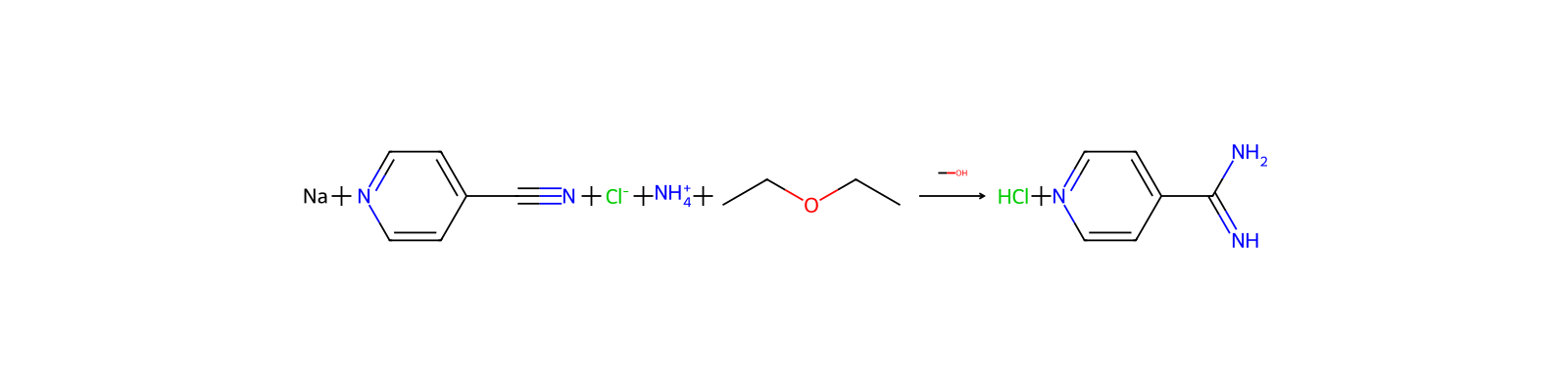
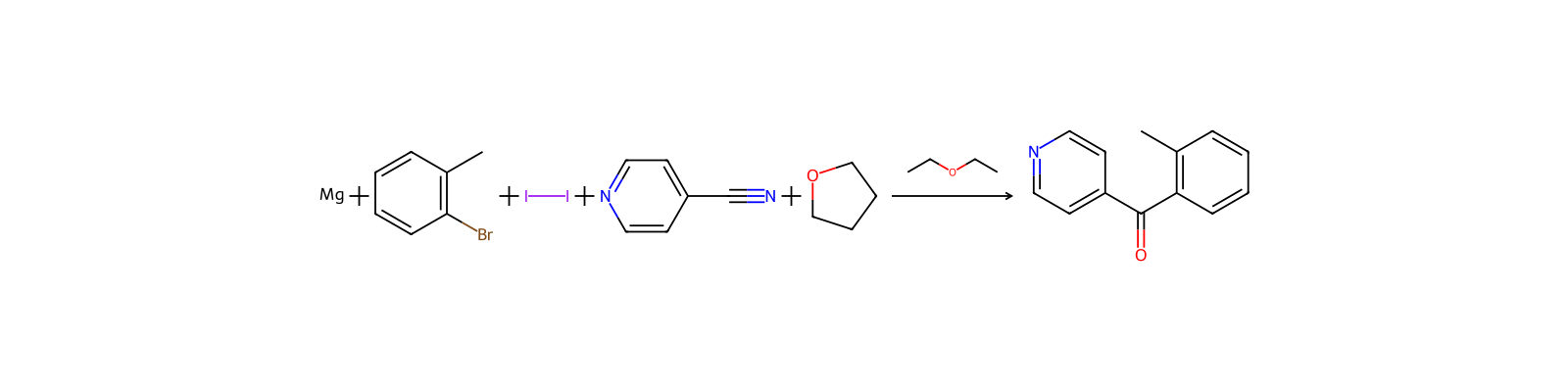
Related reactions
196 records


Linked notes
Loading…