Glyceraldehyde
GLYCERALDEHYDE · glycerose · GLYCERIC ALDEHYDE · Propanal, 2,3-dihydroxy- · NSC 67934 · -PRO-ASN-OH · dl-glyceraldehyd · DL-GLYCERALDEHYDE
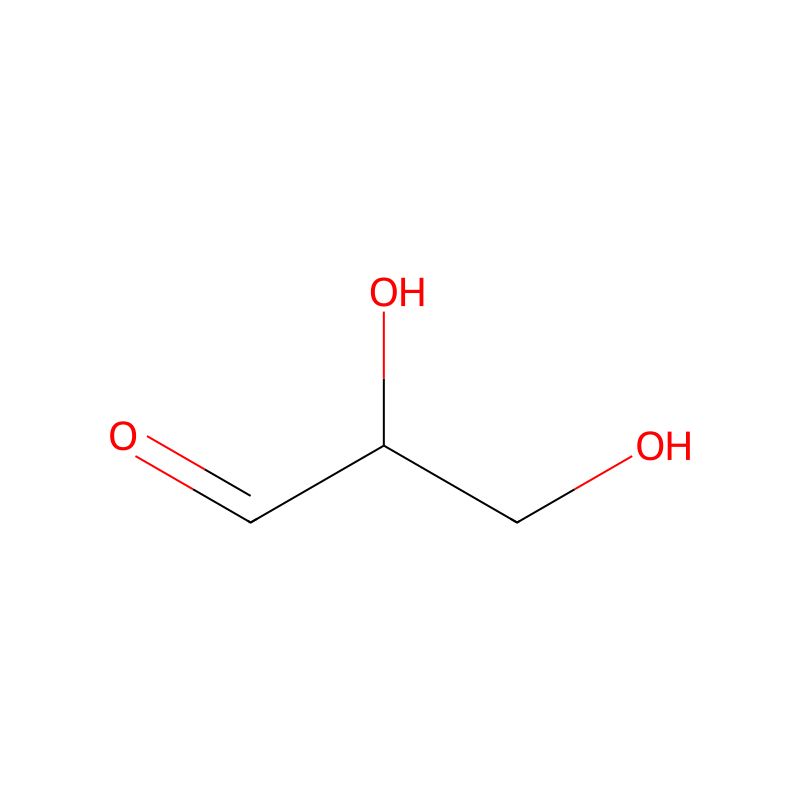
Identifiers & Physical Properties
| CAS No. | 367-47-5 |
|---|---|
| Molecular formula | C3H6O3 |
| Average molar mass | 90.08 g/mol |
| Monoisotopic mass | 90.03169405 g/mol |
| SMILES | O=CC(O)CO |
| InChIKey | MNQZXJOMYWMBOU-UHFFFAOYSA-N |
| PubChem CID | 751 |
| ChEMBL | CHEMBL173813 |
| ChEBI | CHEBI:5445 |
| EC No. | 200-290-0 |
| DTXSID | DTXSID90861586 |
Chemical & Physical Properties
| XLogP | -1.6 |
|---|---|
| Topological polar surface area | 57.5 |
| Hydrogen bond donors | 2 |
| Hydrogen bond acceptors | 3 |
| Rotatable bonds | 2 |
| Heavy atoms | 6 |
| Formal charge | 0 |
| Complexity | 43.3 |
| Chemical classes | Biological Agents -> Monosaccharides and Derivatives |
| Solubility | 17 mg/mLMethanol (Slightly), Water (Slightly, Sonicated))29.13g/L(18 ºC) |
| Melting point | 145 °C144-145 °C(lit.) |
| Physical Description | Solid[Merck Index] Off-white solid[Acros Organics MSDS] |
| Boiling point | 107.25°C (rough estimate) |
| alpha | [α]D20 -0.3~+0.3゜ (c=2.5, H2O) |
| Density | 1.593 g/cm3 (-5℃) |
| Refractive index | 1.4540 (estimate) |
| Storage conditions | 2-8°C |
| Physical state | Solid |
| pKa (acidity coefficient) | 12.60±0.20(Predicted) |
| Color | White to Off-White |
| Biological source | synthetic |
| InChI | InChI=1S/C3H6O3/c4-1-3(6)2-5/h1,3,5-6H,2H2 |
| InChIKey | MNQZXJOMYWMBOU-UHFFFAOYSA-N |
| SMILES | C(=O)C(O)CO |
| CAS DataBase Reference | 56-82-6(CAS DataBase Reference) |
| EWG's Food Scores | 1 |
| FDA UNII | DI19XSG16H |
| EPA Substance Registry System | Glyceraldehyde (56-82-6) |
| UNSPSC Code | 12352201 |
| NACRES | NA.25 |
| CAS Number Unlabeled | 56-82-6 |
| Personal protective equipment (PPE) | Eyeshields, Gloves, type N95 (US) |
| Safety statements (S) | 24/25 |
| Water hazard class (WGK) | 3 |
| RTECS number | MA6475000 |
| F | 10-23 |
| TSCA inventory status | TSCA listed |
| Customs code | 29124990 |
| Storage class | 11 - Combustible Solids |
Safety & Regulations
| Regulatory information | Chemical: Propanal, 2,3-dihydroxy-Propanal, 2,3-dihydroxy-: Does not have an individual approval but may be used under an appropriate group standard |
|---|---|
| Hazards summary | Intraperitoneal LD50 (rat) = 2,000 mg/kg[RTECS] May cause irritation[Acros Organics MSDS] |
| Carcinogen Classification | No indication of carcinogenicity to humans (not listed by IARC). |
| F | 10-23 |
| Personal protective equipment (PPE) | Eyeshields, Gloves, type N95 (US) |
| Water hazard class (WGK) | 3 |
| TSCA inventory status | TSCA listed |
| RTECS number | MA6475000 |
| Customs code | 29124990 |
| Safety statements (S) | 24/25 |
| Storage class | 11 - Combustible Solids |
Applications & Uses
Uses
DL-Glyceraldehyde has been used:as modifying reagent in the preparation of crystallization solution as a substrate to measure aldose reductase activityin the preparation of d/l-glyceraldehyde stock to determine the specific activity of GAPDH (glyceraldehyde 3-phosphate dehydrogenase)
Uses
Isotope labelled Glyceraldehyde is the simplest of all aldoses and have been shown to be the one of the carbonyl metabolite of dietary fructose.
General Description
Glyceraldehyde is a simple monosaccharide. Based on the number of carbon atoms and the type of carbonyl group present, glyceraldehyde belongs to subgroup triose. It is a colourless and sweet compound.