HomeMCPWorkbenchSkills
HomeWorkbenchNotificationsMe
llms.txt · MCP GuidePrivacy Policy · Terms of Service · Supportv1.8.3
  1. Home
  2. /Compound

4-Phenoxybenzoic acid

HCID 75182
New reaction
Print
Basic informationOverviewNames & identifiersPropertiesSafety & regulationChemistry & industryRelated reactionsCompound notes
Substructure searchFind similar structures

Basic information

CAS
2215-77-2
Standard SMILES
O=C(O)c1ccc(Oc2ccccc2)cc1
InChIKey
RYAQFHLUEMJOMF-UHFFFAOYSA-N
Molecular formula
C13H10O3
Average molar mass
214.22 g/mol
Monoisotopic mass
214.06299418

Overview

4-phenoxybenzoic acid is a phenoxybenzoic acid in which the phenoxy group is para to the carboxy group.

Names & identifiers

Preferred name
4-Phenoxybenzoic acid
IUPAC
4-phenoxybenzoic acid
English name
4-Phenoxybenzoic acid
Molecular formula
C13H10O3
Molecular weight
214.22

Names & synonyms

4-Phenoxybenzoic acid2215-77-2p-Phenoxybenzoic acidBenzoic acid, 4-phenoxy-4-Carboxydiphenyl etherDiphenyl ether 4-carboxylic acidBenzoic acid, p-phenoxy-4-Carboxybiphenyl etherK7YP1JL5BZ4CBPENSC-246039DTXSID6062258
Show more names
4-PhenoxybenzoicNSC 246039RARECHEM AL BO 0319TIMTEC-BB SBB0005424-phenoxy-benzoicaciPhenoxybenzoicacid,4-Ibrutinib Impurity 84LABOTEST-BB LT00454671
CHEBI:726324-carboxy biphenyletherRefChem:100323DTXCID7036618218-682-54-Phenoxy-benzoic acid4-PhOC6H4CO2HMFCD00002539

Database identifiers

CAS
2215-77-2
PubChem CID
75182
DTXSID
DTXSID6062258
ChEMBL
CHEMBL107518
ChEBI
CHEBI:72632
UNII
K7YP1JL5BZ
EC Number
218-682-5
Nikkaji
J80.430D

Properties

Computed structural properties

XLogP
3.9
Topological polar surface area
46.5 Ų
Hydrogen bond donors
1
Hydrogen bond acceptors
3
Rotatable bonds
3
Heavy atoms
16
Formal charge
0
Complexity
225

Experimental & physicochemical properties

LogP3.21
Endocrine DisruptorsPotential endocrine disrupting compound

Physicochemical properties

Melting point
163 · 163-165 °C (lit.)
Boiling point
314.35 °C · 314.35°C (rough estimate)
Density
1.1956 · 1.1956 (rough estimate)
refractive index
1.509 · 1.5090 (estimate)
storage temp.
Sealed in dry,Room Temperature
solubility
Very faint turbidity in hot methanol.
form
Crystalline Powder
pka
4.57 · 4.57(at 25℃)
color
White to slightly yellow
Sensitive
Air Sensitive
BRN
2212463 · 2212463
InChI
1S/C13H10O3/c14-13(15)10-6-8-12(9-7-10)16-11-4-2-1-3-5-11/h1-9H,(H,14,15)
InChIKey
RYAQFHLUEMJOMF-UHFFFAOYSA-N
SMILES
OC(=O)c1ccc(Oc2ccccc2)cc1
CAS DataBase Reference
2215 · 2215-77-2(CAS DataBase Reference)
FDA UNII
7 YP1JL5BZ · K7YP1JL5BZ
NIST Chemistry Reference
4 · Benzoic acid, 4-phenoxy-(2215-77-2)
EPA Substance Registry System
4 · Benzoic acid, 4-phenoxy- (2215-77-2)
UNSPSC Code
12352100 · 12352100
NACRES
22 · NA.22
Symbol(GHS)
7 · GHS07
Signal word
Warning
Hazard statements
315 · H315-H319-H335
Precautionary statements
261 · P261-P264-P271-P280-P302+P352-P305+P351+P338
target organs
Respiratory system
PPE
95 · dust mask type N95 (US), Eyeshields, Gloves
Hazard Codes
Xi
Risk Statements
36 · 36/37/38
Safety Statements
26 · 26-37/39-36/37/39-36
WGK Germany
3 · 3
RTECS
6293620 · DH6293620
TSCA
TSCA listed
HazardClass
IRRITANT
HS Code
2918990090 · 2918990090
Storage Class
11 · 11 - Combustible Solids
Hazard Classifications
2 Skin · Eye Irrit. 2Skin Irrit. 2STOT SE 3
Toxicity
10 · TDLo ivn-rat: 10,711 mg/kg BIPBU* 25,686,2002
REACH Registrations
Active

Safety & regulation

Safety information is for reference only and does not replace the supplier’s Safety Data Sheet (SDS), applicable regulations, or professional assessment.

GHS classification

GHS Classification · 4 items

Warning

H315 (100%): Causes skin irritation [Warning Skin corrosion/irritation]

P261, P264, P264+P265, P271, P280, P302+P352, P304+P340, P305+P351+P338, P319, P321, P332+P317, P337+P317, P362+P364, P403+P233, P405, and P501 (click each P-code to see the statement)

Aggregated GHS information provided per 50 reports by companies from 9 notifications to the ECHA C&L Inventory. Each notification may be associated with multiple companies.

Hazard information

Regulatory InformationREACH registered substance: p-phenoxybenzoic acid (EC: 218-682-5)
Hazard Classes and CategoriesSkin Irrit. 2 (100%)

Safety data

PPE
dust mask type N95 (US), Eyeshields, Gloves
wgk
3
tsca
TSCA listed
rtecs
DH6293620
hs_code
2918990090
Toxicity
TDLo ivn-rat: 10,711 mg/kg BIPBU* 25,686,2002
risk_code
36/37/38
Signal word
Warning
Symbol(GHS)
GHS07
hazard_code
Xi
safety_code
26-37/39-36/37/39-36
hazard_class
IRRITANT
Storage Class
11 - Combustible Solids
target organs
Respiratory system
Hazard statements
H315-H319-H335
REACH Registrations
Active
Hazard Classifications
Eye Irrit. 2Skin Irrit. 2STOT SE 3
Precautionary statements
P261-P264-P271-P280-P302+P352-P305+P351+P338

Chemistry & industry

Uses & manufacturing

General Manufacturing InformationBenzoic acid, 4-phenoxy-: ACTIVE

Applications

Uses4-Phenoxybenzoic acid can block DNA binding of the human papillomarvirus (HPV) E2 protein. It is employed as an intermediate of Sitafloxacin, which is a fluoroquinolone antibiotic that shows promise in the treatment of Buruli ulcer.

Upstream & downstream products

Upstream raw materials

1-(p-Phenoxyphenyl)glyoxalBenzoic acid, 4-phenoxy-, ethyl ester4-PhenoxyanilineEthanone,2-chloro-1-(4-phenoxyphenyl)-1-Ethynyl-4-phenoxybenzene4-Phenoxybenzonitrile4-Phenoxybenzoic acid methyl ester2-(Trifluoromethoxy)benzene-1-sulfonyl chloride4'-Phenoxyacetophenone

Downstream products

Propanedinitrile, 2-[hydroxy(4-phenoxyphenyl)Methylene]-5-aMino-3-(4-phenoxyphenyl)-1H-pyrazole-4-carbonitrile

Additional notes

DefinitionChEBI: A phenoxybenzoic acid in which the phenoxy group is para to the carboxy group.

Related reactions

64 records
New reaction record
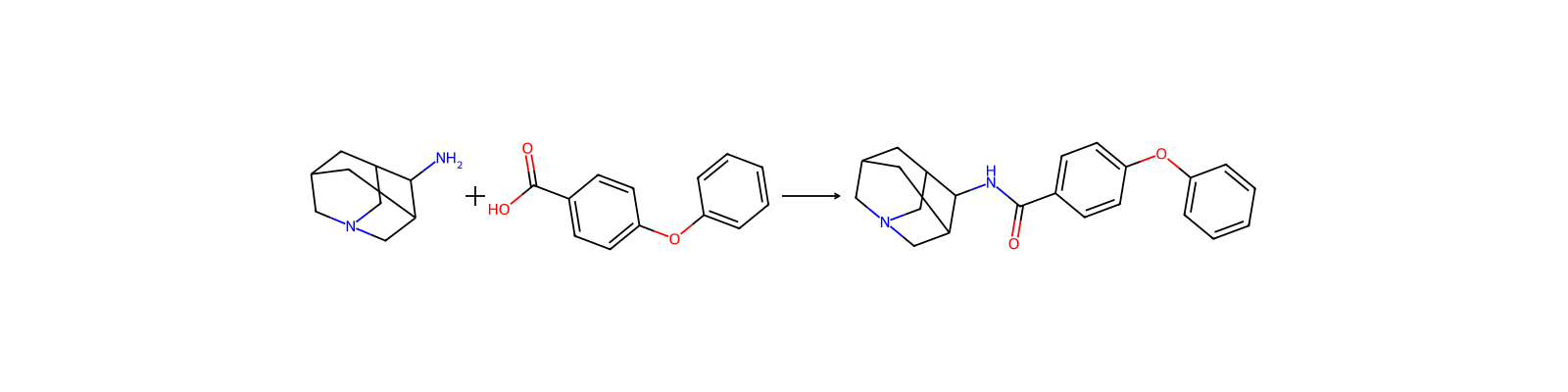
HRID 70922 reaction equation
HRID 70922As reactant
HRID 70937 reaction equation
HRID 70937As reactant
HRID 70941 reaction equation
HRID 70941As reactant
HRID 70944 reaction equation
HRID 70944As reactant
HRID 87317 reaction equation
HRID 87317As reactant
HRID 108598 reaction equation
HRID 108598As reactant
HRID 112953 reaction equation
HRID 112953As reactant
HRID 192305 reaction equation
HRID 192305As reactant
PreviousPage 1 of 8

Compound notes

On this pageBasic informationOverviewNames & identifiersPropertiesSafety & regulationChemistry & industryRelated reactionsCompound notes