

Basic information
- Standard SMILES
O=C(Cl)c1c(F)c(F)c(F)c(F)c1F- InChIKey
MYHOHFDYWMPGJY-UHFFFAOYSA-N- Molecular formula
- C7ClF5O
- Average molar mass
- 230.52 g/mol
- Monoisotopic mass
- 229.9557834
Overview
Pentafluorobenzoyl chloride is the acid chloride of pentafluorobenzoic acid. It is a sensitive derivatising reagent for the analysis of amines, amides and phenols by electron capture gas chromatography. It has a role as a chromatographic reagent. It is a perfluorinated compound and an acyl chloride. It is functionally related to a pentafluorobenzoic acid.
Names & identifiers
- Preferred name
- Pentafluorobenzoyl chloride
- IUPAC
- 2,3,4,5,6-pentafluorobenzoyl chloride
- English name
- Pentafluorobenzoyl chloride
- Molecular formula
- C7ClF5O
- Molecular weight
- 230.52
Names & synonyms
Pentafluorobenzoyl chloride2251-50-52,3,4,5,6-Pentafluorobenzoyl chloride4RXU8P4SDSNSC-97002CHEBI:39425DTXSID90177033RefChem:171363DTXCID0099524218-842-4pentafluorobenzoylchloridePerfluorobenzoyl chloride
Show more names
SKL1300Pentafluorobenzoyl cpentaflurobenzyl cyanidePentafluorobenzoylchloride99%PentafluorobenzoylChloride>
Benzoyl chloride, pentafluoro-C7ClF5OMFCD00000657pentafluorobenzoychlorideNSC97002EINECS 218-842-4NSC 97002UNII-4RXU8P4SDS
Database identifiers
- CAS
2251-50-5- PubChem CID
- 75256
- DTXSID
DTXSID90177033- ChEBI
CHEBI:39425- UNII
- 4RXU8P4SDS
- EC Number
- 218-842-4
- Nikkaji
- J106.089I
Properties
Computed structural properties
- XLogP
- 2.9
- Topological polar surface area
- 17.1 Ų
- Hydrogen bond donors
- 0
- Hydrogen bond acceptors
- 6
- Rotatable bonds
- 1
- Heavy atoms
- 14
- Formal charge
- 0
- Complexity
- 222
Experimental & physicochemical properties
SpringerMaterials PropertiesNuclear quadrupole resonance spectroscopy
Physicochemical properties
- Boiling point
- 158 · 158-159 °C(lit.)
- Density
- 1.601 g/mL · 1.601 g/mL at 25 °C(lit.)
- refractive index
- 20 · n20/D 1.453(lit.)
- Flash point
- None
- storage temp.
- 30 °C · Store below +30°C.
- solubility
- soluble in Chloroform
- form
- Liquid
- Specific Gravity
- 1.601 · 1.601
- color
- Clear colorless to light yellow
- Water Solubility
- decomposes
- Sensitive
- Lachrymatory
- BRN
- 2054397 · 2054397
- Stability
- Moisture Sensitive
- InChI
- 1S/C7ClF5O/c8-7(14)1-2(9)4(11)6(13)5(12)3(1)10
- InChIKey
- MYHOHFDYWMPGJY-UHFFFAOYSA-N
- SMILES
- Fc1c(F)c(F)c(c(F)c1F)C(Cl)=O
- CAS DataBase Reference
- 2251 · 2251-50-5(CAS DataBase Reference)
- FDA UNII
- 4 RXU8P4SDS · 4RXU8P4SDS
- NIST Chemistry Reference
- Pentafluorobenzoyl chloride(2251-50-5)
- UNSPSC Code
- 12352106 · 12352106
- NACRES
- 22 · NA.22
- Symbol(GHS)
- 5 · GHS05
- Signal word
- Danger
- Hazard statements
- 314 · H314
- Precautionary statements
- 280 · P280-P303+P361+P353-P304+P340+P310-P305+P351+P338-P363-P405
- PPE
- Faceshields, Gloves, Goggles, type ABEK (EN14387) respirator filter
- Hazard Codes
- C
- Risk Statements
- 14 · 14-34
- Safety Statements
- 26 · 26-36/37/39-45
- RIDADR
- 3265 · UN 3265 8/PG 2
- WGK Germany
- 3 · 3
- F
- 10 · 10-19-21
- Hazard Note
- Corrosive/Lachrymator
- HazardClass
- 8 · 8
- PackingGroup
- II
- HS Code
- 29163900 · 29163900
- Storage Class
- 8 A · 8A - Combustible corrosive hazardous materials
- Hazard Classifications
- 1 B · Skin Corr. 1B
- Limited Quantities
- 1 L · 1.0 L (0.3 gallons) (liquid) or 1 Kg (2.2 lbs) (solid)
- Excepted Quantities
- Max Inner Pack (30g or 30ml) and Max Outer Pack (500g or 500ml)
Safety & regulation
GHS classification
GHS Classification
Danger
H314 (100%): Causes severe skin burns and eye damage [Danger Skin corrosion/irritation]
P260, P264, P280, P301+P330+P331, P302+P361+P354, P304+P340, P305+P354+P338, P316, P321, P363, P405, and P501 (click each P-code to see the statement)
Aggregated GHS information provided per 61 reports by companies from 6 notifications to the ECHA C&L Inventory.
Hazard information
Hazard Classes and CategoriesSkin Corr. 1B (100%)
Safety data
- F
- 10-19-21
- PPE
- Faceshields, Gloves, Goggles, type ABEK (EN14387) respirator filter
- wgk
- 3
- ridadr
- UN 3265 8/PG 2
- hs_code
- 29163900
- risk_code
- 14-34
- Signal word
- Danger
- Symbol(GHS)
- GHS05
- hazard_code
- C
- hazard_note
- Corrosive/Lachrymator
- safety_code
- 26-36/37/39-45
- hazard_class
- 8
- Storage Class
- 8A - Combustible corrosive hazardous materials
- packing_group
- II
- Hazard statements
- H314
- Limited Quantities
- 1.0 L (0.3 gallons) (liquid) or 1 Kg (2.2 lbs) (solid)
- Excepted Quantities
- Max Inner Pack (30g or 30ml) and Max Outer Pack (500g or 500ml)
- Hazard Classifications
- Skin Corr. 1B
- Precautionary statements
- P280-P303+P361+P353-P304+P340+P310-P305+P351+P338-P363-P405
Chemistry & industry
Applications
DescriptionPentafluorobenzoyl chloride is the acid chloride of pentafluorobenzoic acid. It is a sensitive derivatising reagent for the analysis of amines, amides and phenols by electron capture gas chromatography. It has a role as a chromatographic reagent. It is an acyl chloride and a perfluorinated compound. It derives from a pentafluorobenzoic acid.2,3,4,5,6-Pentafluorobenzoyl chloride was used for derivatization of 5-androstenediol, testosterone, estradiol , dihydrotestosterone and estrone in a study to determine their serum levels. 2,3,4,5,6-Pentafluorobenzoyl chloride was used to derivatize dimethylamine(DMA) in study to develop a rapid and accurate GC–MS method for determination of DMA in human urine. 2,3,4,5,6-Pentafluorobenzoyl chloride was used in a study to detect the presence of Enterobacter cloacae in cultures of Leuconostoc mesenteroide by gas chromatography/mass spectrometry.
UsesPentafluorobenzoyl Chloride is a useful analytical reagent in the derivatization amphetamines as well as other primary amines.
UsesA reagent used for deriving primary amines. 2,3,4,5,6-Pentafluorobenzoyl chloride was used for derivatization of 5-androstenediol, testosterone, estradiol , dihydrotestosterone and estrone in a study to determine their serum levels. 2,3,4,5,6-Pentafluorobenzoyl chloride was used to derivative dimethylamine(DMA) in study to develop a rapid and accurate GC-MS method for determination of DMA in human urine. It was used in a study to detect the presence of Enterobacter cloacae in cultures of Leuconostoc mesenteroide by gas chromatography/mass spectrometry.
UsesPentafluorobenzoyl chloride can be used for the derivatization of a variety of analytes including biological amines. There is an extensive use for the derivatization of lipids.
Upstream & downstream products
Downstream products
Suppliers50 total
国药集团化学试剂有限公司86-21-63210123 · [email protected]
梯希爱(上海)化成工业发展有限公司021-67121386 · [email protected]
山东旭晨化工科技有限公司0533-15715337262 15715337262 · [email protected]
上海阿拉丁生化科技股份有限公司400-6206333 13167063860 · [email protected]
南通润丰石油化工有限公司66017690 19952660367 · [email protected]
常州新氟化学有限公司13275212658 · [email protected]
武汉欣扬瑞和化学科技有限公司13720274133 · [email protected]
温州共赢化学有限公司+86-0086-577-64498589 +86-15355981851 · [email protected]
INTATRADE GmbH+49 3493/605464 · [email protected]
Dayang Chem (Hangzhou) Co.,Ltd.+86-0571-88938639 17705817739 · [email protected]
Syntechem Co.,Ltd[email protected]
韶远科技(上海)有限公司021-50795510 4000665055 · [email protected]
上海迈瑞尔生化科技有限公司4006356688 18621169109 · [email protected]
上海辅欣医药科技有限公司+86-021-021-50872116 · [email protected]
阿法埃莎(中国)化学有限公司400-6106006 · [email protected]
安耐吉化学&3A(安徽泽升科技股份有限公司)400-0056266 · [email protected]
武汉凯威斯科技有限公司86-027-67849912 · [email protected]
Allfluoro Pharmaceutical Company Limited+86-400-0216110 +86-15958047586 · [email protected]
常州安轩化工有限公司13912302692 · [email protected]
上海瀚鸿科技股份有限公司021-54306202 13764082696 · [email protected]
嘉兴市艾森化工有限公司0573-85285100 18627885956 · [email protected]
上海隆盛化工有限公司58099637 13585536065 · [email protected]
孝感深远化工有限公司15527621225; 15527621225 · [email protected]
山东西亚化学有限公司13355009207 13355009207 · [email protected]
Xiamen AmoyChem Co., Ltd+86-86-5926051114 · [email protected]
湖南汇百侍生物科技有限公司0731-85526065 13308475853 · [email protected]
赛默飞世尔科技(中国)有限公司800-810-5118 · [email protected]
北京伊诺凯科技有限公司400-810-7969 010-59572699 · [email protected]
TCI AMERICA800-4238616 · [email protected]
TOKYO CHEMICAL INDUSTRY CO., LTD.03-36680489 · [email protected]
TCI Europe320-37350700 · [email protected]
上氟科技021-65170832 15601903708
越林试剂021-62960152 · [email protected]
Clearsynth Labs Limited+91-22-26355700 · [email protected]
安徽科迪达化工有限公司0554-2106669 · [email protected]
上海石洋化工有限公司021-56795766 · [email protected]
成都零六生物科技有限公司400-1166-196 13458535857 · [email protected]
天津安浩生物科技有限公司[email protected]
上海麦克林生化科技股份有限公司15221275939 15221275939 · [email protected]
上海纳谦化学科技有限公司13598610367 13598610367 · [email protected]
南京多隆生物科技有限公司18905173768 · [email protected]
常州天瑞医药科技有限公司0519-85386832 13382812559 · [email protected]
南京恰风和医药科技有限公司025-57018978 18251899859 · [email protected]
上海有朋化工有限公司021-69005955 13701776567 · [email protected]
上海凯赛化工有限公司021-33516722 13701817765 · [email protected]
上海彤源化工有限公司021-021-69182866 13701855675 · [email protected]
凯试(上海)科技有限公司021-50135380 · [email protected]
上海容立化学科技有限公司021-69992220 13701886816 · [email protected]
上海康拓化工有限公司021-69185552 13701777608 · [email protected]
Sigma-Aldrich西格玛奥德里奇(上海)贸易有限公司021-61415566 800-8193336 · [email protected]
Additional notes
DefinitionChEBI: The acid chloride of pentafluorobenzoic acid. It is a sensitive derivatising reagent for the analysis of amines, amides and phenols by electron capture gas chromatography.
Related reactions
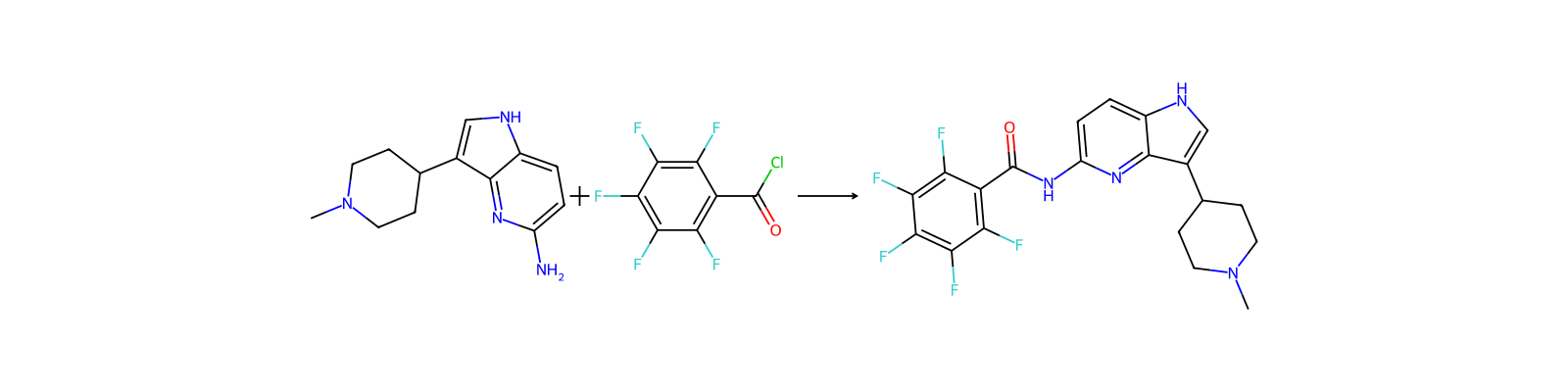
23 records




Linked notes
Loading…