
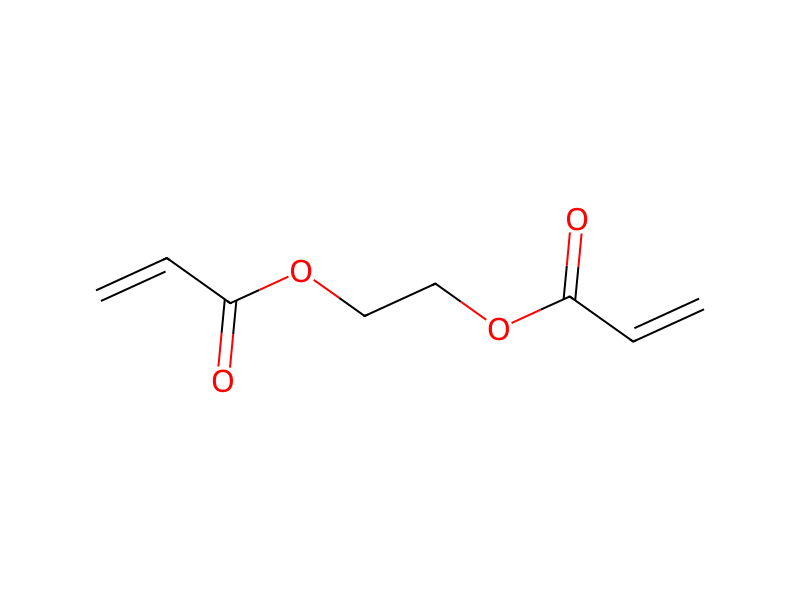
Basic information
- Standard SMILES
C=CC(=O)OCCOC(=O)C=C- InChIKey
KUDUQBURMYMBIJ-UHFFFAOYSA-N- Molecular formula
- C8H10O4
- Average molar mass
- 170.16 g/mol
- Monoisotopic mass
- 170.0579088
Overview
Poly(ethylene glycol diacrylate) is a poly(ethylene glycol) compound terminated with acrylate groups.
Names & identifiers
- Preferred name
- Ethylene glycol diacrylate
- IUPAC
- 2-prop-2-enoyloxyethyl prop-2-enoate
- English name
- ETHYLENE DIACRYLATE
- Molecular formula
- C8H10O4
- Molecular weight
- 170.16
Names & synonyms
Ethylene diacrylateEthylene glycol diacrylateEthylene acrylate2274-11-5Acrylic acid, ethylene esterEthyldiol acrilate2-Propenoic acid, 1,2-ethanediyl ester1,2-Ethanediyl diacrylateCCRIS 627Acrylic acid, diester with ethylene glycolAcrylic acid, ethylene glycol diesterEthyldiol acrilate [Russian]
Show more names
EM 2240/5/74ethyldiolacrilate1,2-Diacrylyl ethaneEthylene glycol diacryla
EINECS 218-886-442Q902RIYEDTXSID9044615NSC 24160BRN 17715272-Propenoic acid, 1,1'-(1,2-ethanediyl) esterLIGHT ESTER EG-ANSC-24160
Database identifiers
- CAS
2274-11-5、26570-48-9- PubChem CID
- 75282
- DTXSID
DTXSID9044615- ChEMBL
CHEMBL3185327- ChEBI
CHEBI:53379- UNII
- 42Q902RIYE
- EC Number
- 218-886-4
- Nikkaji
- J33.799D
Properties
Computed structural properties
- XLogP
- 1.2
- Topological polar surface area
- 52.6 Ų
- Hydrogen bond donors
- 0
- Hydrogen bond acceptors
- 4
- Rotatable bonds
- 7
- Heavy atoms
- 12
- Formal charge
- 0
- Complexity
- 173
Experimental & physicochemical properties
Density1.11 @25 °C
Food Contact SubstancesFCS -> FDA Inventory of Food Contact Substances Listed in 21 CFR
Physicochemical properties
- Melting point
- 184 · 184-193℃
- Boiling point
- 66 · 66-68 °C2 mm Hg(lit.)
- Density
- 1.094 g/mL · 1.094 g/mL at 25 °C(lit.)
- refractive index
- 20 · n20/D 1.453(lit.)
- Flash point
- 198 °F · 198 °F
- storage temp.
- 2 · 2-8°C
- form
- Liquid
- color
- Clear colorless to light yellow
- α-end
- acrylate
- Ω-end
- acrylate
- Major Application
- environmentalpharmaceutical
- InChI
- 1S/C8H10O4/c1-3-7(9)11-5-6-12-8(10)4-2/h3-4H,1-2,5-6H2
- InChIKey
- KUDUQBURMYMBIJ-UHFFFAOYSA-N
- SMILES
- C=CC(=O)OCCOC(=O)C=C
- Indirect Additives used in Food Contact Substances
- ETHYLENE DIACRYLATE
- EWG's Food Scores
- 1 · 1
- FDA UNII
- 42 Q902RIYE · 42Q902RIYE
- EPA Substance Registry System
- Ethylene glycol diacrylate (2274-11-5)
- UNSPSC Code
- 77101502 · 77101502
- NACRES
- 24 · NA.24
- Symbol(GHS)
- 6 · GHS06,GHS09
- Signal word
- Danger
- Hazard statements
- 301 · H301-H312+H332-H315-H319-H335-H411
- Precautionary statements
- 273 · P273-P280-P301+P310+P330-P302+P352+P312-P304+P340+P312-P305+P351+P338
- target organs
- Respiratory system
- Hazard Codes
- Xn,N
- Risk Statements
- 20 · 20/21/22-41-51/53-36/37/38
- Safety Statements
- 26 · 26-36/37/39-61
- RIDADR
- 2810 · UN 2810 6.1/PG 3
- WGK Germany
- 3 · 3
- RTECS
- 350000 · AT0350000
- TSCA
- TSCA listed
- HazardClass
- 6.1 · 6.1(b)
- PackingGroup
- III
- HS Code
- 29161995 · 29161995
- Storage Class
- 6.1 C · 6.1C - Combustible acute toxic Cat.3toxic compounds or compounds which causing chronic effects
- Hazard Classifications
- 3 OralAcute · Acute Tox. 3 OralAcute Tox. 4 DermalAcute Tox. 4 InhalationAquatic Chronic 2Eye Irrit. 2Skin Irrit. 2STOT SE 3
Safety & regulation
GHS classification
GHS Classification
This chemical does not meet GHS hazard criteria for 0.7% (5 of 697) of reports.
Danger
H301+H311 (63.3%): Toxic if swallowed or in contact with skin [Danger Acute toxicity, oral; acute toxicity, dermal]
P260, P261, P262, P264, P264+P265, P270, P271, P272, P273, P280, P284, P301+P316, P301+P317, P302+P352, P304+P340, P305+P351+P338, P305+P354+P338, P316, P317, P319, P320, P321, P330, P332+P317, P333+P317, P337+P317, P361+P364, P362+P364, P391, P403+P233, P405, and P501 (click each P-code to see the statement)
Aggregated GHS information provided per 697 reports by companies from 15 notifications to the ECHA C&L Inventory. Each notification may be associated with multiple companies.
Hazard information
Regulatory Information
Chemical: 2-Propenoic acid, 1,2-ethanediyl ester
2-Propenoic acid, 1,2-ethanediyl ester: Does not have an individual approval but may be used as a component in a product covered by a group standard. It is not approved for use as a chemical in its own right.
Hazard Classes and CategoriesAcute Tox. 3 (72.3%)
Safety & protection
Protective Action Criteria (PAC)
0.90 [mg/m3]
9.9 [mg/m3]
59 [mg/m3]
Safety data
- wgk
- 3
- tsca
- TSCA listed
- rtecs
- AT0350000
- ridadr
- UN 2810 6.1/PG 3
- hs_code
- 29161995
- risk_code
- 20/21/22-41-51/53-36/37/38
- Signal word
- Danger
- Symbol(GHS)
- GHS06,GHS09
- hazard_code
- Xn,N
- safety_code
- 26-36/37/39-61
- hazard_class
- 6.1(b)
- Storage Class
- 6.1C - Combustible acute toxic Cat.3toxic compounds or compounds which causing chronic effects
- packing_group
- III
- target organs
- Respiratory system
- Hazard statements
- H301-H312+H332-H315-H319-H335-H411
- Hazard Classifications
- Acute Tox. 3 OralAcute Tox. 4 DermalAcute Tox. 4 InhalationAquatic Chronic 2Eye Irrit. 2Skin Irrit. 2STOT SE 3
- Precautionary statements
- P273-P280-P301+P310+P330-P302+P352+P312-P304+P340+P312-P305+P351+P338
Chemistry & industry
Uses & manufacturing
General Manufacturing Information2-Propenoic acid, 1,1'-(1,2-ethanediyl) ester: ACTIVE
Applications
Usesenvironmentalpharmaceutical
Upstream & downstream products
Upstream raw materials
Suppliers50 total
国药集团化学试剂有限公司86-21-63210123 · [email protected]
上海阿拉丁生化科技股份有限公司400-6206333 13167063860 · [email protected]
Shandong chuangyingchemical Co., Ltd.18853181302 · [email protected]
南通润丰石油化工有限公司66017690 19952660367 · [email protected]
上海拓旸生物科技有限公司021-59555769 13524932310 · [email protected]
河北创海生物科技有限公司+86-86-13131129325 · [email protected]
武汉科美沃化工有限公司+86-2785736489 +8618171418573 · [email protected]
Dayang Chem (Hangzhou) Co.,Ltd.+86-0571-88938639 17705817739 · [email protected]
上海亚兴生物医药科技有限公司021-58956006,021-58950017 15800617331 · [email protected]
Hebei Yanxi Chemical Co., Ltd.+86-17531190177 · [email protected]
宜兴市文成化工有限公司13961572207 13961572207 · [email protected]
北京华威锐科化工有限公司0757-86329057 18934348241 · [email protected]
上海晶抗生物工程有限公司021-54721350 13524668266 · [email protected]
阿法埃莎(中国)化学有限公司400-6106006 · [email protected]
安耐吉化学&3A(安徽泽升科技股份有限公司)400-0056266 · [email protected]
吉良化学21-62165282 · [email protected]
武汉丰泰威远科技有限公司+86-27-8746-5837 +86-18627785180 · [email protected]
武汉丰泰威远科技有限公司027-87465837 19945049750 · [email protected]
上海竺钥化工有限公司021-33559231 18964673308 · [email protected]
山东西亚化学有限公司13355009207 13355009207 · [email protected]
四川库利南科技有限公司400-1166-196 18981987031 · [email protected]
天津希恩思生化科技有限公司400 638 7771 · [email protected]
湖南汇百侍生物科技有限公司0731-85526065 13308475853 · [email protected]
上海源叶生物科技有限公司13636370518 · [email protected]
武汉欣扬瑞和化学科技有限公司027-83855316 18171155316
TOKYO CHEMICAL INDUSTRY CO., LTD.03-36680489 · [email protected]
厦门赛诺邦格生物科技股份有限公司400-918-9898 · [email protected]
广州吉昕泰新材料科技有限公司13710082414 13924128221 · [email protected]
上海将来实业股份有限公司400-0066400 13621662912 · [email protected]
上海将来实业股份有限公司021-61552785 · [email protected]
厦门赛诺邦格生物科技股份有限公司400-9189898 17359873007 · [email protected]
成都零六生物科技有限公司400-1166-196 13458535857 · [email protected]
湖南华腾制药有限公司400-8592883 · [email protected]
杭州宇昊化工科技有限公司0571-82693216 · [email protected]
上海麦克林生化科技股份有限公司15221275939 15221275939 · [email protected]
湖北巨胜科技有限公司027-59599241 18871490274 · [email protected]
溧阳市瑞普新材料有限公司+86-0519-82038123,18951201333
池州凯隆进出口贸易有限公司[email protected]
Sigma-Aldrich西格玛奥德里奇(上海)贸易有限公司021-61415566 800-8193336 · [email protected]
Henan Alfa Chemical Co., Ltd+8618339805032 · [email protected]
济南睿遥明志医疗科技有限公司15662630077 15662630077 · [email protected]
广东翁江化学试剂有限公司0751-2886766 13927870850 · [email protected]
Alfa Chemistry+1-5166625404 · [email protected]
上海岚克医药科技发展有限公司0086-21-58956006
北京华威锐科化工科技有限公司89508211 18501085097 · [email protected]
南京博米尔生物科技有限公司025-83453382-8005 · [email protected]
山东西亚化学有限公司4009903999 13395398332 · [email protected]
安泰精细化工技术有限公司18503026267 · [email protected]
成都华纯科技有限公司400-1166-196 15982826727 · [email protected]
上海新平精细化学品有限公司18221735425 · [email protected]
Additional notes
DefinitionChEBI: Poly(ethylene glycol diacrylate) is a poly(ethylene glycol) compound terminated with acrylate groups.
Related reactions
5 records


Linked notes
Loading…