Basic information
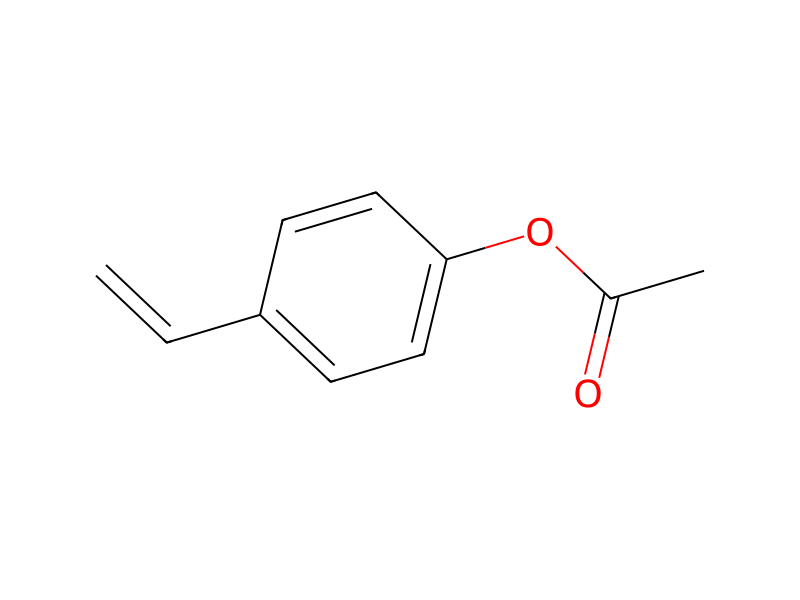
- Standard SMILES
C=Cc1ccc(OC(C)=O)cc1- InChIKey
JAMNSIXSLVPNLC-UHFFFAOYSA-N- Molecular formula
- C10H10O2
- Average molar mass
- 162.18 g/mol
- Monoisotopic mass
- 162.06807956
Names & identifiers
- Preferred name
- 4-Ethenylphenyl acetate
- IUPAC
- (4-ethenylphenyl) acetate
- English name
- 4-Acetoxystyrene
- Molecular formula
- C10H10O2
- Molecular weight
- 162.19
Names & synonyms
4-Acetoxystyrene2628-16-24-Ethenylphenol acetate4-Vinylphenyl acetate4-Ethenylphenyl acetatep-AcetoxystyrenePhenol, 4-ethenyl-, acetatePhenol, 4-ethenyl-, 1-acetatep-Vinylphenol acetateDTXSID2044898Phenol, p-vinyl-, acetateC-908
Show more names
ACETOXYSTYRENEVPAC(4-Ethenylphenyl) acetatePhenol, 4-ethenyl-,1-acetateACS/ASM
BRN 1862793DTXCID00248987S21904AYNACETIC ACID P-VINYLPHENYL ESTERJ71.623E4-06-00-03777 (Beilstein Handbook Reference)RefChem:522572434-600-2
Database identifiers
- CAS
2628-16-2- PubChem CID
- 75821
- DTXSID
DTXSID2044898- ChEMBL
CHEMBL3186305- UNII
- 7S21904AYN
- EC Number
- 434-600-2、607-905-5
- Nikkaji
- J71.623E
Properties
Computed structural properties
- XLogP
- 2.5
- Topological polar surface area
- 26.3 Ų
- Hydrogen bond donors
- 0
- Hydrogen bond acceptors
- 2
- Rotatable bonds
- 3
- Heavy atoms
- 12
- Formal charge
- 0
- Complexity
- 167
Experimental & physicochemical properties
Physical DescriptionLiquid
Physicochemical properties
- Melting point
- 7 · 7-8 °C (lit.)
- Boiling point
- 260 °C · 260 °C (lit.)
- Density
- 1.06 g/mL · 1.06 g/mL at 25 °C (lit.)
- refractive index
- 20 · n20/D 1.538(lit.)
- Flash point
- 190 °F · 190 °F
- storage temp.
- 2 · 2-8°C
- form
- Liquid
- color
- Clear colorless
- Viscosity
- 4.2 cP · 4.2cP(25°CBrookfield)(lit.)
- BRN
- 1862793 · 1862793
- InChI
- InChI=1S/C10H10O2/c1-3-9-4-6-10(7-5-9)12-8(2)11/h3-7H,1H2,2H3
- InChIKey
- JAMNSIXSLVPNLC-UHFFFAOYSA-N
- SMILES
- C1(OC(=O)C)=CC=C(C=C)C=C1
- CAS DataBase Reference
- 2628 · 2628-16-2(CAS DataBase Reference)
- EWG's Food Scores
- 1 · 1
- FDA UNII
- 7 S21904AYN · 7S21904AYN
- NIST Chemistry Reference
- 4 · Phenol, 4-ethenyl-, acetate(2628-16-2)
- EPA Substance Registry System
- 4 · Phenol, 4-ethenyl-, acetate (2628-16-2)
- UNSPSC Code
- 12162002 · 12162002
- NACRES
- 23 · NA.23
- Symbol(GHS)
- 7 · GHS07
- Signal word
- Warning
- Hazard statements
- 302 · H302-H315-H317-H319
- Precautionary statements
- 261 · P261-P264-P280-P301+P312-P302+P352-P305+P351+P338
- Hazard Codes
- Xn
- Risk Statements
- 22 · 22-38-43-36/38
- Safety Statements
- 36 · 36/37-26
- RIDADR
- 2810 · 2810
- WGK Germany
- 3 · 3
- RTECS
- 3784000 · SL3784000
- TSCA
- TSCA listed
- HazardClass
- 6.1 · 6.1
- PackingGroup
- III
- HS Code
- 29153900 · 29153900
- Storage Class
- 10 · 10 - Combustible liquids
- Hazard Classifications
- 4 OralEye · Acute Tox. 4 OralEye Irrit. 2Skin Irrit. 2Skin Sens. 1
- Toxicity
- 50 orl-rat: · LD50 orl-rat: 1503 mg/kg EPASR* 8EHQ-1190-1082
- REACH Registrations
- Active
Safety & regulation
GHS classification
GHS Classification
Danger
H302 (100%): Harmful if swallowed [Warning Acute toxicity, oral]
P260, P261, P262, P264, P264+P265, P270, P271, P272, P273, P280, P284, P301+P317, P302+P352, P304+P340, P305+P351+P338, P316, P319, P320, P321, P330, P332+P317, P333+P317, P337+P317, P361+P364, P362+P364, P391, P403+P233, P405, and P501 (click each P-code to see the statement)
Aggregated GHS information provided per 171 reports by companies from 5 notifications to the ECHA C&L Inventory. Each notification may be associated with multiple companies.
Warning
H302 (100%): Harmful if swallowed [Warning Acute toxicity, oral]
Hazard information
Regulatory Information
Phenol, 4-ethenyl-, 1-acetate is listed on the EPA's Chemical Data Reporting (CDR) system. Manufacturers and importers of Phenol, 4-ethenyl-, 1-acetate are required to report information about their production and use of this chemical to the EPA under the Toxic Substances Control Act (TSCA). (40 eCFR Part 711)
PMN - indicates a commenced PMN (Pre-Manufacture Notices) substance.
Status: Active Update: 16-02-2021 https://echa.europa.eu/registration-dossier/-/registered-dossier/24914
Phenol, 4-ethenyl-, acetate: Does not have an individual approval but may be used under an appropriate group standard
Hazard Classes and Categories
Acute Tox. 4 (100%)
Acute Tox. 4 (100%)
Safety data
- wgk
- 3
- tsca
- TSCA listed
- rtecs
- SL3784000
- ridadr
- 2810
- hs_code
- 29153900
- Toxicity
- LD50 orl-rat: 1503 mg/kg EPASR* 8EHQ-1190-1082
- risk_code
- 22-38-43-36/38
- Signal word
- Warning
- Symbol(GHS)
- GHS07
- hazard_code
- Xn
- safety_code
- 36/37-26
- hazard_class
- 6.1
- Storage Class
- 10 - Combustible liquids
- packing_group
- III
- Hazard statements
- H302-H315-H317-H319
- REACH Registrations
- Active
- Hazard Classifications
- Acute Tox. 4 OralEye Irrit. 2Skin Irrit. 2Skin Sens. 1
- Precautionary statements
- P261-P264-P280-P301+P312-P302+P352-P305+P351+P338
Chemistry & industry
Uses & manufacturing
U.S. Production2023: 621,129 lb
Industry UsesIntermediate
General Manufacturing Information
Plastics Material and Resin Manufacturing
Phenol, 4-ethenyl-, 1-acetate: ACTIVE
Applications
Description4-Acetoxystyrene can be used to synthesize Poly(p-hydroxystyrene) as the main component of photoresist. The chemically amplified photoresist of the poly(p-hydroxystyrene) series is currently the mainstream photoresist product in the world, and it is one of the key technologies for processing photo-etched integrated circuits and manufacturing chips.
Uses4-Acetoxystyrene is a stable Styrene monomer which can be readily polymerized and copolymerized to low, medium and high molecular weight polymers. Undergoes free radical polymerization, similar to styrene.
Preparation methods
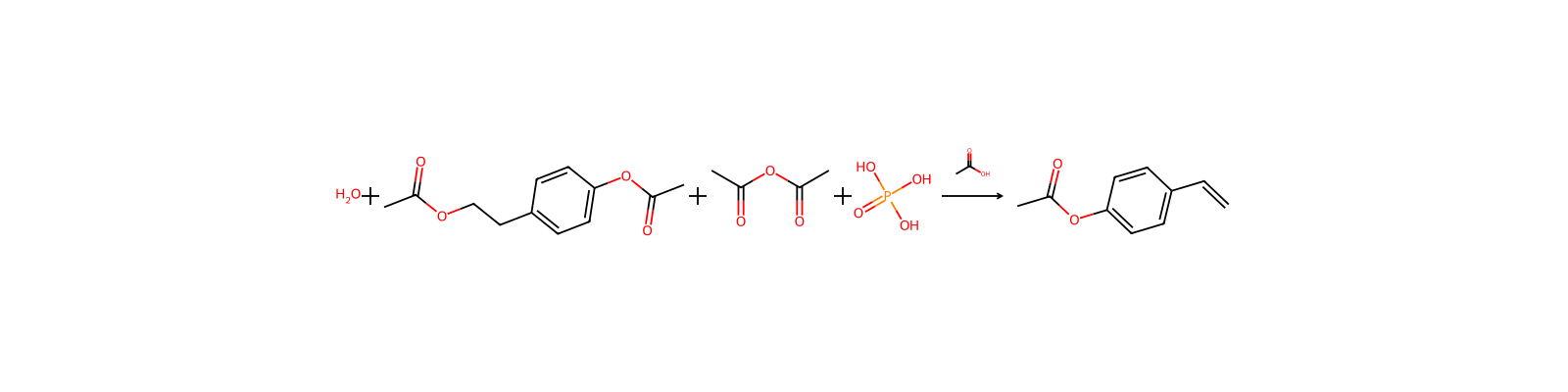
PreparationThe preparation of 4-Acetoxystyrene is as follows:Add p-hydroxystyrene (120g) to a 2L four-neck bottle. triethylamine(106g), phenothiazine (1.2g), Methyl tert-butyl ether (480 g), Dry ice-ethanol bath to -5 to 0 °C, acetyl chloride (86g) was added dropwise with stirring. The internal temperature is controlled at -5 to 0 °C. After the completion of the dropwise addition, the temperature was raised at 10 to 20 °C to continue the reaction for 1 hour. Sampling analysis (central control 1, raw material After completion of the reaction, the mixture was filtered, and the cake was washed with methyl t-butyl ether (50 g × 3). The filtrate was quenched by the addition of 4 g of methanol, and the reaction was stirred for 10 minutes. After completion, phenothiazine (1.2 g) was added and the reaction mixture was concentrated.Methyl tert-butyl ether (580 g) was recovered to give a crude product (160 g).The crude product was distilled under reduced pressure to give the product, p-acetoxy styrene (142 g), yield 87.7%, and sampled for analysis (main content >99%).
Upstream & downstream products
Upstream raw materials
Downstream products
Suppliers50 total
梯希爱(上海)化成工业发展有限公司021-67121386 · [email protected]
上海阿拉丁生化科技股份有限公司400-6206333 13167063860 · [email protected]
温州共赢化学有限公司+86-0086-577-64498589 +86-15355981851 · [email protected]
INTATRADE GmbH+49 3493/605464 · [email protected]
中节能万润股份有限公司0535-6101880 · [email protected]
河北创海生物科技有限公司+86-86-13131129325 · [email protected]
T&W GROUP021-61551611 13296011611 · [email protected]
武汉华瀚鼎诚新材料科技有限公司027-81388558 18963961905 · [email protected]
北京安司莫森技术有限公司010-82954736 13391601435 · [email protected]
Syntechem Co.,Ltd[email protected]
上海迈瑞尔生化科技有限公司4006356688 18621169109 · [email protected]
宇瑞(上海)化学有限公司02150456736 18602143071 · [email protected]
阿法埃莎(中国)化学有限公司400-6106006 · [email protected]
安耐吉化学&3A(安徽泽升科技股份有限公司)400-0056266 · [email protected]
石家庄斯迪亚诺精细化工有限公司0311-89250318 13582355795 · [email protected]
上海瀚鸿科技股份有限公司021-54306202 13764082696 · [email protected]
湖北冠众通科技有限公司0716-7227299 13507251920
上海钰康生物科技有限公司+86-18930848214 +86-021-56762820 · [email protected]
常州桦晟化工科技有限公司0519-85861892 13861049519 · [email protected]
江苏德瑞医药有限公司0512-62620298 17037718886 · [email protected]
杭州东帆化学有限公司86-0571-85151182
山东西亚化学有限公司13355009207 13355009207 · [email protected]
四川库利南科技有限公司400-1166-196 18981987031 · [email protected]
天津希恩思生化科技有限公司400 638 7771 · [email protected]
武汉海正工贸发展有限公司027-8866 0053/88660577/88660578
武汉泰宇凯尚科技有限公司027-027-87680032 18963957250 · [email protected]
上海和宁美生物医药科技有限公司021-18019086215 18019086215 · [email protected]
艾科试剂4008-755-333 18080918076 · [email protected]
上海思域化工科技有限公司86-21-34053660 · [email protected]
赛默飞世尔科技(中国)有限公司800-810-5118 · [email protected]
上海遐瑞医药科技有限公司+86 21 61551611
TCI AMERICA800-4238616 · [email protected]
TOKYO CHEMICAL INDUSTRY CO., LTD.03-36680489 · [email protected]
TCI Europe320-37350700 · [email protected]
上海仁曲医药科技有限公司18171398856 2968382473 · [email protected]
上海将来实业股份有限公司400-0066400 13621662912 · [email protected]
HBCChem, Inc.+1-510-219-6317 · [email protected]
上海笛柏生物科技有限公司400-008-9730,021-54359730 400-008-9730 · [email protected]
常州市卓燊医药化工材料有限公司519-519-85286950 13338194135 · [email protected]
杭州宇昊化工科技有限公司0571-82693216 · [email protected]
无锡海伦生物科技有限公司0510-85629785 18051595327 · [email protected]
上海麦克林生化科技股份有限公司15221275939 15221275939 · [email protected]
上海寰川实业有限公司021-61478794 · [email protected]
江苏艾康生物医药研发有限公司025-66028182 17714375163 · [email protected]
湖北巨胜科技有限公司027-59599241 18871490274 · [email protected]
池州凯隆进出口贸易有限公司[email protected]
Sigma-Aldrich西格玛奥德里奇(上海)贸易有限公司021-61415566 800-8193336 · [email protected]
成都赛诺宁科技有限公司28-87999436 02887999436 · [email protected]
上海皓之翔生物科技有限公司(原上海拓青化工有限公司)526763801 13301653310 · [email protected]
Alfa Chemistry+1-5166625404 · [email protected]
Related reactions
125 records


Linked notes
Loading…