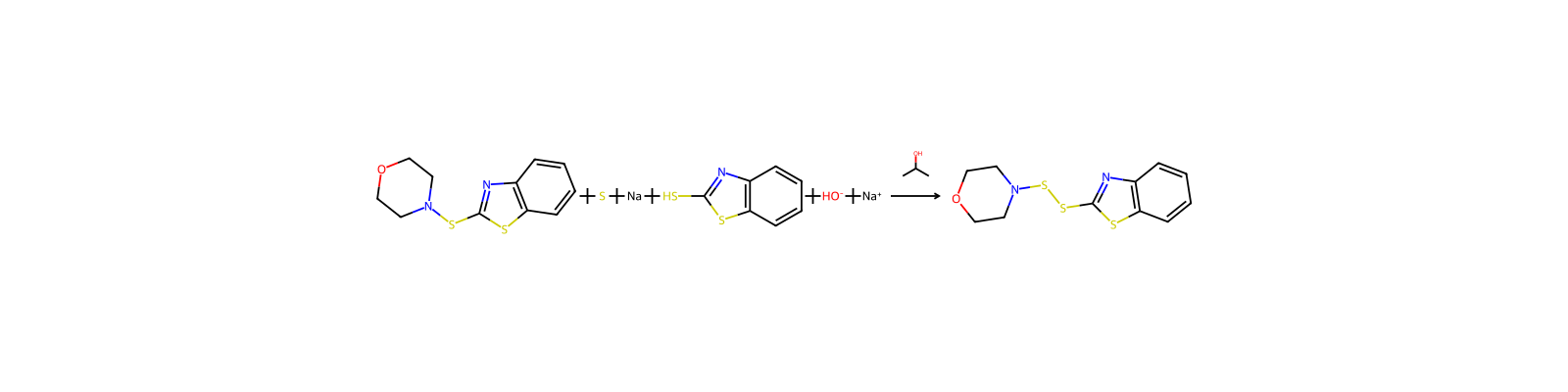
HRID 182319As reactant
Completing data — refresh the page later to see the latest

102-77-2c1ccc2sc(SN3CCOCC3)nc2c1MHKLKWCYGIBEQF-UHFFFAOYSA-NMorpholinylmercaptobenzothiazole is a Standardized Chemical Allergen. The physiologic effect of morpholinylmercaptobenzothiazole is by means of Increased Histamine Release and Cell-mediated Immunity.
102-77-2DTXSID0021096CHEMBL1530581BUFF TO BROWN FLAKES
TAN-COLORED POWDER
Safety information is for reference only and does not replace the supplier’s Safety Data Sheet (SDS), applicable regulations, or professional assessment.
Warning
H315: Causes skin irritation [Warning Skin corrosion/irritation]
P261, P264, P264+P265, P272, P273, P280, P302+P352, P305+P351+P338, P321, P332+P317, P333+P317, P337+P317, P362+P364, P391, and P501 (click each P-code to see the statement)
Warning
H315 (100%): Causes skin irritation [Warning Skin corrosion/irritation]
P261, P264, P264+P265, P272, P273, P280, P302+P352, P305+P351+P338, P321, P332+P317, P333+P317, P337+P317, P362+P364, P391, and P501 (click each P-code to see the statement)
Chemical: Morpholine, 4-(2-benzothiazolylthio)-
Benzothiazole, 2-(4-morpholinylthio)- is listed on the EPA's Chemical Data Reporting (CDR) system. Manufacturers and importers of Benzothiazole, 2-(4-morpholinylthio)- are required to report information about their production and use of this chemical to the EPA under the Toxic Substances Control Act (TSCA). (40 eCFR Part 711)
REACH registered substance: 2-(morpholinothio)benzothiazole (EC: 203-052-4)
2-Benzothiazolylsulfenyl morpholine: Does not have an individual approval but may be used under an appropriate group standard
May cause skin sensitization; [CHEMINFO] Danger of skin sensitization; [MAK] A skin and eye irritant; May cause skin sensitization; [eChemPortal: ESIS] A mild skin and eye irritant; May cause skin sensitization; [MSDSonline] It causes delayed-type skin sensitization; A case of immediate-type hypersensitivity was reported in a dental assistant; [Kanerva, p. 1818] See Mercaptobenzothiazole.
Skin Irrit. 2 (100%)
Eye irritation - category 2
Serious eye damage/eye irritation - Category 2
VCD7623F3K
MORPHOLINYLMERCAPTOBENZOTHIAZOLE
Established Pharmacologic Class [EPC] - Standardized Chemical Allergen
Physiologic Effects [PE] - Increased Histamine Release
Physiologic Effects [PE] - Cell-mediated Immunity
Chemical Structure [CS] - Allergens
Used as a delayed-action vulcanization accelerator; [HSDB] Occupational exposures occur among machinists (corrosion inhibitors) and pottery workers (releasing fluids); [Kanerva, p. 1818]
Metal Machining [Category: Heat or Machine]
Delayed action vulcanization accelerator.
(1972) No Data
(1975) No Data
(1972) No Data
(1975) 9.09X10+7 GRAMS (PRINCPL CUSTMS DISTS)
2023: 1,000,000 - <2,500,000 lb
(1972) PROBABLY GREATER THAN 1.36X10+6 GRAMS
(1975) PROBABLY GREATER THAN 1.36X10+6 GRAMS
>900 kg in 1979
Large Crystals; Large Crystals; Other Solid; Dry Powder
Tan to brown solid with a sweet odor; [HSDB] Pale granules or flakes; [MSDSonline]
Skin Irrit. 2
MATERIALS WHICH ARE TOXIC AS STORED OR WHICH CAN DECOMPOSE INTO TOXIC COMPONENTS...SHOULD BE STORED IN A COOL WELL-VENTILATED PLACE, OUT OF DIRECT RAYS OF THE SUN, AWAY FROM AREAS OF HIGH FIRE HAZARD, AND SHOULD BE PERIODICALLY INSPECTED... INCOMPATIBLE MATERIALS SHOULD BE ISOLATED...
SRP: At the time of review, criteria for land treatment or burial (sanitary landfill) disposal practices are subject to significant revision. Prior to implementing land disposal of waste residue (including waste sludge), consult with environmental regulatory agencies for guidance on acceptable disposal practices.
The ability of N-oxydiethylene-2-benzothiazyl sulfenamide (OBTS) to induce morphological transformation was evaluated in the Balb/3T3 mouse cell line (Cell Transformation Assay). Based on preliminary toxicity determinations (exposure time = 72hrs), OBTS was tested at concentrations of 0.05, 0.20, 2.0, 15.0 or 35.0ug/ml resulting in a range of approximately 80% to 48% survival (estimated graphically). OBTS produced significantly greater transformation frequencies (p < 0.01) over the applied concentration range of 0.2ug/ml to 35.0ug/ml relative to the solvent control (DMSO).
The ability of 2-(morpholinothio)benzothiazolesulfenamide (OBTS) to induce morphological transformation was evaluated in the Balb/3T3 mouse cell line (Cell Transformation Assay). Three samples of the test material were employed. Based on preliminary toxicity determinations (exposure time = 72hrs), all three assays of OBTS were conducted at concentrations ranging from 0.75 to 30ug/ml, resulting in approximately 95% to 20% survival. None of the treatments produced significantly greater transformation frequencies relative to the solvent control (DMSO).
2-(Morpholinothio)benzothiazole sulfenamide (OBTS; purified 4X by crystallization) was examined for mutagenic activity in Salmonella typhimurium strains TA1535, TA1537, TA1538, TA98, TA100, with and without metabolic activation provided by Aroclor-induced rat liver S9 fraction. The test article was not mutagenic to Salmonella tester strains in the plate preincubation assay at concentrations ranging from 0 to 2500 ug/plate under activated or non-activated conditions. Cytotoxicity to Salmonella strains was reported at the high doses in activated and non-activated assays.
The frequency of forward mutations was determined at the TK locus of the mouse lymphoma L5178Y cell line exposed in vitro to N-oxydiethylene-2-benzothiazyl sulfenamide (OBTS). The test article was administered at concentrations ranging from 0.195 to 50 ug/ml in the presence and absence of metabolic activation provided by Aroclor-induced rat liver S9 fraction. In the absence of activation a mutagenic effect was observed at concentrations greater than 10 ug/ml, levels at which OBTS was observed to be highly cytotoxic. In the presence of activation mutagenicity was observed at moderate to highly toxic treatment levels in the 3.13 to 40.0 ug/ml range.
For more TSCA Test Submissions (Complete) data for 2-(4-MORPHOLINOTHIOBENZOTHIAZOLE (12 total), please visit the HSDB record page.
The skin sensitization potentials of morpholine, 2-mercaptobenzothiazole (MBT) and their derivatives, 4,4'-dithiomorpholine (DTDM) and morpholinyl-mercaptobenzothiazole (MMBT) were examined using male Hartley albino guinea pigs. Preparations of 0.5, 2, 5 and 10% were used to determine the threshold irritation concn of each compound on the skin with 0.1 g of each applied on gauze pads of 1.5 sq cm dimensions. Materials were removed after 24 hr and readings taken at 1, 24, 48 hr after removal. For sensitization studies the animals were exposed to about 0.1 g of each cmpd in a concn of 5% of the amount needed to produce minimal intensity erythema from the irritant test. Test materials were removed after 24 hr. The procedure was repeated 3 times/wk for 2 wk. Two wk after the final induction, the challenge test was preformed. The left flank of the test animals was shaved, and 0.1, 0.5 and 2% dose preparations of each induction cmpd were applied. Materials were removed after 24 hr and readings taken at 1, 24 and 48 hr and 7 days after removal. Cross sensitization studies were also performed. The sensitization potential was greatest for DTDM, with MMBT being the next strongest. MBT was also a sensitizer, but morpholine not. The intensity and percent of reactions to challenge depended on the concn of the test cmpd. A variety of cross sensitization reactions occurred suggesting that the morpholine ring alone was not able to induce sensitization; on association with a disulfide bond, it became a strong sensitizing agent. The sensitization potential of MBT appeared directly related to the sulfhydryl functional group in the benzothiazole.
Rubber Product Manufacturing
Benzothiazole, 2-(4-morpholinylthio)-: ACTIVE
DescriptionThis rubber vulcanization accelerator is used as a chemical in the rubber industry, especially in the production of synthetic rubber articles. Is contained in the "mercapto mix". As a corrosion inhibitor, it can be found in cutting fluids or in releasing fluids in the pottery industry. It induces mainly delayed-type hypersensitivity, but a case of immediate-type hypersensitivity was reported in a dental assistant.
UsesDelayed-action vulcanization accelerator.