
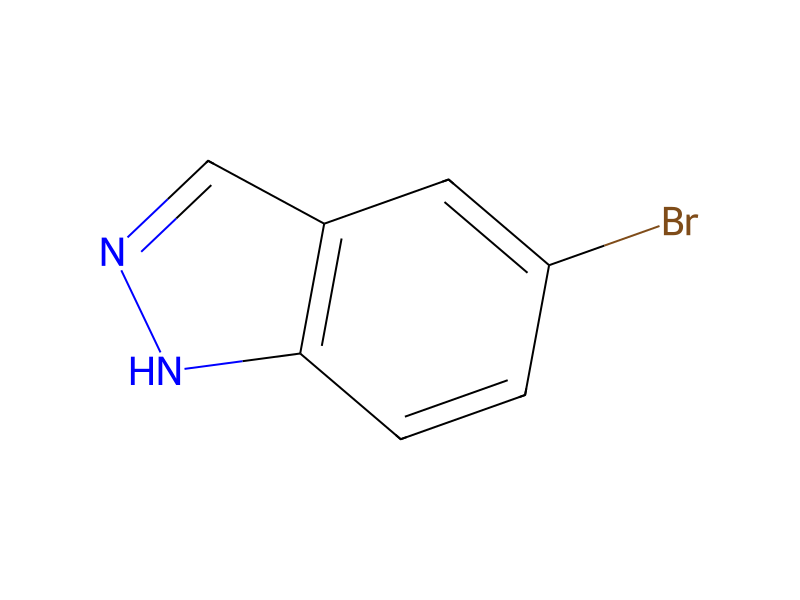
Basic information
- Standard SMILES
Brc1ccc2[nH]ncc2c1- InChIKey
STVHMYNPQCLUNJ-UHFFFAOYSA-N- Molecular formula
- C7H5BrN2
- Average molar mass
- 197.03 g/mol
- Monoisotopic mass
- 195.96361026
Names & identifiers
- Preferred name
- 5-bromo-1H-indazole
- IUPAC
- 5-bromo-1H-indazole
- English name
- 5-bromo-1H-indazole
- Molecular formula
- C7H5BrN2
- Molecular weight
- 197.03
Names & synonyms
5-bromo-1H-indazole53857-57-1DTXSID50354020RefChem:102081DTXCID60305083626-190-05-Bromoindazole5-Bromo-2H-indazole465529-55-91h-indazole, 5-bromo-MFCD008394935-bromoazaindole
Show more names
4-BROMOIMIDAZOLESW-4SWF-45-Bromoindazole-25-Bromoindazole >1H-Indazole, 5-bromo-5-Bromo-1H-indazole 97%5-Bromo-1H-indazole ,98%
5-bromo-azaindole5-bromo-1hindazoleSCHEMBL5562CHEMBL16425cid_761929HMS2497K17BDBM50099398AKOS000320310
Database identifiers
- CAS
53857-57-1- PubChem CID
- 761929
- DTXSID
DTXSID50354020- ChEMBL
CHEMBL16425- EC Number
- 626-190-0
- Nikkaji
- J1.536.246D
Properties
Computed structural properties
- XLogP
- 2.9
- Topological polar surface area
- 28.7 Ų
- Hydrogen bond donors
- 1
- Hydrogen bond acceptors
- 1
- Rotatable bonds
- 0
- Heavy atoms
- 10
- Formal charge
- 0
- Complexity
- 129
Physicochemical properties
- Melting point
- 131 · 131-135 °C(lit.)
- Boiling point
- 333.8 · 333.8±15.0 °C(Predicted)
- Density
- 1.77 · 1.770±0.06 g/cm3(Predicted)
- storage temp.
- Sealed in dry,Room Temperature
- solubility
- soluble in Methanol
- form
- powder to crystal
- pka
- 12.74 · 12.74±0.40(Predicted)
- color
- White to Light yellow to Light orange
- InChI
- InChI=1S/C7H5BrN2/c8-6-1-2-7-5(3-6)4-9-10-7/h1-4H,(H,9,10)
- InChIKey
- STVHMYNPQCLUNJ-UHFFFAOYSA-N
- SMILES
- N1C2=C(C=C(Br)C=C2)C=N1
- CAS DataBase Reference
- 53857 · 53857-57-1(CAS DataBase Reference)
- UNSPSC Code
- 12352100 · 12352100
- NACRES
- 22 · NA.22
- Symbol(GHS)
- 5 · GHS05,GHS07
- Signal word
- Danger
- Hazard statements
- 302 · H302-H318
- Precautionary statements
- 280 · P280-P301+P312+P330-P305+P351+P338+P310
- PPE
- 95 · dust mask type N95 (US), Eyeshields, Gloves
- Hazard Codes
- T,Xn
- Risk Statements
- 25 · 25-36/37/38-22-41
- Safety Statements
- 26 · 26-36-36/37/39-22-39
- RIDADR
- 2811 · UN 2811 6.1/PG 3
- WGK Germany
- 3 · 3
- RTECS
- 3517450 · NI3517450
- Hazard Note
- Harmful
- HS Code
- 29339900 · 29339900
- Storage Class
- 11 · 11 - Combustible Solids
- Hazard Classifications
- 4 OralEye · Acute Tox. 4 OralEye Dam. 1
Safety & regulation
GHS classification
GHS Classification
Danger
H302 (93.6%): Harmful if swallowed [Warning Acute toxicity, oral]
P264, P264+P265, P270, P280, P301+P317, P305+P354+P338, P317, P330, and P501 (click each P-code to see the statement)
Aggregated GHS information provided per 47 reports by companies from 5 notifications to the ECHA C&L Inventory. Each notification may be associated with multiple companies.
Hazard information
Hazard Classes and CategoriesAcute Tox. 4 (93.6%)
Safety data
- PPE
- dust mask type N95 (US), Eyeshields, Gloves
- wgk
- 3
- rtecs
- NI3517450
- ridadr
- UN 2811 6.1/PG 3
- hs_code
- 29339900
- risk_code
- 25-36/37/38-22-41
- Signal word
- Danger
- Symbol(GHS)
- GHS05,GHS07
- hazard_code
- T,Xn
- hazard_note
- Harmful
- safety_code
- 26-36-36/37/39-22-39
- Storage Class
- 11 - Combustible Solids
- Hazard statements
- H302-H318
- Hazard Classifications
- Acute Tox. 4 OralEye Dam. 1
- Precautionary statements
- P280-P301+P312+P330-P305+P351+P338+P310
Chemistry & industry
Applications
Uses5-bromo-1H-indazole (5-BIA) is an indazole compound that can be used as a raw material in organic synthesis for the preparation of compounds such as 5-Iodo-1H-indazole and 3,5-Dibromo-1H-indazole. 5-BIA and its derivatives (7-BIA) can also be used as a highly effective corrosion inhibitor for copper and the protective ability of 5-BIA is more prominent than that of 7-BIA. 5-BIA and its derivatives (7-BIA) can also be used as highly efficient corrosion inhibitors for copper, and 5-BIA has a more prominent protective ability than 7-BIA. 1.5 mM 5-BIA and 1.5 mM 7-BIA have corrosion inhibition efficiencies (ηE) as high as 97.1 % and 94.0 %, respectively[1].
Upstream & downstream products
Upstream raw materials
Downstream products
Suppliers50 total
梯希爱(上海)化成工业发展有限公司021-67121386 · [email protected]
衢州润东化工有限公司0570-8789886 18892685668 · [email protected]
上海阿拉丁生化科技股份有限公司400-6206333 13167063860 · [email protected]
T&W GROUP021-61551611 13296011611 · [email protected]
爱斯特(成都)生物制药股份有限公司+86-28-85122536 85324413 · [email protected]
韶远科技(上海)有限公司021-50795510 4000665055 · [email protected]
科瑞迪化学400-821-5857 021-64326257 · [email protected]
上海超悦化学科技有限公司(原上海斯比德化学)21-65679720 · [email protected]
扬州思域化工有限公司0514-87325867 · [email protected]
阿法埃莎(中国)化学有限公司400-6106006 · [email protected]
安耐吉化学&3A(安徽泽升科技股份有限公司)400-0056266 · [email protected]
武汉凯威斯科技有限公司86-027-67849912 · [email protected]
上海恩诺生物科技有限公司+86 (21) 6435-5022
上海瀚鸿科技股份有限公司021-54306202 13764082696 · [email protected]
衢州市鸿通生物科技有限公司0571-64067827 13372408495 · [email protected]
Shangchem Co., Ltd.+86-21-68182121
上海相辉医药科技有限公司13761987713 · [email protected]
上海景颜化工科技有限公司13817811078 · [email protected]
嘉兴市艾森化工有限公司0573-85285100 18627885956 · [email protected]
Pure Chemistry Scientific Inc.001-857-928-2050 or 1-888-588-9418 · [email protected]
上海保信化学有限公司+86-021-37788663
北京零式京安科技有限责任公司10-61256048 13810278579 · [email protected]
上海西浦化工有限公司+86 (21) 6715-7650 · [email protected]
上海攀鸿化工科技有限公司021-56491756 13512199871 · [email protected]
天津狄克特科技有限公司22-58627059 13920586291 · [email protected]
杰达维(上海)医药科技发展有限公司/J & W PharmLab021-64340559 · [email protected]
上海忆嵘生物科技有限公司18049974220 · [email protected]
杭州东帆化学有限公司86-0571-85151182
skychemical Co.Ltd021-20958197 20965099 · [email protected]
天津希恩思生化科技有限公司400 638 7771 · [email protected]
上海楷石化工有限公司021-50273253 13641951838 · [email protected]
南京斯贝源医药科技有限公司+86-25-68710855, +86-25-68710897 · [email protected]
南京维奥化工有限公司Please Send Email 18652950785 · [email protected]
同创医药(苏州)有限公司0512-63263366 18912765016 · [email protected]
武汉杂环科技有限公司027-88041443 13072715837 · [email protected]
上海思域化工科技有限公司86-21-34053660 · [email protected]
苏州思变化学技术有限公司0512-65617459 18915409046 · [email protected]
赛默飞世尔科技(中国)有限公司800-810-5118 · [email protected]
天津尚德药缘科技有限公司13132578992 · [email protected]
上海遐瑞医药科技有限公司+86 21 61551611
江苏艾康生物医药研发有限公司025-66113011 13913916777 · [email protected]
上海健超生物科技有限公司150-2103-5486 18017383231 · [email protected]
TCI AMERICA800-4238616 · [email protected]
TOKYO CHEMICAL INDUSTRY CO., LTD.03-36680489 · [email protected]
TCI Europe320-37350700 · [email protected]
上海贤鼎生物科技有限公司4009209199 · [email protected]
上海偕腾生物科技有限公司+86-021-58975553 · [email protected]
武汉凯美克化学科技有限公司027-87342388 18086026008 · [email protected]
深圳康特腾科技有限公司86-0755-86635001 · [email protected]
越林试剂021-62960152 · [email protected]
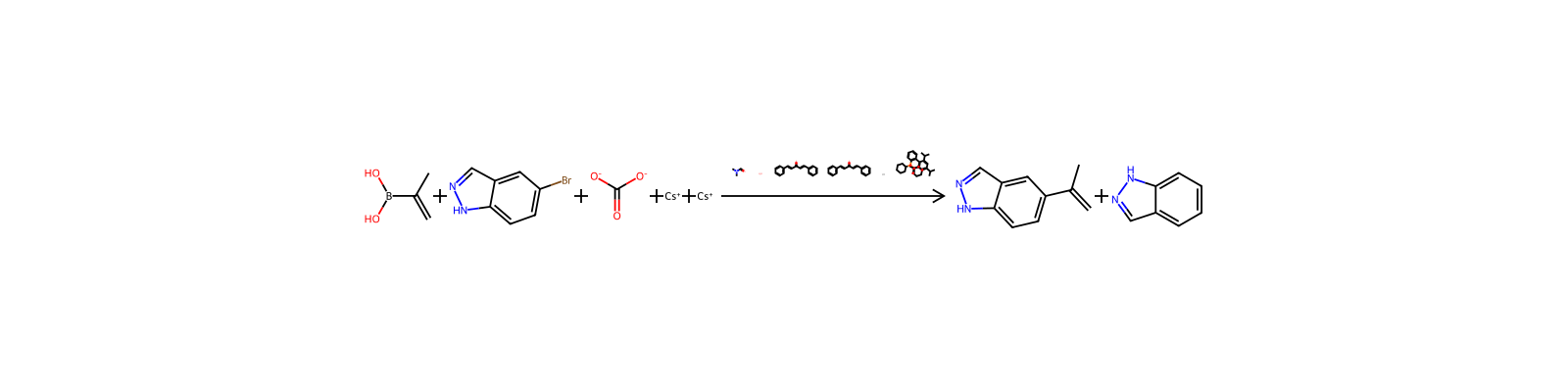
Related reactions
119 records


Linked notes
Loading…