HomeMCPWorkbenchSkills
HomeWorkbenchNotificationsMe
llms.txt · MCP GuidePrivacy Policy · Terms of Service · Supportv1.8.3
  1. Home
  2. /Compound

Octyl isocyanate

HCID 76616
New reaction
Print
Basic informationNames & identifiersPropertiesSafety & regulationChemistry & industryRelated reactionsCompound notes
Substructure searchFind similar structures

Basic information

CAS
3158-26-7
Standard SMILES
CCCCCCCCN=C=O
InChIKey
DYQFCTCUULUMTQ-UHFFFAOYSA-N
Molecular formula
C9H17NO
Average molar mass
155.24 g/mol
Monoisotopic mass
155.13101417

Names & identifiers

Preferred name
Octyl isocyanate
IUPAC
1-isocyanatooctane
English name
Octyl isocyanate
Molecular formula
C9H17NO
Molecular weight
155.24

Names & synonyms

Octyl isocyanate3158-26-7Octane, 1-isocyanato-n-OctylisocyanateDTXSID2062874RefChem:164060DTXCID0038388221-598-11-Isocyanatooctane1-Octyl isocyanateOctylisocyanaten-Octyl isocyanate
Show more names
Octyl isocyate1-isocyanato-octan8-IsocyanatooctaneOctyl isocyanate 97%Octyl isocyanate,99%
MFCD00013887Isocyanic acid, octyl esteroctanisocyanate1-isocyanato-octaneEINECS 221-598-11-Isocyanatooctane #Octyl isocyanate, 97%M7P2BW2GAJ

Database identifiers

CAS
3158-26-7
PubChem CID
76616
DTXSID
DTXSID2062874
UNII
M7P2BW2GAJ
EC Number
221-598-1
Nikkaji
J100.189B

Properties

Computed structural properties

XLogP
4.4
Topological polar surface area
29.4 Ų
Hydrogen bond donors
0
Hydrogen bond acceptors
2
Rotatable bonds
7
Heavy atoms
11
Formal charge
0
Complexity
117

Physicochemical properties

Boiling point
200 · 200-204 °C(lit.)
Density
0.88 g/mL · 0.88 g/mL at 25 °C(lit.)
refractive index
20 · n20/D 1.432(lit.)
Flash point
160 °F · 160 °F
form
Liquid
Specific Gravity
0.88 · 0.88
color
Turbid milky to light yellow
Water Solubility
DECOMPOSES
Sensitive
Moisture Sensitive
InChI
1S/C9H17NO/c1-2-3-4-5-6-7-8-10-9-11/h2-8H2,1H3
InChIKey
DYQFCTCUULUMTQ-UHFFFAOYSA-N
SMILES
CCCCCCCCN=C=O
CAS DataBase Reference
3158 · 3158-26-7(CAS DataBase Reference)
EPA Substance Registry System
1 · Octane, 1-isocyanato- (3158-26-7)
UNSPSC Code
12352100 · 12352100

Safety & regulation

Safety information is for reference only and does not replace the supplier’s Safety Data Sheet (SDS), applicable regulations, or professional assessment.

GHS classification

GHS Classification · 4 items

Danger

H302 (100%): Harmful if swallowed [Warning Acute toxicity, oral]

P233, P260, P261, P264, P264+P265, P270, P271, P280, P284, P301+P317, P302+P352, P304+P340, P305+P351+P338, P317, P319, P321, P330, P332+P317, P337+P317, P342+P316, P362+P364, P403, P403+P233, P405, and P501 (click each P-code to see the statement)

Aggregated GHS information provided per 46 reports by companies from 6 notifications to the ECHA C&L Inventory. Each notification may be associated with multiple companies.

Hazard information

Hazard Classes and CategoriesAcute Tox. 4 (100%)

Safety data

PPE
Eyeshields, Faceshields, Gloves, type ABEK (EN14387) respirator filter
wgk
3
tsca
TSCA listed
ridadr
UN 2206 6.1/PG 3
hs_code
2929109000
risk_code
22-36/37/38-42-20/21/22
Signal word
Danger
Symbol(GHS)
GHS07,GHS08
hazard_code
Xn
safety_code
23-26-36-45-37/39
hazard_class
6.1
Storage Class
6.1C - Combustible acute toxic Cat.3toxic compounds or compounds which causing chronic effects
packing_group
III

Chemistry & industry

Uses & manufacturing

General Manufacturing InformationOctane, 1-isocyanato-: ACTIVE
Applications · 2 items

UsesOctyl isocyanate was used to suppress side reactions such as backbiting or chain transfer reaction during polymerization reactions. It was also used in the synthesis of:low molar mass organogelator containing 2-(2′-hydroxyphenyl)benzoxazole (HPB) unit with long alkyl chainN-octylureaN-cyclopropyl-N′-octylurea

General DescriptionOctyl isocyanate was reported to inactivate serine proteinase, chymotrypsin.

Related reactions

65 records
New reaction record
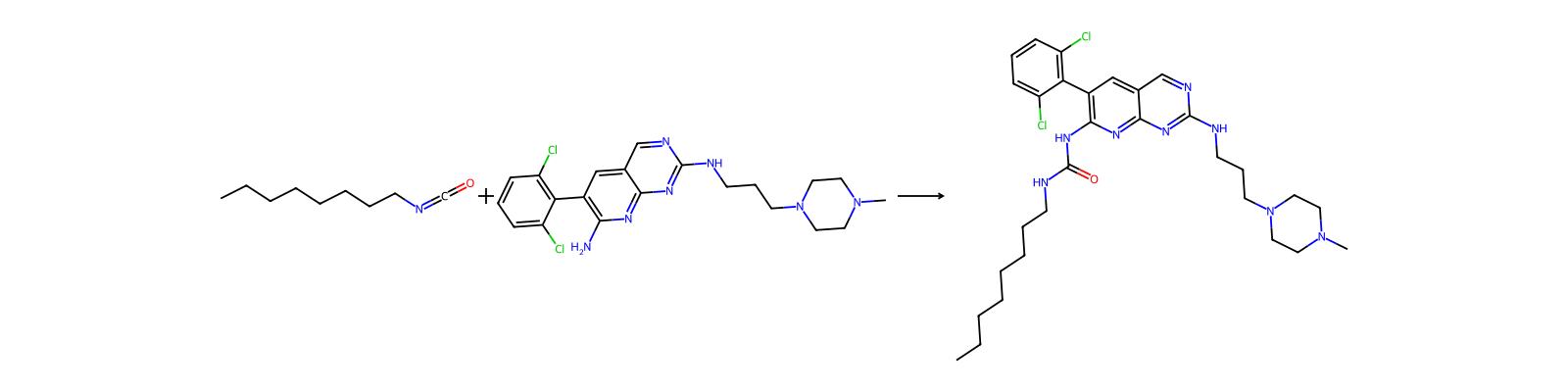
HRID 3434 reaction equation
HRID 3434As reactant
HRID 10025 reaction equation
HRID 10025As reactant
HRID 106927 reaction equation
HRID 106927As reactant
HRID 122051 reaction equation
HRID 122051As reactant
HRID 233051 reaction equation
HRID 233051As reactant
HRID 250837 reaction equation
HRID 250837As reactant
HRID 296779 reaction equation
HRID 296779As product
HRID 316676 reaction equation
HRID 316676As reactant
PreviousPage 1 of 9

Compound notes

On this pageBasic informationNames & identifiersPropertiesSafety & regulationChemistry & industryRelated reactionsCompound notes
NACRES
22 · NA.22
Symbol(GHS)
7 · GHS07,GHS08
Signal word
Danger
Hazard statements
302 · H302-H315-H317-H319-H334-H335
Precautionary statements
261 · P261-P264-P280-P301+P312-P302+P352-P305+P351+P338
target organs
Respiratory system
PPE
Eyeshields, Faceshields, Gloves, type ABEK (EN14387) respirator filter
Hazard Codes
Xn
Risk Statements
22 · 22-36/37/38-42-20/21/22
Safety Statements
23 · 23-26-36-45-37/39
RIDADR
2206 · UN 2206 6.1/PG 3
WGK Germany
3 · 3
TSCA
TSCA listed
HazardClass
6.1 · 6.1
PackingGroup
III
HS Code
2929109000 · 2929109000
Storage Class
6.1 C · 6.1C - Combustible acute toxic Cat.3toxic compounds or compounds which causing chronic effects
Hazard Classifications
4 OralEye · Acute Tox. 4 OralEye Irrit. 2Resp. Sens. 1Skin Irrit. 2Skin Sens. 1STOT SE 3
Limited Quantities
5 L · 5.0 L (1.3 gallons) (liquid) or 5.0 kg (11 lbs) (solid)
Excepted Quantities
Max Inner Pack (30g or 30ml) and Max Outer Pack (1Kg or 1L)
target organs
Respiratory system
Hazard statements
H302-H315-H317-H319-H334-H335
Limited Quantities
5.0 L (1.3 gallons) (liquid) or 5.0 kg (11 lbs) (solid)
Excepted Quantities
Max Inner Pack (30g or 30ml) and Max Outer Pack (1Kg or 1L)
Hazard Classifications
Acute Tox. 4 OralEye Irrit. 2Resp. Sens. 1Skin Irrit. 2Skin Sens. 1STOT SE 3
Precautionary statements
P261-P264-P280-P301+P312-P302+P352-P305+P351+P338