HomeMCPWorkbenchSkills
HomeWorkbenchNotificationsMe
llms.txt · MCP GuidePrivacy Policy · Terms of Service · Supportv1.8.3
  1. Home
  2. /Compound

Iodobenzene diacetate

HCID 76724
New reaction
Print
Basic informationOverviewNames & identifiersPropertiesSafety & regulationChemistry & industryRelated reactionsCompound notes
Substructure searchFind similar structures

Basic information

CAS
3240-34-4
Standard SMILES
CC(=O)OI(OC(C)=O)c1ccccc1
InChIKey
ZBIKORITPGTTGI-UHFFFAOYSA-N
Molecular formula
C10H11IO4
Average molar mass
322.1 g/mol
Monoisotopic mass
321.97021

Overview

glycol-cleaving reagent used with amino alcohols in ring opening & Mannich base reactions; structure

Names & identifiers

Preferred name
Iodobenzene diacetate
IUPAC
[acetyloxy(phenyl)-λ3-iodanyl] acetate
English name
(Diacetoxyiodo)benzene
Molecular formula
C10H11IO4
Molecular weight
322.1

Names & synonyms

(Diacetoxyiodo)benzeneIodobenzene diacetate3240-34-4Iodosobenzene diacetatePhenyliodo diacetatePhenyliodoso acetateBis(acetato)phenyliodinePIDAPhenyliodine diacetatePhenyliodoso diacetatePhenyliodosyl diacetatePhenyliodosodiacetate
Show more names
PhI(OAc)2BAIB[Bis(acetoxy)iodo]benzeneDAIBphenyl-l3-iodanediyl diacetate
Phenyliodine(III) diacetate((diacetoxy)iodo)benzeneIodine, bis(acetato-kappaO)phenyl-NSC-23801AY2C9T5FRZNSC-226375DTXSID0062929DAIB cpd

Database identifiers

CAS
3240-34-4
PubChem CID
76724
DTXSID
DTXSID0062929
ChEMBL
CHEMBL3391738
UNII
AY2C9T5FRZ
EC Number
221-808-1
Nikkaji
J54.893F

Properties

Computed structural properties

XLogP
2.8
Topological polar surface area
52.6 Ų
Hydrogen bond donors
0
Hydrogen bond acceptors
4
Rotatable bonds
5
Heavy atoms
15
Formal charge
0
Complexity
220

Experimental & physicochemical properties

Chemical ClassesOther Classes -> Halogenated Monoaromatics
Physical DescriptionWhite or pale yellow powder; [Alfa Aesar MSDS]

Physicochemical properties

Melting point
163 · 163–165 °C (325–329 °F; 436–438 K)
Density
1.361 g/mL · 1.361 g/mL
refractive index
1.444 · n /D 1.444
Flash point
Not applicable
storage temp.
Keep in dark place,Sealed in dry,Room Temperature
solubility
INSOLUBLE
form
powder
color
white
biological source
mouse
Water Solubility
INSOLUBLE
Sensitive
Light Sensitive
BRN
1879369 · 1879369
Stability
Light and Moisture sensitive
InChI
1S/C10H11IO4/c1-8(12)14-11(15-9(2)13)10-6-4-3-5-7-10/h3-7H,1-2H3
InChIKey
ZBIKORITPGTTGI-UHFFFAOYSA-N
SMILES
CC(OI(OC(C)=O)C1=CC=CC=C1)=O
CAS DataBase Reference
3240 · 3240-34-4(CAS DataBase Reference)
EWG's Food Scores
1 · 1
NIST Chemistry Reference
Iodobenzene diacetate(3240-34-4)
EPA Substance Registry System
Iodine, bis(acetato-.kappa.O)phenyl- (3240-34-4)
UNSPSC Code
12352203 · 12352203
NACRES
41 · NA.41
Symbol(GHS)
7 · GHS07
Signal word
Warning
Hazard statements
335 · H335-H315-H319
Precautionary statements
264 · P264-P280-P302+P352+P332+P313+P362+P364-P305+P351+P338+P337+P313-P261-P280a-P304+P340-P305+P351+P338-P405-P501a
PPE
95 · Eyeshields, Gloves, type N95 (US)
Hazard Codes
Xi
Risk Statements
36 · 36/37/38
Safety Statements
22 · 22-24/25-37/39-26-36/37/39-27
RIDADR
1479 · 1479
WGK Germany
3 · 3
RTECS
3525000 · DA3525000
F
4.1 · 4.10-8
Hazard Note
Irritant
TSCA
TSCA listed
HazardClass
6.1 · 6.1(b)
PackingGroup
III
HS Code
2903999090 · 2903999090
Storage Class
11 · 11 - Combustible Solids
REACH Registrations
Active

Safety & regulation

Safety information is for reference only and does not replace the supplier’s Safety Data Sheet (SDS), applicable regulations, or professional assessment.

GHS classification

GHS Classification · 5 items

This chemical does not meet GHS hazard criteria for 64.4% (38 of 59) of all reports.

Warning

H302 (18.6%): Harmful if swallowed [Warning Acute toxicity, oral]

P261, P264, P264+P265, P270, P271, P280, P301+P317, P302+P352, P304+P340, P305+P351+P338, P319, P321, P330, P332+P317, P337+P317, P362+P364, P403+P233, P405, and P501 (click each P-code to see the statement)

Aggregated GHS information provided per 59 reports by companies from 11 notifications to the ECHA C&L Inventory. Each notification may be associated with multiple companies.

Hazard information

Regulatory Information · 2 items

REACH registered substance: Bis(acetato-O)phenyliodine (EC: 221-808-1)

Iodine, bis(acetato-.kappa.O)phenyl-: Does not have an individual approval but may be used under an appropriate group standard

Hazards SummaryIntravenous LD50 (mouse) = 56 mg/kg; [RTECS] A skin and strong eye irritant; [Alfa Aesar MSDS]
Hazard Classes and CategoriesAcute Tox. 4 (18.6%)

Safety data

F
4.10-8
PPE
Eyeshields, Gloves, type N95 (US)
wgk
3
tsca
TSCA listed
rtecs
DA3525000
ridadr
1479
hs_code
2903999090
risk_code
36/37/38
Signal word
Warning
Symbol(GHS)
GHS07
hazard_code
Xi
hazard_note
Irritant
safety_code
22-24/25-37/39-26-36/37/39-27
hazard_class
6.1(b)
Storage Class
11 - Combustible Solids
packing_group
III
Hazard statements
H335-H315-H319
REACH Registrations
Active
Precautionary statements
P264-P280-P302+P352+P332+P313+P362+P364-P305+P351+P338+P337+P313-P261-P280a-P304+P340-P305+P351+P338-P405-P501a

Chemistry & industry

Uses & manufacturing

UsesGlycol-cleaving reagent used with amino alcohols in ring opening & Mannich base reactions. [ChemIDplus]
General Manufacturing InformationIodine, bis(acetato-.kappa.O)phenyl-: ACTIVE
Applications · 1 item

Uses(Diacetoxyiodo)benzene is a hypervalent iodine reagent that is used in conjunction with catalytic amount of sodium azide in acetonitrile, which enables oxidative decarboxylation of 2-aryl carboxylic acid into the corresponding aldehydes, ketones and nitriles.

Upstream & downstream products

Upstream raw materials

IodobenzeneEthyl 2-(Chlorosulfonyl)acetateAcetic anhydrideHydrogen peroxideAcetic acid4-hydroxyphenyl acetateCyclopropylbenzeneIodosobenzeneTrimethylsilyl acetate[N-(p-Toluenesulfonyl)imino]phenyliodinanep-Toluenesulfonamide1,4-BenzoquinonePeroxyacetic acid

Downstream products

1-IodobutaneDimethylbenzylcarbinyl acetateEthanone, 2,2-bis(acetyloxy)-1-phenyl-2-Propanone, 1-(acetyloxy)-3-bromo-1H-Indol-3-ol, 5-Methoxy-, 3-acetate

Related reactions

54 records
New reaction record
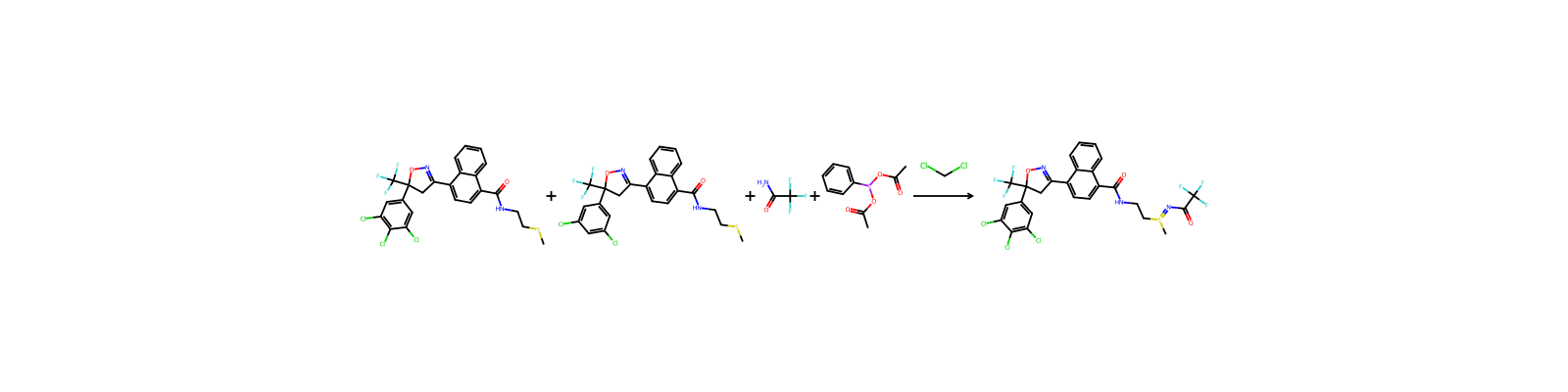
HRID 331497 reaction equation
HRID 331497As reactant
HRID 424626 reaction equation
HRID 424626As reactant
HRID 467594 reaction equation
HRID 467594As reactant
HRID 508129 reaction equation
HRID 508129As reactant
HRID 508131 reaction equation
HRID 508131As reactant
HRID 520679 reaction equation
HRID 520679As reactant
HRID 520684 reaction equation
HRID 520684As reactant
HRID 520847 reaction equation
HRID 520847As reactant
PreviousPage 1 of 7

Compound notes

On this pageBasic informationOverviewNames & identifiersPropertiesSafety & regulationChemistry & industryRelated reactionsCompound notes