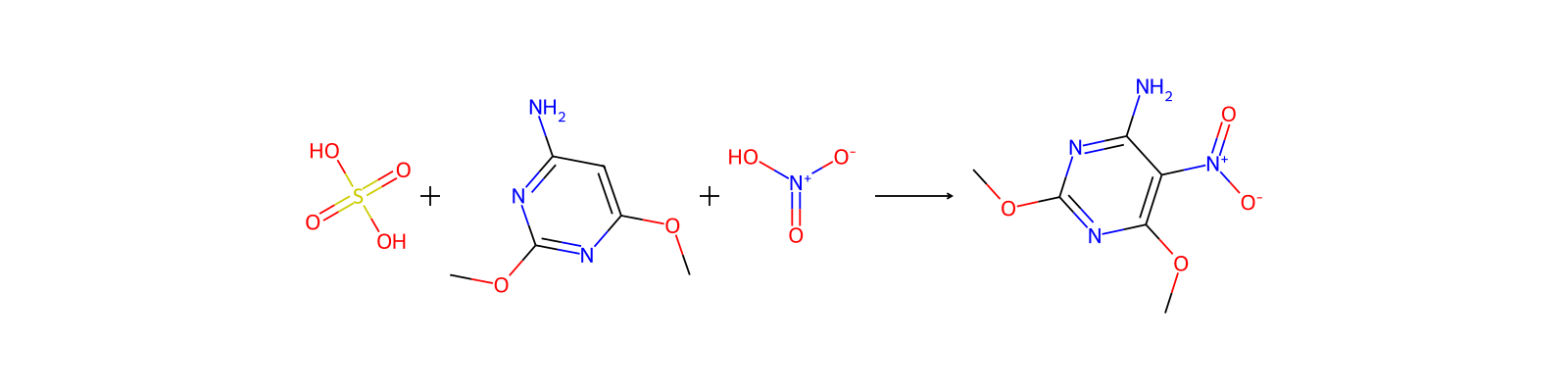
HRID 4131As reactant
Completing data — refresh the page later to see the latest

3289-50-7COc1cc(N)nc(OC)n1LNTJJKHTAZFVJJ-UHFFFAOYSA-N3289-50-7DTXSID2062959Safety information is for reference only and does not replace the supplier’s Safety Data Sheet (SDS), applicable regulations, or professional assessment.
Warning
H315 (100%): Causes skin irritation [Warning Skin corrosion/irritation]
P261, P264, P264+P265, P271, P280, P302+P352, P304+P340, P305+P351+P338, P319, P321, P332+P317, P337+P317, P362+P364, P403+P233, P405, and P501 (click each P-code to see the statement)
Aggregated GHS information provided per 68 reports by companies from 4 notifications to the ECHA C&L Inventory. Each notification may be associated with multiple companies.
Uses4-Amino-2,6-dimethoxypyrimidine is a compound that may be polychlorinated. It is also (Sulfadimethoxine EP Impurity A) is an impurity of Sulfadimethoxine, an antibacterial agents that is an emerging contaminant of concern.
Uses4-Amino-2,6-dimethoxypyrimidine is a compound that may be polychlorinated (1). It is also (Sulfadimethoxine EP Impurity A) is an impurity of Sulfadimethoxine (S699060), an antibacterial agents that is an emerging contaminant of concern (2).
General Description4-Amino-2,6-dimethoxypyrimidine is methoxy substituted 4-aminopyrimidine. Molecules of 4-amino-2,6-dimethoxypyrimidine are linked by an N-H.O hydrogen bond and an N-H.N hydrogen bond, forming sheets containing centrosymmetric rings. Photocatalytic degradation of 4-amino-2,6-dimethoxypyrimidine on TiO2 has been reported. Mass spectra of 4-amino-2,6-dimethoxypyrimidine has been studied.


