
4'-Bromoacetanilide
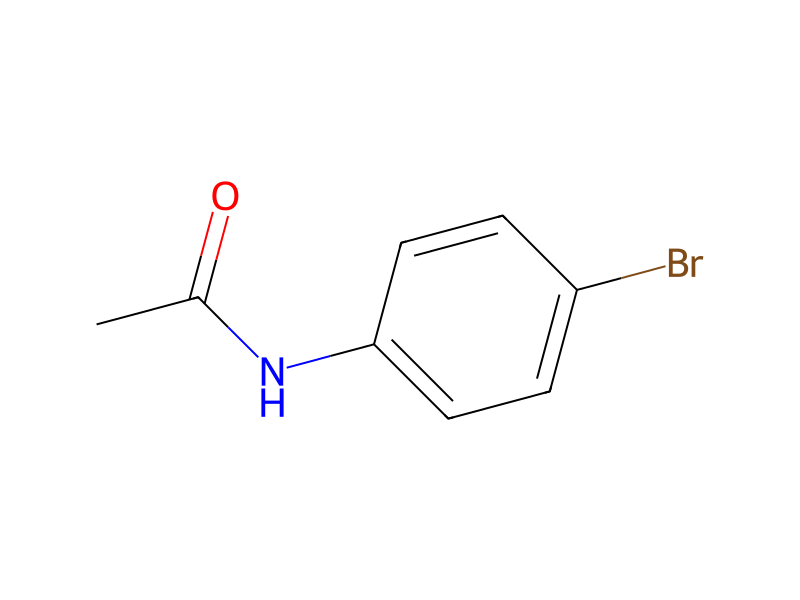
Basic information
- CAS
103-88-8- Standard SMILES
CC(=O)Nc1ccc(Br)cc1- InChIKey
MSLICLMCQYQNPK-UHFFFAOYSA-N- Molecular formula
- C8H8BrNO
- Average molar mass
- 214.06 g/mol
- Monoisotopic mass
- 212.97893
Names & identifiers
- Preferred name
- 4'-Bromoacetanilide
- IUPAC
- N-(4-bromophenyl)acetamide
- English name
- 4'-Bromoacetanilide
- Molecular formula
- C8H8BrNO
- Molecular weight
- 214.06
Names & synonyms
4'-Bromoacetanilide103-88-84-BROMOACETANILIDEN-(4-Bromophenyl)acetamidep-BromoacetanilideBromoanilideAcetamide, N-(4-bromophenyl)-BromoantifebrinAntisepsinAsepsinN-Acetyl-4-bromoanilinep-Bromo-N-acetanilide
Show more names
Bromoacetanilide4-BROMOACETOANILIDE4-Bromoacetanilide, 98% PSusafdo-40Bromanilide
1-Bromo-4-acetamidobenzeneAcetanilide, p-bromo-USAF DO-40Acetanilide, 4'-bromo-N-(4-Bromo-phenyl)-acetamideN-Acetyl-p-bromoanilineNSC 105442N-(p-Bromophenyl)acetamide
Database identifiers
- CAS
103-88-8- PubChem CID
- 7683
- DTXSID
DTXSID6059283- ChEMBL
CHEMBL59019- UNII
- 4KB44F25A3
- EC Number
- 203-154-9
- Nikkaji
- J37.694I
Properties
Computed structural properties
- XLogP
- 2.3
- Topological polar surface area
- 29.1 Ų
- Hydrogen bond donors
- 1
- Hydrogen bond acceptors
- 1
- Rotatable bonds
- 1
- Heavy atoms
- 11
- Formal charge
- 0
- Complexity
- 141
Experimental & physicochemical properties
SpringerMaterials Properties13C nuclear magnetic resonance spectrum
LogP2.14
Physicochemical properties
- Melting point
- 165 · 165-169 °C(lit.)
- Boiling point
- 353.4 °C · 353.4°C (estimate)
- Density
- 1.72 · 1.72
- refractive index
- 1.612 · 1.6120 (estimate)
- storage temp.
- 30 °C · Store below +30°C.
- solubility
- alcohol: moderately soluble
- form
- Crystalline Powder or Crystals
- pka
- 14.25 · 14.25±0.70(Predicted)
- color
- White to beige or light gray
- Water Solubility
- Insoluble
- Merck
- 14 · 14,1399
- BRN
- 2208091 · 2208091
Safety & regulation
Safety information is for reference only and does not replace the supplier’s Safety Data Sheet (SDS), applicable regulations, or professional assessment.
GHS classification
GHS Classification
Warning
H315 (97.9%): Causes skin irritation [Warning Skin corrosion/irritation]
P261, P264, P264+P265, P271, P280, P302+P352, P304+P340, P305+P351+P338, P319, P321, P332+P317, P337+P317, P362+P364, P403+P233, P405, and P501 (click each P-code to see the statement)
Aggregated GHS information provided per 48 reports by companies from 6 notifications to the ECHA C&L Inventory. Each notification may be associated with multiple companies.
Hazard information
Regulatory Information
Chemical: Acetamide, N-(4-bromophenyl)-
Acetamide, N-(4-bromophenyl)-: Does not have an individual approval but may be used under an appropriate group standard
Hazard Classes and CategoriesSkin Irrit. 2 (97.9%)
Safety data
- PPE
- dust mask type N95 (US), Eyeshields, Gloves
- wgk
- 3
- tsca
- TSCA listed
- rtecs
- AD9625000
- ridadr
- 2811
- hs_code
- 29242998
- Toxicity
- mouse,LD50,intraperitoneal,250mg/kg (250mg/kg),National Technical Information Service. Vol. AD277-689,
- risk_code
- 36/37/38
- Signal word
- Warning
- Symbol(GHS)
- GHS07
- hazard_code
- Xi
- hazard_note
Chemistry & industry
Uses & manufacturing
General Manufacturing InformationAcetamide, N-(4-bromophenyl)-: ACTIVE
Applications
Uses4'-Bromoacetanilide is used as an internal standard for phenylurea and the respective metabolic products in oysters. It has also been used as a reagent in the production of a new ligand to form a coordination compex between gadolinium(III) and T=titanium(IV) oxide. It was used in the synthesis of new ligand for anchoring Gd(III) chelates onto TiO2 surface.
Uses4-Bromoacetanilide was used as internal standard in determination of several phenylurea and triazine herbicides and their transformation products in oyster. It was used in the synthesis of new ligand for anchoring Gd(III) chelates onto TiO2 surface.
Preparation methods
PreparationPreparation of 4'-Bromoacetanilide from Acetanilide. Principle: Aromatic compounds can be conveniently brominated by the use of brominating agent, which is normally a solution of bromine in acetic acid. Bromination of activated aromatic compounds usually give 2, 4, 6-tribromo derivatives while moderately activating group like anilide give preferably the para bromo product. Reaction: Procedure: Dissolve 0.5 g acetanilide in 0.6 ml glacial acetic acid and add 2.5 ml bromine solution in acetic acid (25% w/v). Shake the mixture for 1 h. After 1 h, pour the mixture on to crushed ice (20 g) with stirring. Filter the separated product and wash with cold water. Dry the product, record the practical yield and re-crystallize it. Re-crystallization: Dissolve the crude product in minimum amount of ethyl alcohol in a beaker by heating on a water bath. Filter the hot solution and cool the filtrate. The crystals of the product separate out. Filter, dry and record the melting point and TLC (using toluene as a solvent).
Upstream & downstream products
Upstream raw materials
Related reactions
56 records


Compound notes
Loading…