HuagongsheHuagongshe Chemistry Print Report · For research reference only
HCID 76868Generated: October 29, 2026
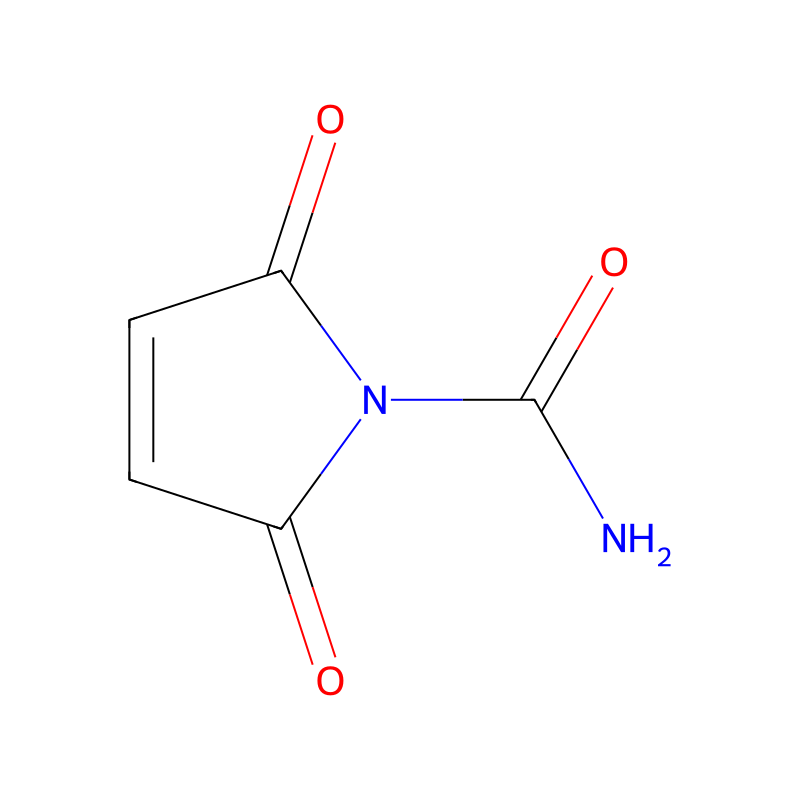
N-Carbamylmaleimide
ASISCHEM Y94152 · N-CARBAMOYLMALEIMIDE · N-CARBAMYL MALEIMIDE · 2,5-dioxo-1-pyrrolecarboxamide · 2,5-dioxopyrrole-1-carboxamide · 1-carbamoyl-3-pyrroline-5-dione · 2,5-dioxo-3-pyrrolinecarboxamid · N-CARBAMOYLMALEIMIDE: TECH., 90%
https://huagongshe.com/en/chemical/76868
Identifiers & Physical Properties
| CAS No. | 3345-50-4 |
|---|
| Molecular formula | C5H4N2O3 |
|---|
| Average molar mass | 140.1 g/mol |
|---|
| Monoisotopic mass | 140.02219199 g/mol |
|---|
| SMILES | NC(=O)N1C(=O)C=CC1=O |
|---|
| InChIKey | BNPFHEFZJPVCCE-UHFFFAOYSA-N |
|---|
| PubChem CID | 76868 |
|---|
| EC No. | 222-097-0 |
|---|
| DTXSID | DTXSID90187096 |
|---|
Chemical & Physical Properties
| XLogP | -0.8 |
|---|
| Topological polar surface area | 80.5 |
|---|
| Hydrogen bond donors | 1 |
|---|
| Hydrogen bond acceptors | 3 |
|---|
| Rotatable bonds | 0 |
|---|
| Heavy atoms | 10 |
|---|
| Formal charge | 0 |
|---|
| Complexity | 225 |
|---|
| Melting point | 157-160°C |
|---|
| Boiling point | 307.0±25.0 °C(Predicted) |
|---|
| Density | 1.658±0.06 g/cm3(Predicted) |
|---|
| pKa (acidity coefficient) | 11.97±0.20(Predicted) |
|---|
| BRN | 117919 |
|---|
| CAS DataBase Reference | 3345-50-4(CAS DataBase Reference) |
|---|
| FDA UNII | 2FBC8KJ3Q8 |
|---|
| GHS pictogram | GHS07 |
|---|
| Signal word | Warning |
|---|
| GHS hazard statements | H315-H319-H335 |
|---|
| GHS precautionary statements | P261-P280a-P304+P340-P305+P351+P338-P405-P501a |
|---|
| Risk statements (R) | 36/37/38 |
|---|
| Safety statements (S) | 26-36/37/39 |
|---|
| RTECS number | UY7352700 |
|---|
| Toxicity | mouse,LD50,intravenous,56mg/kg (56mg/kg),U.S. Army Armament Research & Development Command, Chemical Systems Laboratory, NIOSH Exchange Chemicals. Vol. NX#04857, |
|---|
Safety & Regulations
| GHS classification | WarningH302 (88.4%): Harmful if swallowed [Warning Acute toxicity, oral]P261, P264, P264+P265, P270, P271, P280, P301+P317, P302+P352, P304+P340, P305+P351+P338, P319, P321, P330, P332+P317, P337+P317, P362+P364, P403+P233, P405, and P501 (click each P-code to see the statement)Aggregated GHS information provided per 43 reports by companies from 3 notifications to the ECHA C&L Inventory. Each notification may be associated with multiple companies. |
|---|
| Hazard Classes and Categories | Acute Tox. 4 (88.4%) |
|---|
| RTECS number | UY7352700 |
|---|
| Toxicity | mouse,LD50,intravenous,56mg/kg (56mg/kg),U.S. Army Armament Research & Development Command, Chemical Systems Laboratory, NIOSH Exchange Chemicals. Vol. NX#04857, |
|---|
| Risk statements (R) | 36/37/38 |
|---|
| Signal word | Warning |
|---|
| GHS pictogram | GHS07 |
|---|
| Safety statements (S) | 26-36/37/39 |
|---|
| GHS hazard statements | H315-H319-H335 |
|---|
| GHS precautionary statements | P261-P280a-P304+P340-P305+P351+P338-P405-P501a |
|---|