
HRID 354528As reactant
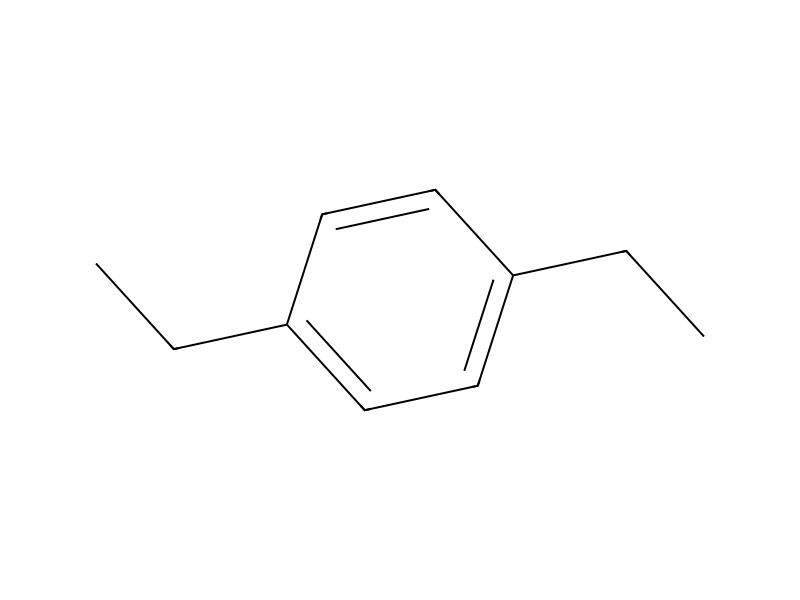
105-05-5CCc1ccc(CC)cc1DSNHSQKRULAAEI-UHFFFAOYSA-N1,4-Diethylbenzene is a member of benzenes.
105-05-5DTXSID4026711CHEMBL3187283CHEBI:34062log Kow= 4.45
4.22
Miscible in ethanol, ethyl ether and acetone
Soluble in alcohol, benzene, carbon tetrachloride, ether. /Diethylbenzene/
In water, 24.8 mg/l @ 25 °C.
55 °C
132 °F (55 °C) (Closed cup)
Safety information is for reference only and does not replace the supplier’s Safety Data Sheet (SDS), applicable regulations, or professional assessment.
Danger
H226 (100%): Flammable liquid and vapor [Warning Flammable liquids]
P210, P233, P240, P241, P242, P243, P264, P264+P265, P273, P280, P301+P316, P302+P352, P303+P361+P353, P305+P354+P338, P317, P321, P331, P332+P317, P362+P364, P370+P378, P391, P403+P235, P405, and P501 (click each P-code to see the statement)
Aggregated GHS information provided per 1120 reports by companies from 16 notifications to the ECHA C&L Inventory. Each notification may be associated with multiple companies.
Warning
H226: Flammable liquid and vapor [Warning Flammable liquids]
Benzene, 1,4-diethyl- is listed on the EPA's Chemical Data Reporting (CDR) system. Manufacturers and importers of Benzene, 1,4-diethyl- are required to report information about their production and use of this chemical to the EPA under the Toxic Substances Control Act (TSCA). (40 eCFR Part 711)
REACH registered substance: 1,4-diethylbenzene (EC: 203-265-2)
1,4-Diethylbenzene: Does not have an individual approval but may be used under an appropriate group standard
Flammable liquid when exposed to heat or flame ... /Diethyl benzene/
COMBUSTIBLE ... MODERATE FIRE RISK. /DIETHYLBENZENE/
Volunteers complain of severe eye irritation and lacrimation at 2000 ppm; [HSDB] An irritant; Effects in high-dose animal studies include general anesthesia and liver changes; [MSDSonline]
The major hazards encountered in the use and handling of 1,4-diethylbenzene stem from its toxicologic properties and flammability. Exposure to this colorless, aromatic-smelling liquid may occur through dermal contact or inhalation at places where it is produced or used as a plasticizer, solvent, chemical intermediate in the manufacture of divinylbenzene, or in powderless etching. Effects from exposure may include contact burns to the skin and eyes. In activities and situations where over-exposure may occur, wear a positive pressure self-contained breathing apparatus and protective clothing. If contact should occur, irrigate exposed eyes with copious amounts of tepid water for at least 15 minutes, and wash exposed skin thoroughly with soap and water. Contaminated clothing and shoes should be removed at the site. 1,4-Diethylbenzene may be ignited by heat, sparks, or flames. Also, containers of this substance may explode in the heat of a fire. Its heavier-than-air vapor may travel to a source of ignition and flash back, or accumulate to explosive concentrations in confined spaces such as sewers. For fires involving 1,4-diethylbenzene, extinguish with dry chemical, CO2, water spray, fog, or standard foam. Isolate the area for 1/2 mile in all directions if a tank, rail car, or tank truck is involved in the fire. Small spills of 1,4-diethylbenzene may be taken up with sand or other noncombustible absorbent and placed into containers for later disposal. For a large spill, use water spray to reduce the vapor, and dike far ahead of the spill to prevent runoff.
Used as an intermediate, solvent, and in powderless etching; [HSDB]
Intermediate; solvent /diethylbenzene/
Used as a solvent in the Parex process for the production of paraxylene.
Diethylbenzenes are used for the manufacture of divinylbenzene. /Diethylbenzenes/
Diethylbenzenes are used in powderless etching. /Diethylbenzenes/
For more Uses (Complete) data for 1,4-DIETHYLBENZENE (6 total), please visit the HSDB record page.
UNREACTED BENZENE, SPENT ALUMINUM CHLORIDE AND ETHYLBENZENE ARE IMPURITIES OF THE FRIEDEL-CRAFTS REACTION. /ETHYLBENZENES/
Impurities of production are propyl- and butyl-benzenes. /Diethylbenzenes/
Ethyl-, triethyl-, and higher polyethylbenzenes are impurities of the Friedel-Crafts alkylation process. /Diethylbenzenes/
MANUFACTURED BY THE FRIEDEL-CRAFTS REACTION INVOLVING ETHYLENE AND BENZENE IN FLUID PHASE USING ALUMINUM CHLORIDE CATALYST. THE CATALYST IS REMOVED BY WASHING WITH WATER AND CAUSTIC. /DIETHYLBENZENES/
Produced by the disproportionation reaction of ethylbenzene. /Diethylbenzenes/
Occurs as a byproduct in the production of ethylbenzene from benzene and ethylene.
Gas-phase alkylation of ethylbenzene with ethylene produced 99% of the 1,4-diethylbenzene isomer by modifying the catalyst.


1.06 [mmHg]
1.03 mm Hg @ 25 °C
/GUIDE 130: FLAMMABLE LIQUIDS (NON-POLAR/WATER-IMMISCIBLE/NOXIOUS)/ Fire or Explosion: HIGHLY FLAMMABLE: Will be easily ignited by heat, sparks or flames. Vapors may form explosive mixtures with air. Vapors may travel to source of ignition and flash back. Most vapors are heavier than air. They will spread along ground and collect in low or confined areas (sewers, basements, tanks). Vapor explosion hazard indoors, outdoors or in sewers. Those substances designated with a "P" may polymerize explosively when heated or involved in a fire. Runoff to sewer may create fire or explosion hazard. Containers may explode when heated. Many liquids are lighter than water. /Diethylbenzene/
/GUIDE 130: FLAMMABLE LIQUIDS (NON-POLAR/WATER-IMMISCIBLE/NOXIOUS)/ Health: May cause toxic effects if inhaled or absorbed through skin. Inhalation or contact with material may irritate or burn skin and eyes. Fire will produce irritating, corrosive and/or toxic gases. Vapors may cause dizziness or suffocation. Runoff from fire control or dilution water may cause pollution. /Diethylbenzene/
/GUIDE 130: FLAMMABLE LIQUIDS (NON-POLAR/WATER-IMMISCIBLE/NOXIOUS)/ Public Safety: CALL Emergency Response Telephone Number ... . As an immediate precautionary measure, isolate spill or leak area for at least 50 meters (150 feet) in all directions. Keep unauthorized personnel away. Stay upwind. Keep out of low areas. Ventilate closed spaces before entering. /Diethylbenzene/
/GUIDE 130: FLAMMABLE LIQUIDS (NON-POLAR/WATER-IMMISCIBLE/NOXIOUS)/ Protective Clothing: Wear positive pressure self-contained breathing apparatus (SCBA). Structural firefighters' protective clothing will only provide limited protection. /Diethylbenzene/
For more DOT Emergency Guidelines (Complete) data for 1,4-DIETHYLBENZENE (8 total), please visit the HSDB record page.
2 - Materials that, under emergency conditions, can cause temporary incapacitation or residual injury.
2 - Materials that must be moderately heated or exposed to relatively high ambient temperatures before ignition can occur. Materials would not under normal conditions form hazardous atmospheres with air, but under high ambient temperatures or under moderate heating could release vapor in sufficient quantities to produce hazardous atmospheres with air.
0 - Materials that in themselves are normally stable, even under fire conditions.
Flam. Liq. 3 (100%)
Flammable liquids - Category 3
No person may /transport,/ offer or accept a hazardous material for transportation in commerce unless that person is registered in conformance ... and the hazardous material is properly classed, described, packaged, marked, labeled, and in condition for shipment as required or authorized by ... /the hazardous materials regulations (49 CFR 171-177)./
The International Air Transport Association (IATA) Dangerous Goods Regulations are published by the IATA Dangerous Goods Board pursuant to IATA Resolutions 618 and 619 and constitute a manual of industry carrier regulations to be followed by all IATA Member airlines when transporting hazardous materials.
The International Maritime Dangerous Goods Code lays down basic principles for transporting hazardous chemicals. Detailed recommendations for individual substances and a number of recommendations for good practice are included in the classes dealing with such substances. A general index of technical names has also been compiled. This index should always be consulted when attempting to locate the appropriate procedures to be used when shipping any substance or article.
UN 2049; Diethylbenzene
IMO 3.3; Diethylbenzenes (ortho-; meta-; para-)
SRP: At the time of review, criteria for land treatment or burial (sanitary landfill) disposal practices are subject to significant revision. Prior to implementing land disposal of waste residue (including waste sludge), consult with environmental regulatory agencies for guidance on acceptable disposal practices.
SRP: The scientific literature for the use of contact lenses in industry is conflicting. The benefit or detrimental effects of wearing contact lenses depend not only upon the substance, but also on factors including the form of the substance, characteristics and duration of the exposure, the uses of other eye protection equipment, and the hygiene of the lenses. However, there may be individual substances whose irritating or corrosive properties are such that the wearing of contact lenses would be harmful to the eye. In those specific cases, contact lenses should not be worn. In any event, the usual eye protection equipment should be worn even when contact lenses are in place. /Diethyl benzene/
TERRESTRIAL FATE: Based on a classification scheme(1), an estimated Koc value of 1600(SRC), determined from a structure estimation method(2), indicates that 1,4-diethylbenzene is expected to have low mobility in soil(SRC). Volatilization of 1,4-diethylbenzene from moist soil surfaces is expected to be an important fate process(SRC) given an estimated Henry's Law constant of 0.007335 atm-cu m/mole(3) estimated from its vapor pressure, 1.03 mm Hg(4), and water solubility, 24.8 mg/l(5). The potential for volatilization of 1,4-diethylbenzene from dry soil surfaces may exist based upon its vapor pressure(4).
AQUATIC FATE: Based on a classification scheme(1), an estimated Koc value of 1600(SRC), determined from an estimation method(2), indicates that 1,4-diethylbenzene is expected to adsorb to suspended solids and sediment(SRC). Volatilization from water surfaces is expected(3) based upon an estimated Henry's Law constant of 0.007335 atm-cu m/mole(4) estimated from its vapor pressure, 1.03 mm Hg(8), and water solubility, 24.8 mg/l(9). Using this estimated Henry's Law constant and an estimation method(3), volatilization half-lives for a model river and model lake are 1.3 hr and 5 days, respectively(SRC). According to a classification scheme(5), an estimated BCF of 530(SRC), from its log Kow of 4.45(6), and a regression-derived equation(7), suggests the potential for bioconcentration in aquatic organisms is high. Groundwater(10) and marine water grab sample tests(11), in which 1,4-diethylbenzene was a constituent of gas oil mixtures, suggests that 1,4-diethylbenzene will biodegrade in the aquatic environment.
ATMOSPHERIC FATE: According to a model of gas/particle partitioning of semivolatile organic compounds in the atmosphere(1), 1,4-diethylbenzene, which has a vapor pressure of 1.03 mm Hg at 25 °C(2), is expected to exist solely as a vapor in the ambient atmosphere. Vapor-phase 1,4-diethylbenzene is degraded in the atmosphere by reaction with photochemically-produced hydroxyl radicals(SRC); the half-life for this reaction in air is estimated to be 2 days(SRC), calculated from its rate constant of 8.1X10⁻¹² cu cm/molecule-sec at 25 °C determined using a structure estimation method(3). 1,2-Diethylbenzene has the potential to undergo direct photolysis in air as it absorbs UV light at wavelengths in the environmentally significant range, >290 nm(4).
Off-gas concns from the Skyway Waste treatment and Highland Creek plant in Ontario, Canada consisted of 185 and 625 ug/cu m 1,4-diethylbenzene, respectively(1). 1,4-Diethylbenzene represented 0.44% and 0.36% of the total emission components from light duty vehicle emissions collected in August and October of 1994, respectively, from the Caldecott Tunnel in California(2). Vulcanization and extrusion operations during rubber and synthetic production with electrical insulation emits 1,4-diethylbenzene to the air(3). 1,4-Diethylbenzene was detected at a concn of 2.0 ug/cu m in a plume at a distance of 1 mile from its source, a General Motors facility located in Janesville, Wisconsin(4). Leachate samples taken from Guelph and Muskoka municipal waste treatment plants in Ontario were tested for 1,4-diethylbenzene and none was detected(5). 1,4-Diethylbenzene was found in unquantified amounts in the effluent sample of a water treatment plant(7). 1,4-Diethylbenzene was detected, but not quantified, as an introduced volatile organic compound in the water of a test stand basin after a four-stroke outboard motor filled with unleaded gasoline was left in operation for 10 minutes(6).
Using a structure estimation method based on molecular connectivity indices(1), the Koc for 1,4-diethylbenzene can be estimated to be 1600(SRC). According to a classification scheme(2), this estimated Koc value suggests that 1,4-diethylbenzene is expected to have low mobility in soil.
URBAN/SUBURBAN: 1,4-Diethylbenzene was listed as one of 64 most abundant air pollutants in US cities(4). For 821 air samples, collected from 1984-6, in 39 US cities, the median 1,4-diethylbenzene concn is 2.4 ppbC with a minimum and maximum concn of 4.0 and 33 ppbC(4). According to the National Ambient Volatile Organic Compounds (VOCs) Database, the median urban atmospheric concn of 1,4-diethylbenzene below the detection limit for 250 samples and the median suburban atmospheric concn of 1,4-diethylbenzene is 0.250 ppbV for 71 samples(2). The 1,4-diethylbenzene concn ranged from 0 to 3 ppbV at a downtown Los Angeles location where it was detected in 16 of 17 samples in the Fall of 1981(3). Diethylbenzenes were detected in 4 of 4 outdoor air samples and 8 of 12 indoor air samples from 10 public access buildings (offices, schools, homes for the elderly and a hospital)(1).
SOURCE DOMINATED: 1,4-Diethylbenzene was detected in the air at the Gatwick Airport, UK in 1979(1).
MEN EXPOSED TO 1000 PPM ... EXPERIENCED EYE IRRITATION WHICH RAPIDLY DIMINISHED IN INTENSITY ON CONTINUED EXPOSURE. A CONCN OF 2000 PPM CAUSED IMMEDIATE, SEVERE EYE IRRITATION, LACRIMATION, AND IRRITATION OF THE MUCOUS MEMBRANES OF THE NOSE. ... 5000 PPM ... CAUSES INTOLERABLE IRRITATION OF ... EYES ... NOSE. /ETHYLBENZENE/
SKIN INJURY FROM CONTACT WITH PARADIETHYLBENZENE IS DESCRIBED.
1,4-Diethylbenzene's production and use as a component of gasoline at a 0.10 WT%(1), kerosine and No. 2 fuel oil(2), and its presence as a product of combustion engines(3), may result in its release to the environment through various waste streams(SRC).
1,4-Diethylbenzene at a concn of 0.5 ppmC was completely removed within 5 days from a gas oil mixture added to acclimated fresh-wellwater grab samples from Tuffenwies and Zurich, Switzerland, with a pH of 8.0, at 10 and 25 °C and microbial populations of 300-400 cells/ml(1). A gas oil mixture with a concn of 0.5 ppm contained 1,4-diethylbenzene, which degraded at a moderate rate in North Sea coastal waters maintained at 20 °C for 14 days(2).
An estimated BCF of 530 was calculated for 1,4-diethylbenzene(SRC), using a log Kow of 4.45(1,SRC) and a regression-derived equation(2). According to a classification scheme(3), this BCF suggests the potential for bioconcentration in aquatic organisms is high.
The Henry's Law constant for 1,4-diethylbenzene is estimated as 7.3X10⁻³ atm-cu m/mole(SRC) from its vapor pressure, 1.03 mm Hg(1), and water solubility, 24.8 mg/l(2). This estimated Henry's Law constant indicates that 1,4-diethylbenzene is expected to volatilize rapidly from water surfaces(3). Based on this estimated Henry's Law constant, the volatilization half-life from a model river (1 m deep, flowing 1 m/sec, wind velocity of 3 m/sec)(3) is estimated as 1.3 hr(SRC). The volatilization half-life from a model lake (1 m deep, flowing 0.05 m/sec, wind velocity of 0.5 m/sec)(3) is estimated as 5 days(SRC). 1,4-Diethylbenzene's estimated Henry's Law constant(1,2) indicates that volatilization from moist soil surfaces may occur(SRC). The potential for volatilization of 1,4-diethylbenzene from dry soil surfaces may exist(SRC) based upon a vapor pressure of 1.03 mm Hg(1).
DIETHYL BENZENE TESTED BY DROP ON A RABBIT EYE CAUSED TRANSIENT SYMPTOMS OF IRRITATION, BUT NO INJURY WAS DETECTABLE BY FLUORESCEIN STAINING. /DIETHYL BENZENE/
CHRONIC TOXICITY. ... EXPOSED RATS, RABBITS, GUINEA PIGS, AND MONKEYS TO CONCN OF ... 400 PPM TO 2200 PPM, 7 TO 8 HR/DAY, 5 DAYS A WK FOR AS LONG AS 6 MONTHS. THE GUINEA PIGS, RABBITS, AND MONKEYS ... NOT AFFECTED...A SLIGHT INCREASE IN AVG WT OF KIDNEYS AND LIVERS ... IN ... RATS EXPOSED TO 400 PPM FOR 186 DAYS. /ETHYLBENZENE/
WHEN ADMIN TO RATS ORALLY AT 0.1 LD50, DIETHYLBENZENE, MIXT OF ISOMERS, CAUSED SLIGHT HEMORRHAGE, DYSTROPHIC & DEGENERATIVE CHANGES IN LIVER, GASTRIC MUCOSA, DUODENUM, SPLEEN & KIDNEYS. DECR OF PROTEIN & GLYCOGEN IN LIVER WERE OBSERVED. /ISOMER MIXT/
DIETHYLBENZENE, 2.5 MG/KG IN RABBITS DECR SIGNIFICANTLY WT OF ADRENAL GLANDS & SUMMATION OF SUBTHRESHOLD IMPULSES.
Petrochemical Manufacturing
Benzene, 1,4-diethyl-: ACTIVE
Can be separated from its isomers by the Parex process.
The o-, m-, and p- isomers are produced in the ratio of 1:6:3 from alkylation reactions.
The o-, m-, and p- isomers are produced in a ratio of 5%:65%:3%. A similar isomer distribution is found when produced via gas-phase alkylation of ethylbenzene with ethylene.
Uses1,4-Diethylbenzene, is used as a solvent and an intermediate in the manufacture of other organic compounds for the finished products of such as curing agents, engineering plastics andcross-linking agents.
DefinitionChEBI: 1,4-Diethylbenzene is a member of benzenes.