HomeMCPWorkbenchSkills
HomeWorkbenchNotificationsMe
llms.txt · MCP GuidePrivacy Policy · Terms of Service · Supportv1.8.3
  1. Home
  2. /Compound

2,4-Dichloropyrimidine

HCID 77531
New reaction
Print
Basic informationOverviewNames & identifiersPropertiesSafety & regulationChemistry & industryRelated reactionsCompound notes
Substructure searchFind similar structures

Basic information

CAS
3934-20-1
Standard SMILES
Clc1ccnc(Cl)n1
InChIKey
BTTNYQZNBZNDOR-UHFFFAOYSA-N
Molecular formula
C4H2Cl2N2
Average molar mass
148.98 g/mol
Monoisotopic mass
147.9595035

Overview

structure in first source

Names & identifiers

Preferred name
2,4-Dichloropyrimidine
IUPAC
2,4-dichloropyrimidine
English name
2,4-Dichloropyrimidine
Molecular formula
C4H2Cl2N2
Molecular weight
148.98

Names & synonyms

2,4-Dichloropyrimidine3934-20-12,6-DichloropyrimidineDTXSID9049293YV96122OCDNSC-20212NSC-37531NSC-49119DTXCID4029149RefChem:445486223-508-6Pyrimidine, 2,4-dichloro-
Show more names
2,4-dichloropyrimidine hydrochloride2,4DCPYNSC 20212NSC 37531NSC 49119AKOS 910582,4-Dichloropyrimidi4-DichloropyriMidine
2,4-dichlorpyrimidin2,4-Dichloro-pyrimidineMFCD00006061Pazopanib Impurity 72,4 dichlorpyrimidine2,4-dichloropyrimidin2,4-dichloropyrmidinePazopanib Intermediates

Database identifiers

CAS
3934-20-1
PubChem CID
77531
DTXSID
DTXSID9049293
ChEMBL
CHEMBL3188699
UNII
YV96122OCD
EC Number
223-508-6
Nikkaji
J189I

Properties

Computed structural properties

XLogP
2.1
Topological polar surface area
25.8 Ų
Hydrogen bond donors
0
Hydrogen bond acceptors
2
Rotatable bonds
0
Heavy atoms
8
Formal charge
0
Complexity
78.4

Experimental & physicochemical properties

SpringerMaterials Properties15N nuclear magnetic resonance spectrum
LogP1.16

Physicochemical properties

Melting point
57 · 57-61 °C (lit.)
Boiling point
101 °C/23 · 101 °C/23 mmHg (lit.)
Density
1.6445 · 1.6445 (rough estimate)
refractive index
1.63 · 1.6300 (estimate)
Flash point
101 °C/23mm · 101°C/23mm
storage temp.
Keep in dark place,Sealed in dry,Room Temperature
solubility
Chloroform (Slightly), Ethyl Acetate (Slightly), Methanol (Slightly)
form
Powder, Crystals and/or Chunks
pka
-2.84 · -2.84±0.20(Predicted)
color
White to yellow to beige or grayish

Safety & regulation

Safety information is for reference only and does not replace the supplier’s Safety Data Sheet (SDS), applicable regulations, or professional assessment.

GHS classification

GHS Classification · 4 items

Warning

H315 (93.5%): Causes skin irritation [Warning Skin corrosion/irritation]

P261, P264, P264+P265, P271, P272, P280, P302+P352, P304+P340, P305+P351+P338, P319, P321, P332+P317, P333+P317, P337+P317, P362+P364, P403+P233, P405, and P501 (click each P-code to see the statement)

Aggregated GHS information provided per 93 reports by companies from 22 notifications to the ECHA C&L Inventory. Each notification may be associated with multiple companies.

Hazard information

Regulatory InformationREACH registered substance: 2,4-dichloropyrimidine (EC: 223-508-6)
Hazard Classes and CategoriesSkin Irrit. 2 (93.5%)

Safety data

PPE
dust mask type N95 (US), Eyeshields, Gloves
wgk
3
tsca
TSCA listed
ridadr
1759
hs_code
2933599090
risk_code
36/37/38
Signal word
Warning
Symbol(GHS)
GHS07
hazard_code
Xi
safety_code
26-36-28A
hazard_class
8
Storage Class
11 - Combustible Solids
packing_group
III

Chemistry & industry

Uses & manufacturing

General Manufacturing InformationPyrimidine, 2,4-dichloro-: INACTIVE

Applications

Uses2,4-Dichloropyrimidine was used in the synthesis of medicinally important 4-aryl-5-pyrimidinylimidazoles.

General Description2,4-Dichloropyrimidine is a human skin sensitizer. It undergoes effective one-pot, regioselective double Suzuki coupling reaction to yield diarylated pyrimidines.

Preparation methods · 1 item

PreparationObtained by chlorination of uracil. Add uracil, phosphorus trichloride, and xylene amine into the reaction pot, heat to 130 ℃, reflux for about 45min, slightly cool, put in crushed ice, that is, the precipitation of purple solid, filtered while hot and not dissolved, washed with ice water, vacuum drying, a kind of purple crude, decolorized with petroleum ether (boiling range of 60-90 ℃), recrystallized, obtained 2,4-dichloropyrimidine.

Upstream & downstream products

Upstream raw materials

Phosphorus oxitrichlorideUracilXylidine

Downstream products

5-Formyl-2,4-dimethoxypyrimidine(E)-5-(2-Carboxyvinyl)-2,4-dimethoxypyrimidine2,4-Diethoxypyrimidine

Related reactions

877 records
New reaction record
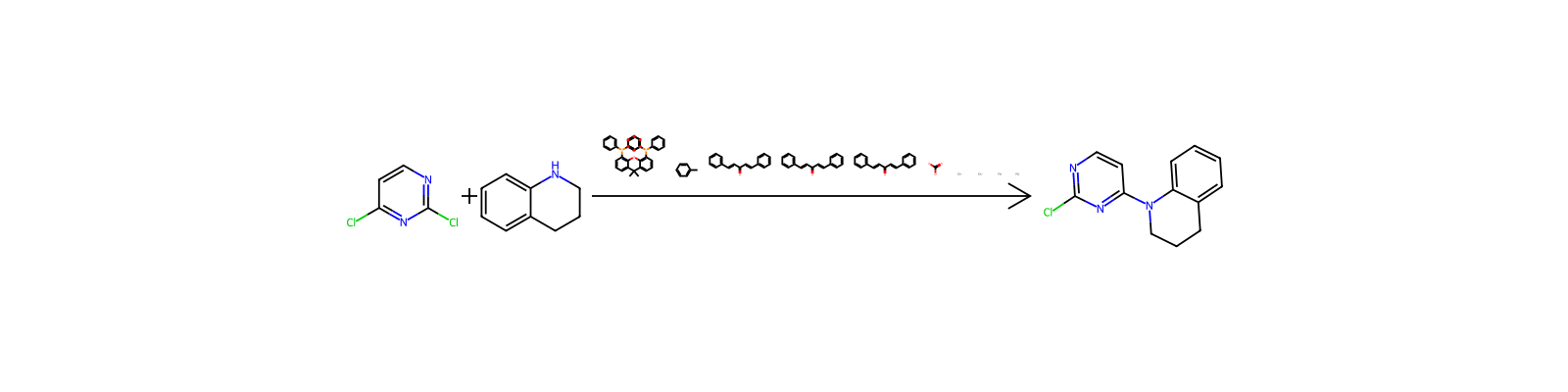
HRID 75 reaction equation
HRID 75As reactant
HRID 237 reaction equation
HRID 237As reactant
HRID 7632 reaction equation
HRID 7632As reactant
HRID 12082 reaction equation
HRID 12082As reactant
HRID 12087 reaction equation
HRID 12087As reactant
HRID 12277 reaction equation
HRID 12277As reactant
HRID 12287 reaction equation
HRID 12287As reactant
HRID 13474 reaction equation
HRID 13474As reactant
PreviousPage 1 of 110

Compound notes

On this pageBasic informationOverviewNames & identifiersPropertiesSafety & regulationChemistry & industryRelated reactionsCompound notes
Water Solubility
Soluble in water (partly), methanol, chloroform, and ethyl acetate.
Sensitive
Moisture Sensitive
BRN
110911 · 110911
InChI
1S/C4H2Cl2N2/c5-3-1-2-7-4(6)8-3/h1-2H
InChIKey
BTTNYQZNBZNDOR-UHFFFAOYSA-N
SMILES
Clc1ccnc(Cl)n1
CAS DataBase Reference
3934 · 3934-20-1(CAS DataBase Reference)
FDA UNII
96122 OCD · YV96122OCD
NIST Chemistry Reference
2 · Pyrimidine, 2,4-dichloro-(3934-20-1)
EPA Substance Registry System
2 · Pyrimidine, 2,4-dichloro- (3934-20-1)
UNSPSC Code
12352100 · 12352100
NACRES
22 · NA.22
Symbol(GHS)
7 · GHS07
Signal word
Warning
Hazard statements
315 · H315-H319-H335
Precautionary statements
261 · P261-P264-P271-P280-P302+P352-P305+P351+P338
target organs
Respiratory system
PPE
95 · dust mask type N95 (US), Eyeshields, Gloves
Hazard Codes
Xi
Risk Statements
36 · 36/37/38
Safety Statements
26 · 26-36-28A
RIDADR
1759 · 1759
WGK Germany
3 · 3
TSCA
TSCA listed
HazardClass
8 · 8
PackingGroup
III
HS Code
2933599090 · 2933599090
Storage Class
11 · 11 - Combustible Solids
Hazard Classifications
2 Skin · Eye Irrit. 2Skin Irrit. 2STOT SE 3
REACH Registrations
Active
target organs
Respiratory system
Hazard statements
H315-H319-H335
REACH Registrations
Active
Hazard Classifications
Eye Irrit. 2Skin Irrit. 2STOT SE 3
Precautionary statements
P261-P264-P271-P280-P302+P352-P305+P351+P338
2,4-Dimethoxypyrimidine
4-Hydroxypyrimidine
Chlorimuron-ethyl
4-Benzyloxy-2-chloropyrimidine
5-Iodo-2,4-dimethoxypyrimidine
4-Amino-2-chloropyrimidine
2-Chloro-4-(N,N-dimethylamino)pyrimidine
2-Chloro-4-hydrazinopyrimidine
2-Chloro(bromo)pyrimidine
N4-Methylcytosine
2-Chloro-4-methoxypyrimidine
2,4-Difluoropyrimidine
4-(3-Pyridyl)-2-chloropyrimidine
Benzyl-(2-chloro-pyrimidin-4-yl)-methyl-amine
Phenol, 5-[(2-chloro-4-pyrimidinyl)amino]-2-methyl-