

Basic information
- CAS
3973-18-0- Standard SMILES
C#CCOCCO- InChIKey
GHGCQQRMJCSIBQ-UHFFFAOYSA-N- Molecular formula
- C5H8O2
- Average molar mass
- 100.12 g/mol
- Monoisotopic mass
- 100.05242949
Names & identifiers
- Preferred name
- 2-Propynoxyethanol
- IUPAC
- 2-prop-2-ynoxyethanol
- English name
- Propynol ethoxylate
- Molecular formula
- C5H8O2
- Molecular weight
- 100.12
Names & synonyms
3973-18-0Ethanol, 2-(2-propynyloxy)-2-(Prop-2-yn-1-yloxy)ethanol2-Propynoxyethanol2-(2-Propyn-1-yloxy)ethanol2-(2-Propynyloxy)ethanolEthylene glycol monopropargyl ether2-(Propargyloxy)ethanol3-(2-hydroxyethoxy)-1-propyneUNII-2EQ7D0F9DREthanol, 2-(2-propyn-1-yloxy)-2EQ7D0F9DR
Show more names
PME2-(prop-2-yn-1-yloxy)ethan-1-olCOBethoxyL2-(prop-2-ynyloxy)ethanolpropargyl alcohol ethoxylateCSTB
4-Oxa-1-hexyn-6-olEINECS 223-601-1DTXSID9044665RefChem:89342DTXCID7024665223-601-1GHGCQQRMJCSIBQ-UHFFFAOYSA-NPropynol ethoxylate
Database identifiers
- CAS
3973-18-0- PubChem CID
- 77596
- DTXSID
DTXSID9044665- UNII
- 2EQ7D0F9DR
- EC Number
- 223-601-1
- Nikkaji
- J113.065J
Properties
Computed structural properties
- XLogP
- -0.5
- Topological polar surface area
- 29.5 Ų
- Hydrogen bond donors
- 1
- Hydrogen bond acceptors
- 2
- Rotatable bonds
- 3
- Heavy atoms
- 7
- Formal charge
- 0
- Complexity
- 69
Physicochemical properties
- Boiling point
- 80 · 80-90 °C(Press: 12-14 Torr)
- Density
- 1.0261 · 1.0261
- refractive index
- 1.4502 · 1.4502
- storage temp.
- -20 °C · Sealed in dry,Store in freezer, under -20°C
- solubility
- Chloroform (Sparingly), Ethyl Acetate (Slightly)
- form
- Oil
- pka
- 14.22 · 14.22±0.10(Predicted)
- color
- Colourless to Pale Yellow
- Stability
- Light Sensitive
- InChI
- InChI=1S/C5H8O2/c1-2-4-7-5-3-6/h1,6H,3-5H2
- InChIKey
- GHGCQQRMJCSIBQ-UHFFFAOYSA-N
- SMILES
- C(O)COCC#C
- CAS DataBase Reference
- 3973 · 3973-18-0(CAS DataBase Reference)
- FDA UNII
- 2 EQ7D0F9DR · 2EQ7D0F9DR
- EPA Substance Registry System
- 2 · Ethanol, 2-(2-propynyloxy)- (3973-18-0)
- UNSPSC Code
- 12352202 · 12352202
- NACRES
- 77 · NA.77
- Symbol(GHS)
- 7 · GHS07
- Signal word
- Warning
- Hazard statements
- 315 · H315-H319-H335
- Precautionary statements
- 280 · P280-P302+P352-P362+P364
- Hazard Codes
- Xi
- Risk Statements
- 36 · 36
- Safety Statements
- 26 · 26
- WGK Germany
- 1 · WGK 1
- TSCA
- TSCA listed
- HS Code
- 2909498090 · 2909498090
- Storage Class
- 11 · 11 - Combustible Solids
Safety & regulation
GHS classification
GHS Classification
This chemical does not meet GHS hazard criteria for 6.1% (10 of 163) of reports.
Danger
H302 (81%): Harmful if swallowed [Warning Acute toxicity, oral];H318 (64.4%): Causes serious eye damage [Danger Serious eye damage/eye irritation];H319 (29.4%): Causes serious eye irritation [Warning Serious eye damage/eye irritation];H330 (64.4%): Fatal if inhaled [Danger Acute toxicity, inhalation];H332 (13.5%): Harmful if inhaled [Warning Acute toxicity, inhalation];H335 (65.6%): May cause respiratory irritation [Warning Specific target organ toxicity, single exposure; Respiratory tract irritation];H361f (64.4%): Suspected of damaging fertility [Warning Reproductive toxicity];H373 (64.4%): May causes damage to organs through prolonged or repeated exposure [Warning Specific target organ toxicity, repeated exposure]
P203, P260, P261, P264, P264+P265, P270, P271, P280, P284, P301+P317, P304+P340, P305+P351+P338, P305+P354+P338, P316, P317, P318, P319, P320, P330, P337+P317, P403+P233, P405, and P501 (click each P-code to see the statement)
Aggregated GHS information provided per 163 reports by companies from 9 notifications to the ECHA C&L Inventory. Each notification may be associated with multiple companies.;Reported as not meeting GHS hazard criteria per 10 of 163 reports by companies.;There are 8 notifications provided by 153 of 163 reports by companies with hazard statement code(s).;Information may vary between notifications depending on impurities, additives, and other factors. The percentage value in parenthesis indicates the notified classification ratio from companies that provide hazard codes. Only hazard codes with percentage values above 10% are shown. For more detailed information, please visit ECHA C&L website.
Hazard information
Regulatory Information
Chemical: Ethanol, 2-(2-propynyloxy)-
Ethanol, 2-(2-propynyloxy)-: Does not have an individual approval but may be used as a component in a product covered by a group standard. It is not approved for use as a chemical in its own right.
Hazard Classes and CategoriesAcute Tox. 4 (81%);Eye Dam. 1 (64.4%);Eye Irrit. 2 (29.4%);Acute Tox. 2 (64.4%);Acute Tox. 4 (13.5%);STOT SE 3 (65.6%);Repr. 2 (64.4%);STOT RE 2 (64.4%)
Regulatory information
Regulatory Information
Chemical: Ethanol, 2-(2-propynyloxy)-
Ethanol, 2-(2-propynyloxy)-: Does not have an individual approval but may be used as a component in a product covered by a group standard. It is not approved for use as a chemical in its own right.
Safety data
- wgk
- WGK 1
- tsca
- TSCA listed
- hs_code
- 2909498090
- risk_code
- 36
- Signal word
- Warning
- Symbol(GHS)
- GHS07
- hazard_code
- Xi
- safety_code
- 26
- Storage Class
- 11 - Combustible Solids
- Hazard statements
- H315-H319-H335
- Precautionary statements
- P280-P302+P352-P362+P364
Chemistry & industry
Uses & manufacturing
General Manufacturing InformationEthanol, 2-(2-propyn-1-yloxy)-: ACTIVE
Applications
DescriptionPropargyl-PEG2-alcohol has propargyl and alcohol end groups. The propargyl can participate in copper-catalyzed Click Chemistry reactions with azides.
UsesPropynol Ethoxylate is an intermediate and it is shown to be used in the design and synthesis of a tag-free chemical probe for photoafiinity labeling.
General DescriptionPropynol ethoxylate, known as 2-propyn-1-ol, is a colourless flammable liquid with a pleasant odour. This volatile organic compound (VOC) occurs naturally in plants and animals and can also be synthesised in a laboratory environment. Propargyl alcohol polyoxyethylene ether has a wide range of applications and plays an important role in scientific research and industrial processes. It is used as a fuel, solvent and reagent in chemical reactions, as well as an important ingredient in the manufacture of many pharmaceuticals and industrial products. In scientific research, it is used as a reagent in organic synthesis, as a solvent in analytical chemistry and as a fuel in combustion studies.
Upstream & downstream products
Upstream raw materials
Suppliers100 total
郑州阿尔法化工有限公司+86-18530059196 · [email protected]
衢州润东化工有限公司0570-8789886 18892685668 · [email protected]
南通润丰石油化工有限公司66017690 19952660367 · [email protected]
武汉科美沃化工有限公司+86-2785736489 +8618171418573 · [email protected]
武汉博莱特化工有限公司+86-027-85583407 +86-13554014698 · [email protected]
Dayang Chem (Hangzhou) Co.,Ltd.+86-0571-88938639 17705817739 · [email protected]
武汉松石科技股份有限公司27-85615902 15827493093
Hebei Yanxi Chemical Co., Ltd.+86-17531190177 · [email protected]
北京华威锐科化工有限公司0757-86329057 18934348241 · [email protected]
Wuhan EnTai Technology Development Co,.Ltd86-27-82330560 · [email protected]
山东穗泰生物科技有限公司15689727968 · [email protected]
安耐吉化学&3A(安徽泽升科技股份有限公司)400-0056266 · [email protected]
湖北和昌新材料科技股份有限公司13296505482
上海瀚鸿科技股份有限公司021-54306202 13764082696 · [email protected]
上海钰康生物科技有限公司+86-18930848214 +86-021-56762820 · [email protected]
杭州璟皓生物科技有限公司(原河南辛迪加生物)17513242016 · [email protected]
武汉吉和昌新材料股份有限公司18602737196 18602737196
唐山默内德贸易有限公司+86-315-8309571 +86-15633399667 · [email protected]
武汉赛沃尔化工有限公司027-85613400 18707177243 · [email protected]
唐山默内德贸易有限公司0315-8309571 15633399667 · [email protected]
四川库利南科技有限公司400-1166-196 18981987031 · [email protected]
天津希恩思生化科技有限公司400 638 7771 · [email protected]
武汉科美沃化工有限公司027-85736489 · [email protected]
南京维奥化工有限公司Please Send Email 18652950785 · [email protected]
武汉欣扬瑞和化学科技有限公司027-83855316 18171155316
江苏艾康生物医药研发有限公司025-66113011 13913916777 · [email protected]
上海健超生物科技有限公司150-2103-5486 18017383231 · [email protected]
Yangzhou Model Electronic Materials Co., Ltd.+8613761402923 · [email protected]
北京环宇世纪化学科技有限公司hysj_bj.com
HBCChem, Inc.+1-510-219-6317 · [email protected]
厦门赛诺邦格生物科技股份有限公司400-9189898 17359873007 · [email protected]
成都零六生物科技有限公司400-1166-196 13458535857 · [email protected]
湖北瑞今化学有限公司027 83642615 13995607107 · [email protected]
上海麦克林生化科技股份有限公司15221275939 15221275939 · [email protected]
凯试(上海)科技有限公司021-50135380 · [email protected]
湖北巨胜科技有限公司027-59599241 18871490274 · [email protected]
吉林中科研伸科技有限公司0431-80534353 19917294565 · [email protected]
武汉吉和昌国际贸易有限公司13971123046 18672350362
TargetMol中国(陶术生物)021-021-33632979 15002134094 · [email protected]
苏州新凯生物医药技术有限公司0512-67213637 13952409868 · [email protected]
上海陶术生物科技股份有限公司+1-781-999-5354; +1-00000000000 · [email protected]
深圳吉和昌新材料有限公司13823135556
杭州鼎燕化工有限公司0571-87157530-8003 18267553885 · [email protected]
厦门志信化学有限公司+86-5922680277 +86-13806087780 · [email protected]
南京世洲生物科技有限公司025-85563444 18351873721 · [email protected]
上海岚克医药科技发展有限公司0086-21-58956006
北京华威锐科化工科技有限公司89508211 18501085097 · [email protected]
上海源叶生物科技有限公司13636370518 · [email protected]
武汉市承天精细化工有限公司18164098996 · [email protected]
武汉克米克生物医药技术有限公司027-13163388153 13163388153 · [email protected]
Related reactions
9 records


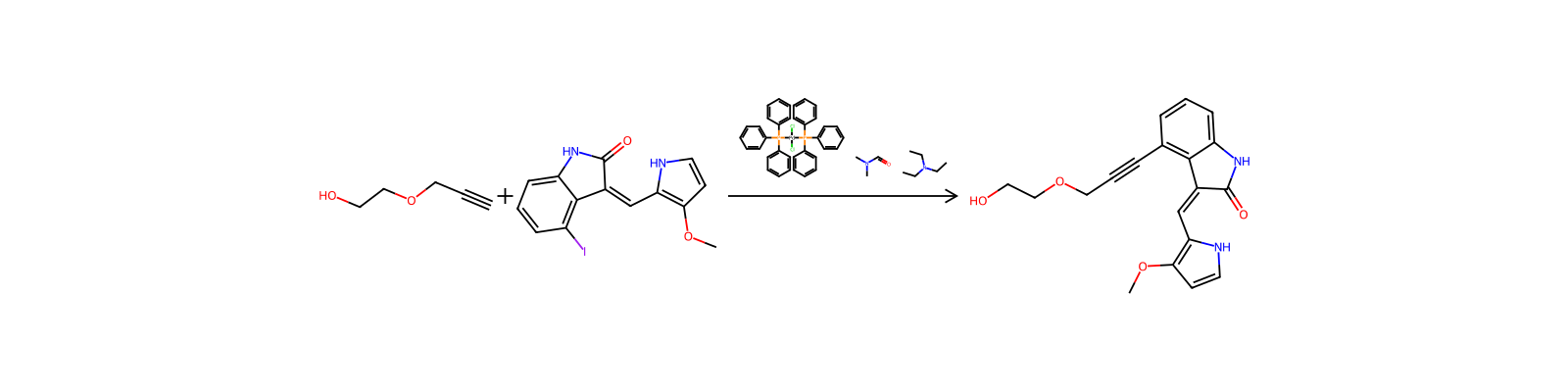


Compound notes
Loading…