HomeMCPWorkbenchSkills
HomeWorkbenchNotificationsMe
llms.txt · MCP GuidePrivacy Policy · Terms of Service · Supportv1.8.3
  1. Home
  2. /Compound

5-Bromopyrimidine

HCID 78344
New reaction
Print
Basic informationOverviewNames & identifiersPropertiesSafety & regulationChemistry & industryRelated reactionsCompound notes
Substructure searchFind similar structures

Basic information

CAS
4595-59-9
Standard SMILES
Brc1cncnc1
InChIKey
GYCPLYCTMDTEPU-UHFFFAOYSA-N
Molecular formula
C4H3BrN2
Average molar mass
158.98 g/mol
Monoisotopic mass
157.94796

Overview

a radiosensitizing agent

Names & identifiers

Preferred name
5-Bromopyrimidine
IUPAC
5-bromopyrimidine
English name
5-Bromopyrimidine
Molecular formula
C4H3BrN2
Molecular weight
158.98

Names & synonyms

5-Bromopyrimidine4595-59-9Pyrimidine, 5-bromo-5-BrPy compound5Z9X6MAT38DTXSID4063531RefChem:102211DTXCID6040458224-992-1MFCD000061175-bromo pyrimidine5-bromo-pyrimidine
Show more names
5-bromo-pyrimidin5-pyriMidine5-Brompyrimidin5-Bromo-1,3-diazinePYRIMIDINE, 2-BROMO-5-Bromopyrimidine,98%5-Bromopyrimidine >5-BROMOPYRIMIDINE 0.98
5-bromanylpyrimidineEINECS 224-992-1CHEMBL3423442STR00327HY-W008017PS-3029SY004103EN300-29556

Database identifiers

CAS
4595-59-9
PubChem CID
78344
DTXSID
DTXSID4063531
ChEMBL
CHEMBL3423442
UNII
5Z9X6MAT38
EC Number
224-992-1
Nikkaji
J236.494H

Properties

Computed structural properties

XLogP
0.7
Topological polar surface area
25.8 Ų
Hydrogen bond donors
0
Hydrogen bond acceptors
2
Rotatable bonds
0
Heavy atoms
7
Formal charge
0
Complexity
51.7

Experimental & physicochemical properties

LogP0.66
Physical DescriptionDry Powder

Physicochemical properties

Melting point
67 · 67-73 °C (lit.)
Boiling point
168 °C · 168°C(lit.)
Density
1.6448 · 1.6448 (rough estimate)
refractive index
1.526 · 1.5260 (estimate)
storage temp.
Sealed in dry,Room Temperature
solubility
Soluble in chloroform.
form
Crystalline Powder or Chunks
pka
1.4 · 1.40±0.10(Predicted)
color
Yellow to beige-brown
BRN
107326 · 107326
InChI
InChI=1S/C4H3BrN2/c5-4-1-6-3-7-2-4/h1-3H
InChIKey

Safety & regulation

Safety information is for reference only and does not replace the supplier’s Safety Data Sheet (SDS), applicable regulations, or professional assessment.

GHS classification

GHS Classification · 4 items

Warning

H315 (57.1%): Causes skin irritation [Warning Skin corrosion/irritation]

P261, P264, P264+P265, P271, P280, P302+P352, P304+P340, P305+P351+P338, P319, P321, P332+P317, P337+P317, P362+P364, P403+P233, P405, and P501 (click each P-code to see the statement)

Aggregated GHS information provided per 91 reports by companies from 10 notifications to the ECHA C&L Inventory. Each notification may be associated with multiple companies.

Hazard information

Regulatory Information · 2 items

Pyrimidine, 5-bromo- is listed on the EPA's Chemical Data Reporting (CDR) system. Manufacturers and importers of Pyrimidine, 5-bromo- are required to report information about their production and use of this chemical to the EPA under the Toxic Substances Control Act (TSCA). (40 eCFR Part 711)

Pyrimidine, 5-bromo-: Does not have an individual approval but may be used under an appropriate group standard

Hazard Classes and CategoriesSkin Irrit. 2 (57.1%)
CSL Reaction Information · 6 items

CSL00135

ACETONE + 5-BROMOPYRIMIDINE + SULFURIC ACID + PERACETIC ACID

Upon drying the powder product was being scraped from a sintered glass funnel to complete the neutralization of the hemiacid salt when an explosion occurred. Subsequent testing determined that the peroxide dimer of acetone was the most likely cause of the explosion. This material is reported to be both shock and friction sensitive and known to sublime at room temperature.

Explosive

ACS Safety Letters

7/8/18

Safety data

PPE

Chemistry & industry

Uses & manufacturing

U.S. Production2023: 50,000 - <250,000 lb
Industry UsesIntermediate
General Manufacturing Information · 2 items

Pesticide, Fertilizer, and Other Agricultural Chemical Manufacturing

Pyrimidine, 5-bromo-: ACTIVE

Applications · 4 items

Description5-Bromopyrimidine is an important structural unit in organic compounds, featuring a bromine functional group on its pyrimidine ring which serves as the active moiety enabling participation in diverse chemical reactions. Through acid-catalysed electrophilic alkylation of aromatic compounds with 5-bromopyrimidine, followed by oxidative rearrangement to form the dihydropyrimidine ring. Subsequent Sonogashira cross-coupling enables the preparation of 4-aryl-5-pyrimidylacetylene derivatives, which possess medicinal value.

Uses5-Bromopyrimidine was used in the synthesis of N-heteroaryl substituted 9-arylcarbazolyl derivatives via palladium-catalyzed aerobic and ligand-free Suzuki reaction, (5-(phenylethynyl)pyrimidine) via microwave assisted organic synthesis (MAOS) Sonogashira protocol.

Uses5-Bromopyrimidine was used in the synthesis of:N-heteroaryl substituted 9-arylcarbazolyl derivatives via palladium-catalyzed aerobic and ligand-free Suzuki reaction(5-(phenylethynyl)pyrimidine) via microwave assisted organic synthesis (MAOS) Sonogashira protocolIntermediate for the synthesis of plant growth regulator flurprimidol

General DescriptionRapid nucleophilic displacement reactions of 5-bromopyrimidine with nucleophiles under microwave irradiation has been studied. 5-Bromopyrimidine undergoes direct metallation with lithuium diisopropylamide to yield 4-lithio-5-bromopyrimidine.

Preparation methods

5-Bromopyrimidine is prepared by reacting dibromodifuranone with formamide in the presence of B2O2 catalyst at 180-185°C to obtain the product.

Related reactions

610 records
New reaction record
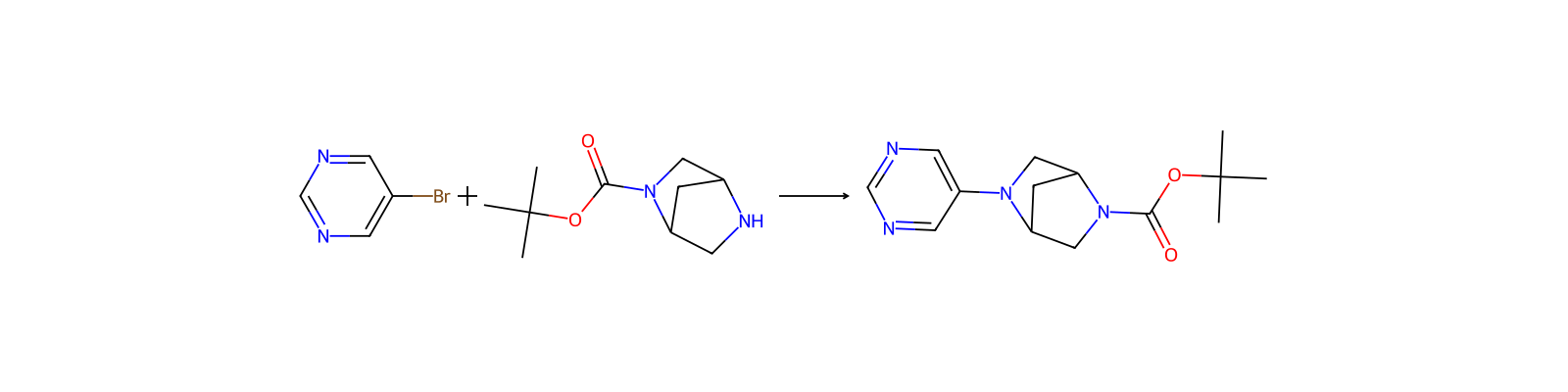
HRID 451 reaction equation
HRID 451As reactant
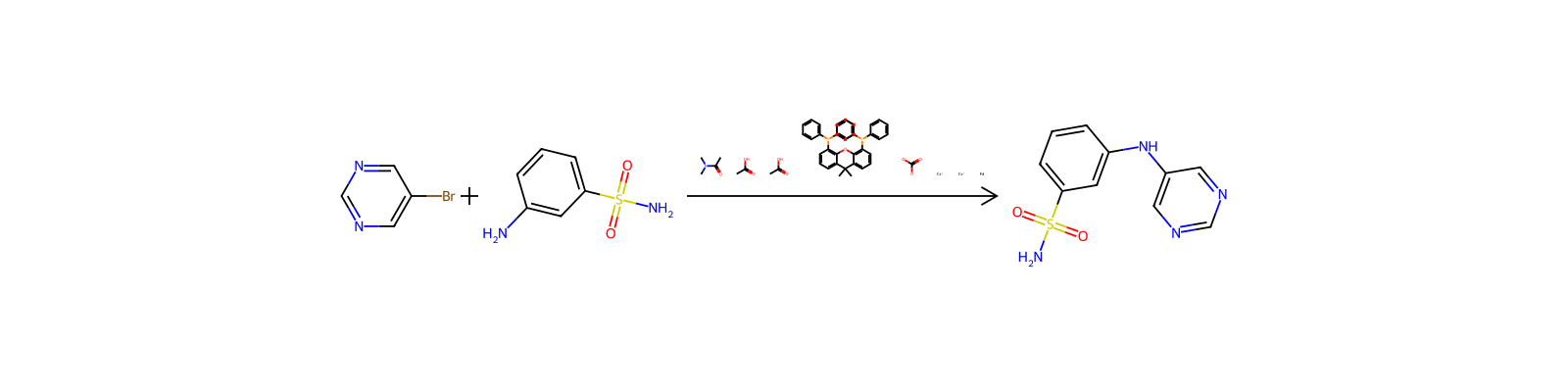
HRID 3292 reaction equation
HRID 3292As reactant
HRID 4511 reaction equation
HRID 4511As reactant
HRID 19875 reaction equation
HRID 19875As reactant
HRID 76130 reaction equation
HRID 76130As reactant
HRID 99776 reaction equation
HRID 99776As reactant
HRID 107647 reaction equation
HRID 107647As reactant
HRID 113137 reaction equation
HRID 113137As reactant
PreviousPage 1 of 77

Compound notes

On this pageBasic informationOverviewNames & identifiersPropertiesSafety & regulationChemistry & industryRelated reactionsCompound notes
GYCPLYCTMDTEPU-UHFFFAOYSA-N
SMILES
C1=NC=C(Br)C=N1
CAS DataBase Reference
4595 · 4595-59-9(CAS DataBase Reference)
FDA UNII
5 Z9X6MAT38 · 5Z9X6MAT38
NIST Chemistry Reference
5 · Pyrimidine, 5-bromo-(4595-59-9)
EPA Substance Registry System
5 · Pyrimidine, 5-bromo- (4595-59-9)
UNSPSC Code
12352100 · 12352100
NACRES
22 · NA.22
Symbol(GHS)
7 · GHS07
Signal word
Warning
Hazard statements
315 · H315-H319-H335
Precautionary statements
261 · P261-P264-P271-P280-P302+P352-P305+P351+P338
target organs
Respiratory system
PPE
95 · dust mask type N95 (US), Eyeshields, Gloves
Hazard Codes
Xi
Risk Statements
36 · 36/37/38-36/38
Safety Statements
26 · 26-36-37/39
WGK Germany
3 · 3
Hazard Note
Irritant
TSCA
TSCA listed
HazardClass
IRRITANT, KEEP COLD
HS Code
2933599090 · 2933599090
Storage Class
11 · 11 - Combustible Solids
Hazard Classifications
2 Skin · Eye Irrit. 2Skin Irrit. 2STOT SE 3
dust mask type N95 (US), Eyeshields, Gloves
wgk
3
tsca
TSCA listed
hs_code
2933599090
risk_code
36/37/38-36/38
Signal word
Warning
Symbol(GHS)
GHS07
hazard_code
Xi
hazard_note
Irritant
safety_code
26-36-37/39
hazard_class
IRRITANT, KEEP COLD
Storage Class
11 - Combustible Solids
target organs
Respiratory system
Hazard statements
H315-H319-H335
Hazard Classifications
Eye Irrit. 2Skin Irrit. 2STOT SE 3
Precautionary statements
P261-P264-P271-P280-P302+P352-P305+P351+P338
Preparation

Upstream & downstream products

Upstream raw materials

2,3-Dihydrofuran4-Hydroxy-2,5-dimethyl-3(2H)furanone

Downstream products

5-Hydroxypyrimidine5-Pyrimidinecarboxylic acid5-Pyrimidinylboronic acidPyrimidine-5-carboxaldehyde5-HydroxypyrimidineEthyl 5-pyrimidinecarboxylate 983-Pyrimidin-5-yl-benzoic acidMethyl pyrimidine-5-carboxylatePyrimidine, 5-bromo-4-methyl- (7CI,8CI,9CI)5-CyanopyrimidineFenarimol