
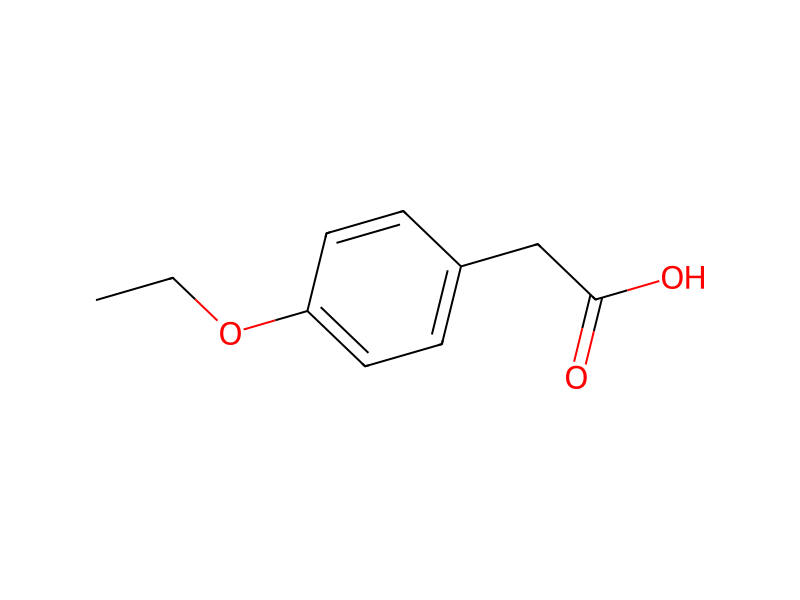
Basic information
- Standard SMILES
CCOc1ccc(CC(=O)O)cc1- InChIKey
ZVVWZNFSMIFGEP-UHFFFAOYSA-N- Molecular formula
- C10H12O3
- Average molar mass
- 180.2 g/mol
- Monoisotopic mass
- 180.07864424
Names & identifiers
- Preferred name
- Benzeneacetic acid, 4-ethoxy-
- IUPAC
- 2-(4-ethoxyphenyl)acetic acid
- English name
- 4-ETHOXYPHENYLACETIC ACID
- Molecular formula
- C10H12O3
- Molecular weight
- 180.2
Names & synonyms
4-Ethoxyphenylacetic acidBenzeneacetic acid, 4-ethoxy-Pinstatic acidEINECS 225-545-3DTXSID6063648RefChem:562867DTXCID5040673225-545-34919-33-92-(4-ethoxyphenyl)acetic acid(4-ethoxyphenyl)acetic acidp-Ethoxyphenylacetic acid
Show more names
ASISCHEM D13368VITAS-BB TBB000370RARECHEM AL BO 0341P-ETHOXY-A-TOLUIC ACID4-ethoxy-benzeneaceticaci2-(4-ethoxyphenyl)acetate
MFCD000043462-(4-Ethoxyphenyl)ethanoic Acidpara-Ethoxyphenylacetic acidYI6MJV8YN5HCREnamine_0048284-Ethoxybenzeneacetic acip-ethoxyphenyl acetic acid
Database identifiers
- CAS
4919-33-9- PubChem CID
- 78631
- DTXSID
DTXSID6063648- UNII
- MJV8YN5HCR
- EC Number
- 225-545-3
- Nikkaji
- J5.200K
Properties
Computed structural properties
- XLogP
- 1.9
- Topological polar surface area
- 46.5 Ų
- Hydrogen bond donors
- 1
- Hydrogen bond acceptors
- 3
- Rotatable bonds
- 4
- Heavy atoms
- 13
- Formal charge
- 0
- Complexity
- 160
Physicochemical properties
- Melting point
- 87 · 87-90 °C(lit.)
- Boiling point
- 318.5 · 318.5±17.0℃ (760 Torr)
- Density
- 1.144 · 1.144±0.06 g/cm3 (20 ºC 760 Torr)
- refractive index
- 1.543 · 1.5430 (estimate)
- Flash point
- 125.8 · 125.8±14.4℃
- storage temp.
- Sealed in dry,Room Temperature
- form
- Crystalline Powder
- pka
- 4.46 · 4.46±0.10(Predicted)
- color
- White to beige
- BRN
- 1103143 · 1103143
- InChI
- InChI=1S/C10H12O3/c1-2-13-9-5-3-8(4-6-9)7-10(11)12/h3-6H,2,7H2,1H3,(H,11,12)
- InChIKey
- ZVVWZNFSMIFGEP-UHFFFAOYSA-N
- SMILES
- C1(CC(O)=O)=CC=C(OCC)C=C1
- CAS DataBase Reference
- 4919 · 4919-33-9(CAS DataBase Reference)
- EPA Substance Registry System
- 4 · Benzeneacetic acid, 4-ethoxy- (4919-33-9)
- Symbol(GHS)
- 7 · GHS07
- Signal word
- Warning
- Hazard statements
- 315 · H315-H319-H335
- Precautionary statements
- 261 · P261-P280a-P304+P340-P305+P351+P338-P405-P501a
- Hazard Codes
- Xn
- Risk Statements
- 36 · 36/37/38-22
- Safety Statements
- 37 · 37/39-26
- WGK Germany
- 3 · 3
- TSCA
- TSCA listed
- HS Code
- 29189900 · 29189900
Safety & regulation
GHS classification
GHS Classification
Warning
H302 (20%): Harmful if swallowed [Warning Acute toxicity, oral];H315 (100%): Causes skin irritation [Warning Skin corrosion/irritation];H319 (100%): Causes serious eye irritation [Warning Serious eye damage/eye irritation];H335 (100%): May cause respiratory irritation [Warning Specific target organ toxicity, single exposure; Respiratory tract irritation]
P261, P264, P264+P265, P270, P271, P280, P301+P317, P302+P352, P304+P340, P305+P351+P338, P319, P321, P330, P332+P317, P337+P317, P362+P364, P403+P233, P405, and P501 (click each P-code to see the statement)
Aggregated GHS information provided per 5 reports by companies from 2 notifications to the ECHA C&L Inventory. Each notification may be associated with multiple companies.;Information may vary between notifications depending on impurities, additives, and other factors. The percentage value in parenthesis indicates the notified classification ratio from companies that provide hazard codes. Only hazard codes with percentage values above 10% are shown. For more detailed information, please visit ECHA C&L website.
Hazard information
Hazard Classes and CategoriesAcute Tox. 4 (20%);Skin Irrit. 2 (100%);Eye Irrit. 2A (100%);STOT SE 3 (100%)
Safety data
- wgk
- 3
- tsca
- TSCA listed
- hs_code
- 29189900
- risk_code
- 36/37/38-22
- Signal word
- Warning
- Symbol(GHS)
- GHS07
- hazard_code
- Xn
- safety_code
- 37/39-26
- Hazard statements
- H315-H319-H335
- Precautionary statements
- P261-P280a-P304+P340-P305+P351+P338-P405-P501a
Chemistry & industry
Uses & manufacturing
General Manufacturing InformationBenzeneacetic acid, 4-ethoxy-: INACTIVE
Applications
Usesp-Ethoxyphenylacetic acid is an important intermediate in the synthesis of pesticides, pharmaceuticals, and liquid crystal materials, and it is also a widely used fuel additive internationally.
Upstream & downstream products
Upstream raw materials
Downstream products
Suppliers50 total
国药集团化学试剂有限公司86-21-63210123 · [email protected]
常州帝通化工有限公司+86-0519-88298848 · [email protected]
湖北蝶化新材料科技有限公司86-18372897-544 18995560451
阿诺西(上海)生物技术有限公司400-1107768 15058188853 · [email protected]
郑州阿尔法化工有限公司+86-18530059196 · [email protected]
苏州道澜生物医药科技有限公司15952404857 · [email protected]
上海阿拉丁生化科技股份有限公司400-6206333 13167063860 · [email protected]
上海凌富药物研究有限公司+86(21)5895 0110 19945755304 · [email protected]
上海摩睿化学科技有限公司13382110328 15255501563 · [email protected]
南通润丰石油化工有限公司66017690 19952660367 · [email protected]
湖北威德利化学试剂有限公司181-6332-1995 18062128043 · [email protected]
上海麦克林生化科技股份有限公司021-50706066 15221275939 · [email protected]
上海炎泽化工有限公司15345144255 19975051755 · [email protected]
杭州品高化工有限公司0571-87658025 · [email protected]
上海腾准生物科技有限公司19821570922 · [email protected]
Dayang Chem (Hangzhou) Co.,Ltd.+86-0571-88938639 17705817739 · [email protected]
郑州鸿晟医药科技有限公司0371-55695890 15637198702 · [email protected]
山东利腾生物科技有限公司+86-18663721413 +86-15552573001 · [email protected]
毕佳索(上海毕得医药科技股份有限公司)400-6005915 · [email protected]
Syntechem Co.,Ltd[email protected]
北京索莱宝科技有限公司010-50973130 17801761073 · [email protected]
武汉易泰科技有限公司上海分公司18930552037 · [email protected]
阿法埃莎(中国)化学有限公司400-6106006 · [email protected]
安耐吉化学&3A(安徽泽升科技股份有限公司)400-0056266 · [email protected]
常州安轩化工有限公司13912302692 · [email protected]
上海相辉医药科技有限公司13761987713; 13761987713 · [email protected]
嘉兴市艾森化工有限公司0573-85285100 18627885956 · [email protected]
郑州研德生物科技有限公司0371-63682289 15538176268 · [email protected]
Zhejiang J&C Biological Technology Co.,Limited+1-2135480471 · [email protected]
NANJING YINGWEN BIOTECHNOLOGY CO LTD+86-13382787392 · [email protected]
山东西亚化学有限公司13355009207 13355009207 · [email protected]
淄博润恒生物科技有限公司13561657928 13561657928 · [email protected]
赛默飞世尔科技(中国)有限公司800-810-5118 · [email protected]
越林试剂021-62960152 · [email protected]
镇江卡博医药科技有限公司0511-81886918 18136818960 · [email protected]
上海毕得医药科技股份有限公司400-164-7117 18317119277 · [email protected]
上海寰川实业有限公司021-61478794 · [email protected]
湖北巨胜科技有限公司027-59599241 18871490274 · [email protected]
普善实业(陕西)有限公司029-81310890 18165209495 · [email protected]
江苏倍达医药科技有限公司0512-63009836 18994340901 · [email protected]
厦门志信化学有限公司+86-5922680277 +86-13806087780 · [email protected]
北京汇科盈生物科技有限公司15210661751 · [email protected]
sgtlifesciences pvt ltd+91-8790379245 · [email protected]
湖北万业众诚化学试剂有限责任公司18671296875 · [email protected]
嘉兴市浙嘉生物科技有限公司0573-85609002 · [email protected]
南京艾比克斯生化科技有限公司025-87193546 18652950785 · [email protected]
上海源叶生物科技有限公司13636370518 · [email protected]
成都华纯科技有限公司400-1166-196 15982826727 · [email protected]
武汉卡诺斯科技有限公司18064039730 · [email protected]
广州市金华大化学试剂有限公司020-84383047 · [email protected]
Related reactions
21 records





Linked notes
Loading…