
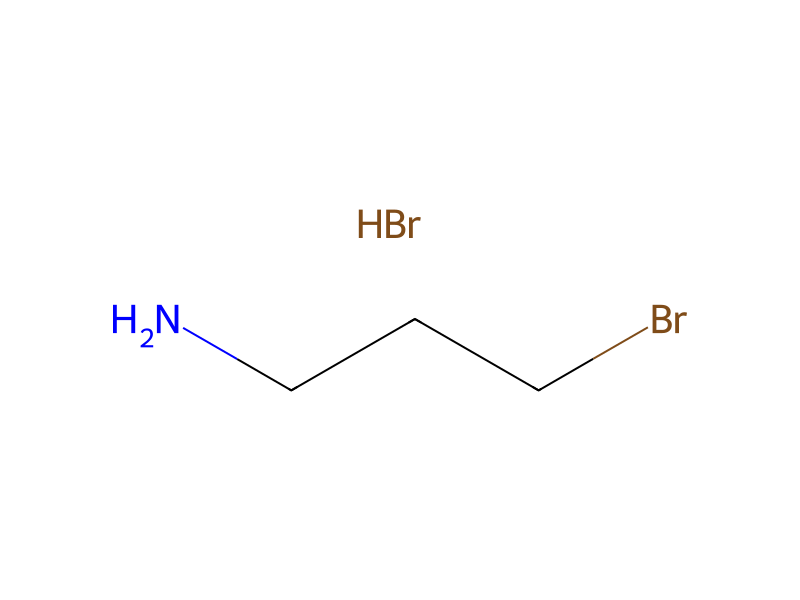
Basic information
- Standard SMILES
Br.NCCCBr- InChIKey
PQIYSSSTRHVOBW-UHFFFAOYSA-N- Molecular formula
- C3H9Br2N
- Average molar mass
- 218.92 g/mol
- Monoisotopic mass
- 216.91017349
Names & identifiers
- Preferred name
- 3-Bromopropylamine hydrobromide
- IUPAC
- 3-bromopropan-1-amine;hydrobromide
- English name
- 3-Bromopropylamine hydrobromide
- Molecular formula
- C3H9Br2N
- Molecular weight
- 218.92
Names & synonyms
3-Bromopropylamine hydrobromide5003-71-41-Propanamine, 3-bromo-, hydrobromide1-Propanamine, 3-bromo-, hydrobromide (1:1)NSC-78813DTXSID8063674R37T6824WARefChem:499383DTXCID3040774225-675-03-bromopropan-1-amine hydrobromide3-Aminopropyl bromide hydrobromide
Show more names
amine hydrobromide3-Bromopropylamine Hydrobromate3-BromopropyLPemafibrate SM1-Imp53-BROMOPROPYLAMINE HBR3-Brompropylaminhydrobromid3-bromo-propylaminhydrobromide3-bromopropanaminehydrobromide
3-Bromopropanamine hydrobromideMFCD000129123-Bromopropylammonium bromide1-Amino-3-bromopropane hydrobromide3-Bromo-1-propanamine, hydrobromideEINECS 225-675-0NSC 788133-bromopropan-1-amine;hydrobromide
Database identifiers
- CAS
5003-71-4- PubChem CID
- 78701
- DTXSID
DTXSID8063674- UNII
- R37T6824WA
- EC Number
- 225-675-0
Properties
Computed structural properties
- Topological polar surface area
- 26 Ų
- Hydrogen bond donors
- 2
- Hydrogen bond acceptors
- 1
- Rotatable bonds
- 2
- Heavy atoms
- 6
- Formal charge
- 0
- Complexity
- 16.4
Experimental & physicochemical properties
Chemical ClassesNitrogen Compounds -> Halogenated Aliphatic Amines
Physical DescriptionHygroscopic crystalline powder; [Alfa Aesar MSDS]
Physicochemical properties
- Melting point
- 171 · 171-172 °C(lit.)
- storage temp.
- Inert atmosphere,Room Temperature
- form
- Powder or Chunks
- color
- White to off-white
- Water Solubility
- Soluble in water (50 mg/ml).
- Sensitive
- Hygroscopic
- BRN
- 3906418 · 3906418
- InChI
- InChI=1S/C3H8BrN.BrH/c4-2-1-3-5;/h1-3,5H2;1H
- InChIKey
- PQIYSSSTRHVOBW-UHFFFAOYSA-N
- SMILES
- C(CBr)CN.Br
- CAS DataBase Reference
- 5003 · 5003-71-4(CAS DataBase Reference)
- EPA Substance Registry System
- 1 · 1-Propanamine, 3-bromo-, hydrobromide (5003-71-4)
- UNSPSC Code
- 12352100 · 12352100
- NACRES
- 22 · NA.22
- Symbol(GHS)
- 7 · GHS07
- Signal word
- Warning
- Hazard statements
- 315 · H315-H319-H335
- Precautionary statements
- 261 · P261-P264-P271-P280-P302+P352-P305+P351+P338
- target organs
- Respiratory system
- PPE
- 95 · dust mask type N95 (US), Eyeshields, Gloves
- Hazard Codes
- Xi
- Risk Statements
- 36 · 36/37/38
- Safety Statements
- 26 · 26-36-37/39
- WGK Germany
- 3 · 3
- RTECS
- 9925000 · UH9925000
- TSCA
- TSCA listed
- HS Code
- 29211980 · 29211980
- Storage Class
- 11 · 11 - Combustible Solids
- Hazard Classifications
- 2 Skin · Eye Irrit. 2Skin Irrit. 2STOT SE 3
Safety & regulation
GHS classification
GHS Classification
Warning
H315 (100%): Causes skin irritation [Warning Skin corrosion/irritation]
P261, P264, P264+P265, P271, P280, P302+P352, P304+P340, P305+P351+P338, P319, P321, P332+P317, P337+P317, P362+P364, P403+P233, P405, and P501 (click each P-code to see the statement)
Aggregated GHS information provided per 48 reports by companies from 6 notifications to the ECHA C&L Inventory. Each notification may be associated with multiple companies.
Hazard information
Regulatory Information3-Bromopropylammonium bromide: Does not have an individual approval but may be used under an appropriate group standard
Hazards SummaryIntraperitoneal LD50 (mouse) = 109 mg/kg; [RTECS] A skin and strong eye irritant; [Alfa Aesar MSDS] See 2-Chloro-N,N-dimethyl-1-propanamine hydrochloride and 2-Bromoethylamine.
Hazard Classes and CategoriesSkin Irrit. 2 (100%)
Safety data
- PPE
- dust mask type N95 (US), Eyeshields, Gloves
- wgk
- 3
- tsca
- TSCA listed
- rtecs
- UH9925000
- hs_code
- 29211980
- risk_code
- 36/37/38
- Signal word
- Warning
- Symbol(GHS)
- GHS07
- hazard_code
- Xi
- safety_code
- 26-36-37/39
- Storage Class
- 11 - Combustible Solids
- target organs
- Respiratory system
- Hazard statements
- H315-H319-H335
- Hazard Classifications
- Eye Irrit. 2Skin Irrit. 2STOT SE 3
- Precautionary statements
- P261-P264-P271-P280-P302+P352-P305+P351+P338
Chemistry & industry
Uses & manufacturing
General Manufacturing Information1-Propanamine, 3-bromo-, hydrobromide (1:1): ACTIVE
Applications
Uses3-Bromopropylamine hydrobromide is used as pharmaceutical raw materials and intermediates. Homotaurine is synthesized from 3-bromopropylamine hydrobromide.
Uses3-Bromopropylamine hydrobromide is commonly used as a reagent to introduce propylamine group to the molecular skeleton. Some of the other reported applications include:Synthesis of photochemically and thermally reactive azobenzene rotaxane and indolocarbazole-containing [2]rotaxane.Synthesis of indenoisoquinoline based active topoisomerase I inhibitors as anticancer agents.
Upstream & downstream products
Upstream raw materials
Downstream products
Suppliers50 total
国药集团化学试剂有限公司86-21-63210123 · [email protected]
梯希爱(上海)化成工业发展有限公司021-67121386 · [email protected]
衢州润东化工有限公司0570-8789886 18892685668 · [email protected]
上海阿拉丁生化科技股份有限公司400-6206333 13167063860 · [email protected]
爱斯特(成都)生物制药股份有限公司+86-28-85122536 85324413 · [email protected]
韶远科技(上海)有限公司021-50795510 4000665055 · [email protected]
科瑞迪化学400-821-5857 021-64326257 · [email protected]
Syntechem Co.,Ltd[email protected]
上海迈瑞尔生化科技有限公司4006356688 18621169109 · [email protected]
北京华威锐科化工有限公司0757-86329057 18934348241 · [email protected]
武汉易泰科技有限公司上海分公司18930552037 · [email protected]
阿法埃莎(中国)化学有限公司400-6106006 · [email protected]
安耐吉化学&3A(安徽泽升科技股份有限公司)400-0056266 · [email protected]
石家庄斯迪亚诺精细化工有限公司0311-89250318 13582355795 · [email protected]
上海瀚鸿科技股份有限公司021-54306202 13764082696 · [email protected]
上海相辉医药科技有限公司13761987713 · [email protected]
上海景颜化工科技有限公司13817811078 · [email protected]
嘉兴市艾森化工有限公司0573-85285100 18627885956 · [email protected]
Pure Chemistry Scientific Inc.001-857-928-2050 or 1-888-588-9418 · [email protected]
上海泰坦科技股份有限公司400-6009262 15618770481 · [email protected]
上海隆盛化工有限公司58099637 13585536065 · [email protected]
山东西亚化学有限公司13355009207 13355009207 · [email protected]
玛雅试剂+86 (573) 82222445 (0)18006601000 452520369 · [email protected]
四川库利南科技有限公司400-1166-196 18981987031 · [email protected]
上海耐士化工科技有限公司400-188-0725 +86 21 34310725 13611771617
天津希恩思生化科技有限公司400 638 7771 · [email protected]
河南多贝化工有限公司0370-2785118 17550508557 · [email protected]
上海昊锐医药生物科技有限公司021-58388037;21-58388037 13472507714 · [email protected]
艾科试剂4008-755-333 18080918076 · [email protected]
上海思域化工科技有限公司86-21-34053660 · [email protected]
赛默飞世尔科技(中国)有限公司800-810-5118 · [email protected]
北京伊诺凯科技有限公司400-810-7969 010-59572699 · [email protected]
江苏艾康生物医药研发有限公司025-66113011 13913916777 · [email protected]
TCI AMERICA800-4238616 · [email protected]
TOKYO CHEMICAL INDUSTRY CO., LTD.03-36680489 · [email protected]
TCI Europe320-37350700 · [email protected]
上海贤鼎生物科技有限公司4009209199 · [email protected]
深圳康特腾科技有限公司86-0755-86635001 · [email protected]
上海睿升化工科技有限公司+86-021-50935922
上海湄水化工科技有限公司021-60549325 18616193163
上海将来实业股份有限公司021-61552785 · [email protected]
HBCChem, Inc.+1-510-219-6317 · [email protected]
上海笛柏生物科技有限公司400-008-9730,021-54359730 400-008-9730 · [email protected]
日照力德士化工有限公司010-51268198 · [email protected]
美岚实业(上海)有限公司021-58958189 · [email protected]
上海石洋化工有限公司021-56795766 · [email protected]
上海爱蝶实业有限公司021-58957966 18930537195 · [email protected]
成都零六生物科技有限公司400-1166-196 13458535857 · [email protected]
广拓化学(上海)有限公司021-60899189-8001 18918189673 · [email protected]
湖南华腾制药有限公司400-8592883 · [email protected]
Related reactions
116 records


Linked notes
Loading…