
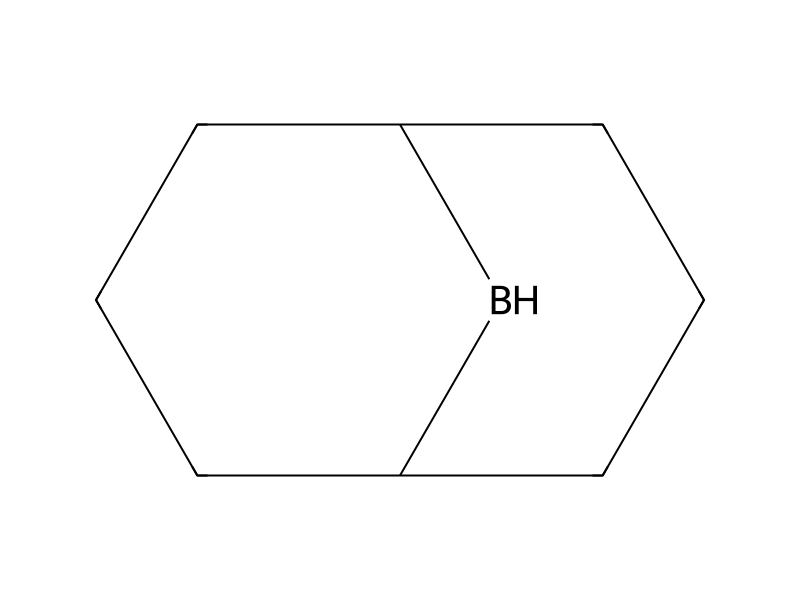
Basic information
- CAS
280-64-8- Standard SMILES
B1C2CCCC1CCC2- InChIKey
FEJUGLKDZJDVFY-UHFFFAOYSA-N- Molecular formula
- C8H15B
- Average molar mass
- 122.02 g/mol
- Monoisotopic mass
- 122.12668088
Overview
an amino acid protecting group
Names & identifiers
- Preferred name
- 9-Borabicyclo(3.3.1)nonane
- IUPAC
- 9-borabicyclo[3.3.1]nonane
- English name
- 9-Borabicyclo[3.3.1]nonane
- Molecular formula
- C8H15B
- Molecular weight
- 122.02
Names & synonyms
9-BBN compound9-BBN cpdRefChem:5492209-Borabicyclo3.3.1nonaneDTXCID2037760206-000-9280-64-84K4J8L1OG99-Borabicyclo(3,3,1)nonane9-Borabicyclo(3.3.1)nonane9-borabicyclononaneDTXSID3074781
Show more names
9-BBN9-BBN, 0.4M SOLUTION IN HEXANESKseal9-BorabicycL9-BBN monomero[3.3.1]nonane9-BBN(0.5M in toluene)9-Borabicyclo[3.3.1]nona9-Borabicyclo[3.3.1]none9-BBN MonoMer, 0.5M in THF
(1beta,5beta)-9-Borabicyclo[3.3.1]nonane
Database identifiers
- CAS
280-64-8- PubChem CID
- 78966
- DTXSID
DTXSID3074781- EC Number
- 206-000-9
Properties
Computed structural properties
- Topological polar surface area
- 0 Ų
- Hydrogen bond donors
- 0
- Hydrogen bond acceptors
- 0
- Rotatable bonds
- 0
- Heavy atoms
- 9
- Formal charge
- 0
- Complexity
- 80.7
Experimental & physicochemical properties
Chemical ClassesMetals -> Metalloid Compounds (Boron)
Physical DescriptionWhite solid; [Acros Organics MSDS]
Physicochemical properties
- Melting point
- 140 · 140-142 °C
- Boiling point
- 68 · 68-70 °C
- Density
- 0.894 g/mL · 0.894 g/mL at 25 °C
- Flash point
- 1 °F · 1 °F
- storage temp.
- Flammables area
- solubility
- Miscible with ether, hexane, benzene, toluene, carbon tetrachloride, chloroform, dimethylsulfide and dichloromethane. Slightly miscible with cyclohexane, dimethoxyethane, diglyme and dioxane.
- form
- liquid
- Water Solubility
- reacts
- Sensitive
- Air & Moisture Sensitive
- BRN
- 605509 · 605509
- InChI
- InChI=1S/C8H15B/c1-3-7-5-2-6-8(4-1)9-7/h7-9H,1-6H2
Safety & regulation
GHS classification
GHS Classification
Danger
H250 (72.6%): Catches fire spontaneously if exposed to air [Danger Pyrophoric liquids]
P210, P222, P223, P231, P231+P232, P233, P260, P264, P280, P301+P330+P331, P302+P335+P334, P302+P361+P354, P304+P340, P305+P354+P338, P316, P321, P363, P370+P378, P402+P404, P405, and P501 (click each P-code to see the statement)
Aggregated GHS information provided per 146 reports by companies from 4 notifications to the ECHA C&L Inventory. Each notification may be associated with multiple companies.
Hazard information
Regulatory Information
PMN - indicates a commenced PMN (Pre-Manufacture Notices) substance.
Status: Active Update: 15-04-2023 https://echa.europa.eu/registration-dossier/-/registered-dossier/24223
9-Borabicyclo3.3.1nonane: Does not have an individual approval but may be used under an appropriate group standard
Hazards SummaryReacts with water; May cause irritation; [Acros Organics MSDS]
Hazard Classes and CategoriesPyr. Sol. 1 (72.6%)
Safety data
- F
- 1-10-34
- wgk
- 3
- tsca
- TSCA listed
- ridadr
- UN 3399 4.3/PG 1
- hs_code
- 29319090
- risk_code
- 14-20/21/22-36/37/38-36/37-19-14/15-11-67-65-62-51/53-48/20-38-40
- Signal word
- Danger
- Symbol(GHS)
- GHS02,GHS07,GHS08,GHS09
- hazard_code
- F,Xn,Xi,N
- safety_code
Chemistry & industry
Uses & manufacturing
General Manufacturing Information9-Borabicyclo[3.3.1]nonane: ACTIVE
Applications
Uses9-BBN monomer acts as a selective hydroboration reagent in synthetic organic chemistry. It is employed in Suzuki reactions as well as in the preparation of terminal alcohols by the region selective addition of alkenes followed by oxidative cleavage using hydrogen peroxide. It is also used in copper-catalyzed cross-coupling reactions of organoboron compounds with primary alkyl halides and pseudohalides. It acts as a protecting group for alkenes. Further, it is used as a reactant for Hetero-Diels-Alder reaction for the synthesis of spirocyclic alkaloids. In addition to this, it is used in intramolecular insertion of alkenes into palladium-nitrogen bonds.
UsesProtecting group for alkenesReactant for: Linear SPPS synthesis of ubiquitin derivativesCopper-catalyzed cross-coupling reactions of organoboron compounds with primary alkyl halides and pseudohalidesIntramolecular insertion of alkenes into palladium-nitrogen bondsPreparation of (phosphonoacetyl)ornithine to study effect on arginine biosynthetic genes in yeastHetero-Diels-Alder reaction for synthesis of spirocyclic alkaloids
General Description9-Borabicyclo[3.3.1]nonane is an organic compound, which is generally used as a hydroborating agent. It is thermally stable, less sensitive to oxygen and water when compared to other dialkyl boranes. It is commonly used to prepare aldehydes from alkynes.
Upstream & downstream products
Downstream products
Suppliers100 total
Related reactions
759 records





Compound notes
Loading…