HomeMCPWorkbenchSkills
HomeWorkbenchNotificationsMe
llms.txt · MCP GuidePrivacy Policy · Terms of Service · Supportv1.8.3
  1. Home
  2. /Compound

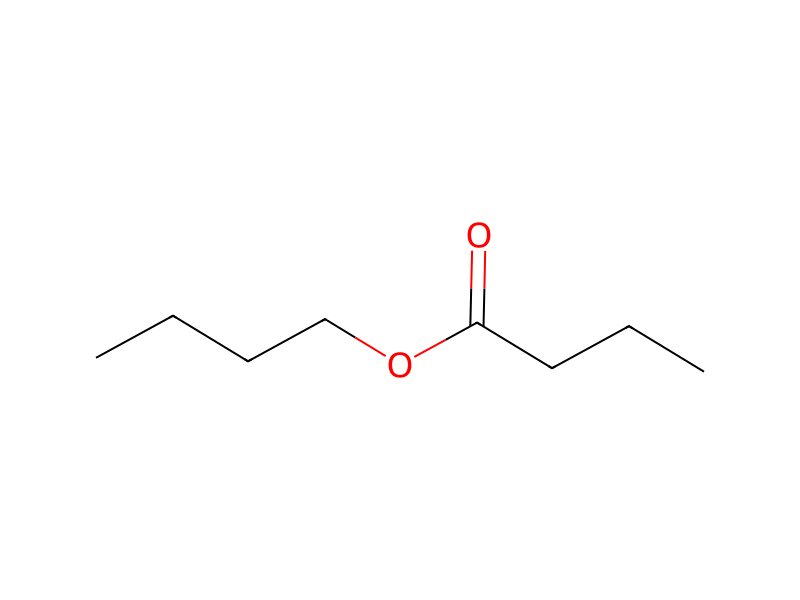
Butyl butyrate

HCID 7983
New reaction
Print
Basic informationOverviewNames & identifiersPropertiesSafety & regulationChemistry & industryRelated reactionsCompound notes
Substructure searchFind similar structures

Basic information

CAS
109-21-7
Standard SMILES
CCCCOC(=O)CCC
InChIKey
XUPYJHCZDLZNFP-UHFFFAOYSA-N
Molecular formula
C8H16O2
Average molar mass
144.21 g/mol
Monoisotopic mass
144.11502975

Overview

Butyl butyrate appears as a colorless liquid. Insoluble in water. A marine pollutant. Poses a threat to the aquatic environment. Immediate steps should be taken to prevent spread to the environment. May penetrate soils and contaminate groundwater and nearby waterways. Mildly irritates the eyes and skin.

Names & identifiers

Preferred name
Butyl butyrate
IUPAC
butyl butanoate
English name
Butyl butyrate
Molecular formula
C8H16O2
Molecular weight
144.21

Names & synonyms

Butyl butyrate109-21-7Butyl butanoaten-Butyl butyrateButanoic acid, butyl estern-Butyl butanoate1-Butyl butyrateButyl butylateN-BUTYL N-BUTYRATEButyric acid, butyl esterButyl n-butyraten-Butyl n-butanoate
Show more names
FEMA 2186ButanoicacidbutylesterBUTYL BUTYRATE, NATURAL
FEMA No. 2186Butyric acid n-butyl ester1BHV00T1M4NSC-8458DTXSID7041702CHEBI:87429RefChem:122231DTXCID5021702

Database identifiers

CAS
109-21-7
PubChem CID
7983
DTXSID
DTXSID7041702
ChEBI
CHEBI:87429
UNII
1BHV00T1M4
EC Number
203-656-8
Nikkaji
J2.876B

Properties

Computed structural properties

XLogP
2.2
Topological polar surface area
26.3 Ų
Hydrogen bond donors
0
Hydrogen bond acceptors
2
Rotatable bonds
6
Heavy atoms
10
Formal charge
0
Complexity
89.3

Experimental & physicochemical properties

LipidsFatty Acyls [FA] -> Fatty esters [FA07] -> Short fatty esters [FA0710]
SolventsSolvents -> Esters (<C12)
SpringerMaterials PropertiesDensity
FragrancesFragrance Ingredient (Butyl butyrate) -> IFRA transparency List
Food AdditivesFLAVORING AGENT OR ADJUVANT -> FDA Substance added to food
Density · 4 items

0.872 at 68 °F (USCG, 1999) - Less dense than water; will float

0.867-0.871

0.872

0.872 @ 20°C

Flavoring AgentsEU Flavoring substances
Solubility · 3 items

0.5 mg/mL at 20 °C

miscible with alcohol, ether, most vegetable oils; slightly soluble in propylene glycol, water

1 ml in 3 ml 70% alcohol (in ethanol)

Flash Point · 2 items

Safety & regulation

Safety information is for reference only and does not replace the supplier’s Safety Data Sheet (SDS), applicable regulations, or professional assessment.

GHS classification

GHS Classification · 6 items

Warning

H226: Flammable liquid and vapor [Warning Flammable liquids]

P210, P233, P240, P241, P242, P243, P280, P303+P361+P353, P370+P378, P403+P235, and P501 (click each P-code to see the statement)

Warning

H226 (100%): Flammable liquid and vapor [Warning Flammable liquids]

P210, P233, P240, P241, P242, P243, P280, P303+P361+P353, P370+P378, P403+P235, and P501 (click each P-code to see the statement)

Hazard information

Regulatory Information · 4 items

Chemical: Butanoic acid, butyl ester

Butanoic acid, butyl ester is listed on the EPA's Chemical Data Reporting (CDR) system. Manufacturers and importers of Butanoic acid, butyl ester are required to report information about their production and use of this chemical to the EPA under the Toxic Substances Control Act (TSCA). (40 eCFR Part 711)

REACH registered substance: Butyl butyrate (EC: 203-656-8)

Butyl butyrate: Does not have an individual approval but may be used under an appropriate group standard

Other Safety InformationIMAP assessments - Butanoic acid, butyl ester: Human health tier I assessment
DOT LabelClass 9
Fire HazardsExcerpt from ERG Guide 171 [Substances (Low to Moderate Hazard)]:
Health HazardsInhalation or ingestion causes headache, dizziness, nausea, vomiting, and narcosis. Contact with liquid irritates eyes. (USCG, 1999)
Hazards Summary · 1 item

A moderate skin irritant; [RTECS] A mild skin and eye irritant; [CAMEO] A skin and eye irritant; Inhalation or ingestion may cause headache, dizziness, nausea, vomiting, and narcosis; [CHRIS] A moderate eye, mucous membrane, and respiratory tract irritant; [OSHA] Safe when used as a flavoring agent in food; [JECFA] An irritant; Vapors may cause dizziness or suffocation; Narcotic in high concentrations; [Acros Organics MSDS]

Chemistry & industry

Pharmacology

Cellular LocationsExtracellular

Uses & manufacturing

UsesPermitted for use as an inert ingredient in non-food pesticide products; [EPA] Used as flavoring agent or adjuvant; [FDA] Used to make printed circuit boards and in the flavoring and fragrance industries; [OSHA]
U.S. Production2023: 50,000 - <250,000 lb
Industry UsesIntermediate
Use Classification · 3 items

Fragrance Ingredients

Flavouring Agent -> FLAVOURING_AGENT -> JECFA Functional Classes

Flavoring Agents -> JECFA Flavorings Index

General Manufacturing Information · 2 items

All Other Basic Organic Chemical Manufacturing

Butanoic acid, butyl ester: ACTIVE

Applications · 6 items

DescriptionButyl butyrate is a kind of ester formed through the condensation of butyric acid and n-butanol. It has a pleasant flavor, and thus being used in the flavor industry to generate a sweet fruity flavor of pineapple-like. It occurs naturally in many kinds of fruits including apple, banana, berries, pear, plum, and strawberry. It is also found in alcoholic beverages. However, it should be noted that it is a marine pollutant, posing a threat to the marine environment. It may also penetrate into soil, contaminating groundwater and other nearby waterways.

OccurrenceReported found in fresh apple, apple juice, banana, orange juice, orange peel oil, melon, strawberry, Passiflora mollisima, soybean, honey and blue cheese.

It is very important for the food and beverages industries and used as perfuming agents. It is a applied as a solvent for resins.

Related reactions

5 records
New reaction record
HRID 28234 reaction equation
HRID 28234As product
HRID 544757 reaction equation
HRID 544757As product
HRID 1268665 reaction equation
HRID 1268665As reactant
HRID 1885106 reaction equation
HRID 1885106As product
HRID 2053501 reaction equation
HRID 2053501As product

Compound notes

On this pageBasic informationOverviewNames & identifiersPropertiesSafety & regulationChemistry & industryRelated reactionsCompound notes

128 °F (USCG, 1999)

128 °F

Boiling Point · 5 items

332 °F at 760 mmHg (USCG, 1999)

166.00 °C. @ 760.00 mm Hg

165 °C

332 °F

166 °C @760 [mm Hg]

Melting Point · 3 items

-133 °F (USCG, 1999)

-91.5 °C

-133 °F

Vapor Pressure · 3 items

10.34 mmHg (USCG, 1999)

1.81 [mmHg]

10.34 mmHg

Physicochemical properties

Melting point
91.5 °C · −91.5 °C (−132.7 °F; 181.7 K)
Boiling point
165 °C · 165 °C (329 °F; 438 K)
Density
0.8692 g/cm3 · 0.8692 g/cm3 at 20 °C
vapor pressure
1.32 hPa · 1.32hPa at 20℃
FEMA
2186 · 2186 | BUTYL BUTYRATE
refractive index
1.41 · 1.41
FLAVIS Number
9.042 · 09.042 | Butyl butyrate
Flash point
49 °C · 49 °C (120 °F; 322 K)
storage temp.
Flammables area
solubility
0.5 g/l · 0.50g/l
form
clear liquid
color
Colorless
Odor
100 % · at 100.00 %. fruity banana pineapple green cherry tropical fruit ripe fruit juicy fruit
Odor Type
fruity
biological source
synthetic
Odor Threshold
0.0048 ppm · 0.0048ppm
explosive limit
1 % · 1%(V)
Water Solubility
Soluble in water. (1 g/L).
Merck
14 · 14,1556
JECFA Number
151 · 151
BRN
1747101 · 1747101
Henry's Law Constant
1.7 · 1.7×10-2 mol/(m3Pa) at 25℃, Brockbank (2013)
Cosmetics Ingredients Functions
PERFUMING
InChI
1S/C8H16O2/c1-3-5-7-10-8(9)6-4-2/h3-7H2,1-2H3
InChIKey
XUPYJHCZDLZNFP-UHFFFAOYSA-N
SMILES
CCCCOC(=O)CCC
LogP
2.16 at · 2.16 at 20℃
CAS DataBase Reference
109 · 109-21-7(CAS DataBase Reference)
Substances Added to Food (formerly EAFUS)
BUTYL BUTYRATE
FDA 21 CFR
172.515 · 172.515
EWG's Food Scores
1 · 1
FDA UNII
1 BHV00T1M4 · 1BHV00T1M4
NIST Chemistry Reference
Butyl butyrate(109-21-7)
EPA Substance Registry System
Butyl butyrate (109-21-7)
UNSPSC Code
85151701 · 85151701
NACRES
24 · NA.24
Symbol(GHS)
2 · GHS02,GHS07
Signal word
Warning
Hazard statements
315 · H315-H319-H412-H226
Precautionary statements
501 · P501-P273-P240-P210-P233-P243-P241-P242-P264-P280-P370+P378-P337+P313-P305+P351+P338-P362+P364-P303+P361+P353-P332+P313-P403+P235
PPE
Eyeshields, Faceshields, Gloves, type ABEK (EN14387) respirator filter
Risk Statements
10 · 10
Safety Statements
2 · 2-24/25
RIDADR
3272 · UN 3272 3/PG 3
WGK Germany
2 · 2
RTECS
8120000 · ES8120000
TSCA
TSCA listed
HazardClass
3 · 3
PackingGroup
III
HS Code
2915600000 · 2915600000
Storage Class
3 · 3 - Flammable liquids
Hazard Classifications
2 Flam · Aquatic Chronic 2Flam. Liq. 3
Toxicity
50 · mouse,LD50,intraperitoneal,8900mg/kg (8900mg/kg),Food and Cosmetics Toxicology. Vol. 17, Pg. 521, 1979.
REACH Registrations
Active
Reactive GroupEsters, Sulfate Esters, Phosphate Esters, Thiophosphate Esters, and Borate Esters
Reactivity Profile · 1 item

BUTYL BUTYRATE reacts with acids to liberate heat along with butyl alcohol and butyric acid. Strong oxidizing acids may cause a vigorous reaction that is sufficiently exothermic to ignite the reaction products. Heat is also generated by interaction with caustic solutions. Flammable hydrogen is generated by mixing with alkali metals and hydrides. May attack some forms of plastics (USCG, 1999).

Air and Water ReactionsInsoluble in water.
NFPA Hazard Classification · 3 items

1 - Materials that, under emergency conditions, can cause significant irritation.

2 - Materials that must be moderately heated or exposed to relatively high ambient temperatures before ignition can occur. Materials would not under normal conditions form hazardous atmospheres with air, but under high ambient temperatures or under moderate heating could release vapor in sufficient quantities to produce hazardous atmospheres with air.

0 - Materials that in themselves are normally stable, even under fire conditions.

Hazard Classes and Categories · 4 items

Flam. Liq. 3 (100%)

Flammable liquid - category 3

Flammable liquids - Category 3

Flam. Liq. 3

Safety & protection

Fire FightingExcerpt from ERG Guide 171 [Substances (Low to Moderate Hazard)]:
First AidINHALATION: Move victim to fresh air and call a physician; give artificial respiration if necessary.
Nonfire Spill ResponseExcerpt from ERG Guide 171 [Substances (Low to Moderate Hazard)]:
Isolation and EvacuationExcerpt from ERG Guide 171 [Substances (Low to Moderate Hazard)]:
Protective Action Criteria (PAC) · 3 items

14 [mg/m3]

150 [mg/m3]

910 [mg/m3]

Personal Protective Equipment (PPE)All-purpose canister mask or chemical cartridge respirator; glass or face (USCG, 1999)

Toxicology

Adverse EffectsNeurotoxin - Acute solvent syndrome

Safety data

PPE
Eyeshields, Faceshields, Gloves, type ABEK (EN14387) respirator filter
wgk
2
tsca
TSCA listed
rtecs
ES8120000
ridadr
UN 3272 3/PG 3
hs_code
2915600000
Toxicity
mouse,LD50,intraperitoneal,8900mg/kg (8900mg/kg),Food and Cosmetics Toxicology. Vol. 17, Pg. 521, 1979.
risk_code
10
Signal word
Warning
Symbol(GHS)
GHS02,GHS07
safety_code
2-24/25
hazard_class
3
Storage Class
3 - Flammable liquids
packing_group
III
Hazard statements
H315-H319-H412-H226
REACH Registrations
Active
Hazard Classifications
Aquatic Chronic 2Flam. Liq. 3
Precautionary statements
P501-P273-P240-P210-P233-P243-P241-P242-P264-P280-P370+P378-P337+P313-P305+P351+P338-P362+P364-P303+P361+P353-P332+P313-P403+P235
Uses

UsesFlavoring.

UsesButyl butyrate can be used as a reactant to synthesize:N-(Phenylmethyl)butanamide by reacting with benzylamine via ester-amide exchange reaction in the presence of supported graphene oxide catalyst.Cyclohexyl butyrate by acylation reaction with cyclohexanol using a ruthenium pincer PNN complex catalyst.Butyl ether by triiron dodecacarbonyl catalyzed hydrosilylation reaction.

General DescriptionA colorless liquid. Insoluble in water. A marine pollutant. Poses a threat to the aquatic environment. Immediate steps should be taken to prevent spread to the environment. May penetrate soils and contaminate groundwater and nearby waterways. Mildly irritates the eyes and skin.

Preparation methods

PreparationBy passing vapors of n-butyl alcohol over MnO2 or ZnO at 400°C, also by passing vapors of n-butyl alcohol over CuO-VO at 180 to 200°C.

Upstream & downstream products

Upstream raw materials

Calcium chlorideZinc oxideManganese dioxide1-ButanolButanoic acid,2-ethyl-3-hydroxyhexyl esterPropyl chloroformateDibutyl etherButyraldehyde1-ChloropropaneAluminum ethoxideGERANYL BUTYRATEGeraniolEthanol

Downstream products

Cyclopropanecarboxylic acid

Additional notes

DefinitionChEBI: A butanoate ester of butan-1-ol.