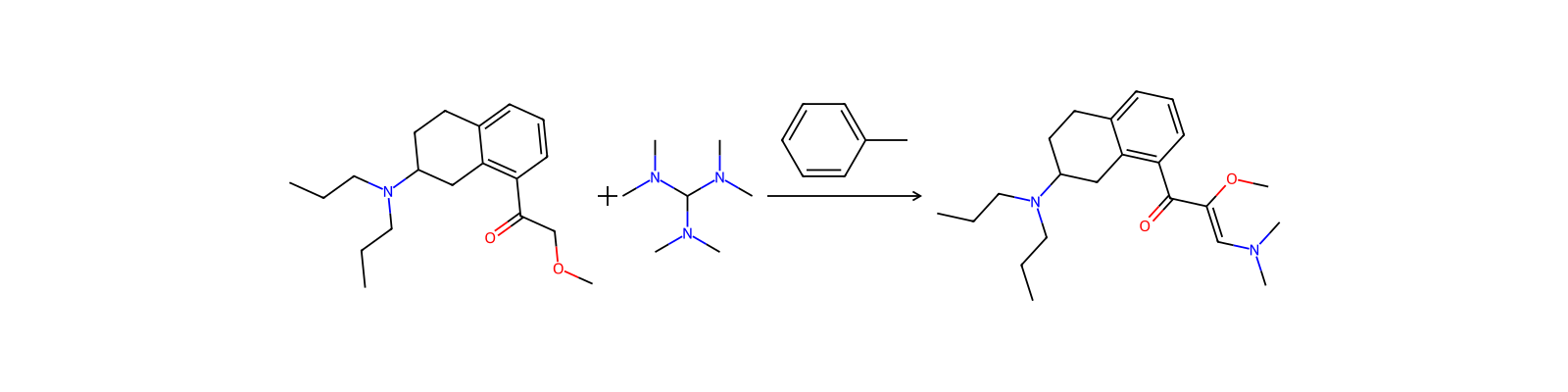
HRID 22138As reactant

5762-56-1CN(C)C(N(C)C)N(C)CMUMVIYLVHVCYGI-UHFFFAOYSA-N5762-56-1DTXSID20206284CHEMBL3301703Safety information is for reference only and does not replace the supplier’s Safety Data Sheet (SDS), applicable regulations, or professional assessment.
Danger
H225 (100%): Highly Flammable liquid and vapor [Danger Flammable liquids]
P210, P233, P240, P241, P242, P243, P260, P264, P280, P301+P330+P331, P302+P361+P354, P303+P361+P353, P304+P340, P305+P354+P338, P316, P321, P363, P370+P378, P403+P235, P405, and P501 (click each P-code to see the statement)
Aggregated GHS information provided per 42 reports by companies from 2 notifications to the ECHA C&L Inventory. Each notification may be associated with multiple companies.
UsesReagent for the introduction of the dimethylaminoethylidene group.1 General review;2 RO polymerization of lactide.3
UsesN,N,N'',N'',N'''',N''''-Hexamethylmethanetriamine, can be used in the synthesis of the phosphoramidite derivative of the new nucleoside analog. It can also be used as reagent for the introduction of the dimethylaminoethylidene group.
UsesTris(dimethylamino)methane was used:to prepare the phosphoramidite derivative of the new nucleoside analogas reagent for the introduction of the dimethylaminoethylidene group in ring-opening (RO) polymerization of lactide
General DescriptionNMR spectra and their temperature-dependence has been reported for tris(dimethylamino)methane. Tris(dimethylamino)methane reacts with crowded α-(o-nitrophenyl) ketone to yield tetrahydroquinoline derivative.