
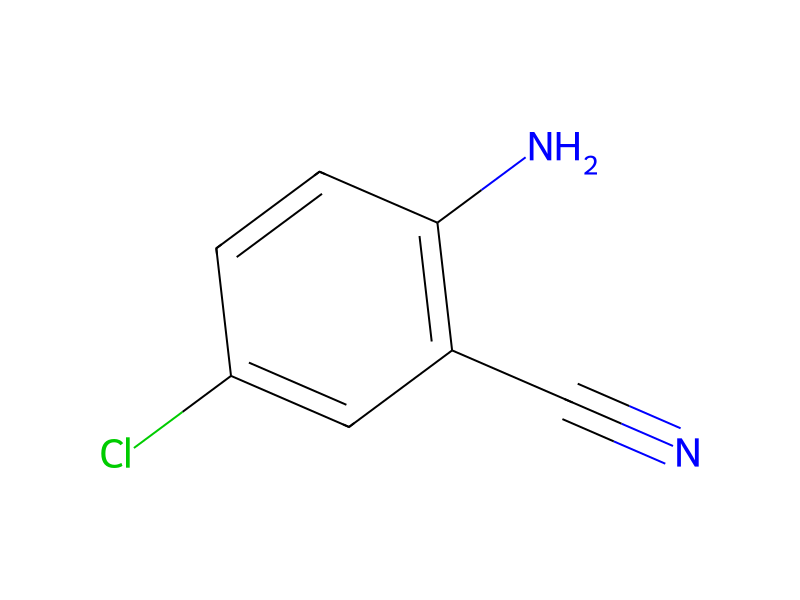
Basic information
- CAS
5922-60-1- Standard SMILES
N#Cc1cc(Cl)ccc1N- InChIKey
QYRDWARBHMCOAG-UHFFFAOYSA-N- Molecular formula
- C7H5ClN2
- Average molar mass
- 152.58 g/mol
- Monoisotopic mass
- 152.01412584
Overview
structure in first source
Names & identifiers
- Preferred name
- 2-Amino-5-chlorobenzonitrile
- IUPAC
- 2-amino-5-chlorobenzonitrile
- English name
- 2-Amino-5-chlorobenzonitrile
- Molecular formula
- C7H5ClN2
- Molecular weight
- 152.58
Names & synonyms
2-Amino-5-chlorobenzonitrile5922-60-1Benzonitrile, 2-amino-5-chloro-GY0X0082QBDTXSID4022234RefChem:464565DTXCID102234227-651-55-ChloroanthranilonitrileAnthranilonitrile, 5-chloro-2-Amino-5-chloro-benzonitrileMFCD00017106
Show more names
ACBNTIMTEC-BB SBB0040505-Chloro-2-aminobenzonitrile2-amino-5-chloro-benzonitrilAMINO(2-) 5-CHLORO-BENZONITRILE1-CYANO-2-AMINO-5-CHLOROBENZENE
4-Chloro-2-cyanoaniline2-Cyano-4-chloroanilineEINECS 227-651-52-amino-5-chlorobenzenecarbonitrile6-Amino-3-chlorobenzonitrile2-Amino-5-chlorobenzonitrile, 98%GEO-00097STK802208
Database identifiers
- CAS
5922-60-1- PubChem CID
- 80019
- DTXSID
DTXSID4022234- UNII
- GY0X0082QB
- EC Number
- 227-651-5
- Nikkaji
- J223.886A
Properties
Computed structural properties
- XLogP
- 2.6
- Topological polar surface area
- 49.8 Ų
- Hydrogen bond donors
- 1
- Hydrogen bond acceptors
- 2
- Rotatable bonds
- 0
- Heavy atoms
- 10
- Formal charge
- 0
- Complexity
- 160
Physicochemical properties
- Melting point
- 96 · 96-99 °C (lit.)
- Boiling point
- 132 · 132-135 °C/0.5 mmHg (lit.)
- Density
- 1.2763 · 1.2763 (rough estimate)
- refractive index
- 1.55 · 1.5500 (estimate)
- Flash point
- 230 °F · >230 °F
- storage temp.
- Keep in dark place,Inert atmosphere,Room temperature
- solubility
- Chloroform (Slightly), DMSO (Slightly)
- pka
- 1.18 · 1.18±0.10(Predicted)
- form
- Crystalline Needles
- color
- White to light beige
- InChI
- 1S/C7H5ClN2/c8-6-1-2-7(10)5(3-6)4-9/h1-3H,10H2
- InChIKey
- QYRDWARBHMCOAG-UHFFFAOYSA-N
- SMILES
- Nc1ccc(Cl)cc1C#N
- CAS DataBase Reference
- 5922 · 5922-60-1(CAS DataBase Reference)
- FDA UNII
- 0 X0082QB · GY0X0082QB
- EPA Substance Registry System
- 2 · Benzonitrile, 2-amino-5-chloro- (5922-60-1)
- UNSPSC Code
- 12352100 · 12352100
- NACRES
- 22 · NA.22
- Symbol(GHS)
- 7 · GHS07
- Signal word
- Warning
- Hazard statements
- 302 · H302+H312+H332-H315-H319-H335
- Precautionary statements
- 261 · P261-P280-P301+P312-P302+P352+P312-P304+P340+P312-P305+P351+P338
- target organs
- Respiratory system
- PPE
- 95 · dust mask type N95 (US), Eyeshields, Gloves
- Hazard Codes
- Xn,Xi
- Risk Statements
- 20 · 20/21/22-36/37/38
- Safety Statements
- 26 · 26-36-36/37/39
- RIDADR
- 3276 · 3276
- WGK Germany
- 3 · 3
- Hazard Note
- Irritant
- TSCA
- TSCA listed
- HazardClass
- 6.1 · 6.1
- PackingGroup
- III
- HS Code
- 29269090 · 29269090
- Storage Class
- 11 · 11 - Combustible Solids
- Hazard Classifications
- 4 DermalAcute · Acute Tox. 4 DermalAcute Tox. 4 InhalationAcute Tox. 4 OralAquatic Chronic 3Eye Irrit. 2Skin Irrit. 2STOT SE 3
Safety & regulation
GHS classification
GHS Classification
Danger
H301 (14%): Toxic if swallowed [Danger Acute toxicity, oral]
P261, P262, P264, P264+P265, P270, P271, P280, P301+P316, P301+P317, P302+P352, P304+P340, P305+P351+P338, P316, P317, P319, P321, P330, P332+P317, P337+P317, P361+P364, P362+P364, P403+P233, P405, and P501 (click each P-code to see the statement)
Aggregated GHS information provided per 50 reports by companies from 9 notifications to the ECHA C&L Inventory. Each notification may be associated with multiple companies.
Hazard information
Hazard Classes and CategoriesAcute Tox. 3 (14%)
Safety data
- PPE
- dust mask type N95 (US), Eyeshields, Gloves
- wgk
- 3
- tsca
- TSCA listed
- ridadr
- 3276
- hs_code
- 29269090
- risk_code
- 20/21/22-36/37/38
- Signal word
- Warning
- Symbol(GHS)
- GHS07
- hazard_code
- Xn,Xi
- hazard_note
- Irritant
- safety_code
- 26-36-36/37/39
- hazard_class
- 6.1
- Storage Class
- 11 - Combustible Solids
- packing_group
- III
- target organs
- Respiratory system
- Hazard statements
- H302+H312+H332-H315-H319-H335
- Hazard Classifications
- Acute Tox. 4 DermalAcute Tox. 4 InhalationAcute Tox. 4 OralAquatic Chronic 3Eye Irrit. 2Skin Irrit. 2STOT SE 3
- Precautionary statements
- P261-P280-P301+P312-P302+P352+P312-P304+P340+P312-P305+P351+P338
Chemistry & industry
Uses & manufacturing
General Manufacturing InformationBenzonitrile, 2-amino-5-chloro-: ACTIVE
Applications
Uses2-Amino-5-chlorobenzonitrile was used to build up the 2,2-dioxide-1H-2,1,3-benzothiadiazine ring system.
General DescriptionThe vibrational spectra of 2-amino-5-chlorobenzonitrile was studied using density functinal theory.
Preparation methods
PreparationSynthesis of 2-amino-5-chlorobenzonitrile is reported in the literature by two methods. The first method involves synthesis from 2-aminobenzonitrile, N-chlorosuccinimide an d acetonitrile. The second method involves synthesis from 5-chloroisatin-β-oxime and bis(2-ethylhexyl)phthalate. Both the methods are not feasible commercially as far as the cost and availability of raw materials are concerned.
Upstream & downstream products
Upstream raw materials
Downstream products
Suppliers100 total
国药集团化学试剂有限公司86-21-63210123 · [email protected]
梯希爱(上海)化成工业发展有限公司021-67121386 · [email protected]
上海阿拉丁生化科技股份有限公司400-6206333 13167063860 · [email protected]
成都超九八生物科技有限公司13348960310 13348960310 · [email protected]
温州共赢化学有限公司+86-0086-577-64498589 +86-15355981851 · [email protected]
爱斯特(成都)生物制药股份有限公司+86-28-85122536 85324413 · [email protected]
上海赫文斯化工有限公司15721252604 17321035817 · [email protected]
Dayang Chem (Hangzhou) Co.,Ltd.+86-0571-88938639 17705817739 · [email protected]
韶远科技(上海)有限公司021-50795510 4000665055 · [email protected]
Syntechem Co.,Ltd[email protected]
上海迈瑞尔生化科技有限公司4006356688 18621169109 · [email protected]
北京华威锐科化工有限公司0757-86329057 18934348241 · [email protected]
上海辅欣医药科技有限公司+86-021-021-50872116 · [email protected]
阿法埃莎(中国)化学有限公司400-6106006 · [email protected]
上海德默医药科技有限公司400-021-7337 2355568890 · [email protected]
安耐吉化学&3A(安徽泽升科技股份有限公司)400-0056266 · [email protected]
武汉凯威斯科技有限公司86-027-67849912 · [email protected]
常州安轩化工有限公司13912302692 · [email protected]
上海瀚鸿科技股份有限公司021-54306202 13764082696 · [email protected]
Pure Chemistry Scientific Inc.001-857-928-2050 or 1-888-588-9418 · [email protected]
郑州药领医药科技有限公司13526569071 · [email protected]
上海泰坦科技股份有限公司400-6009262 15618770481 · [email protected]
郑州研德生物科技有限公司0371-63682289 15538176268 · [email protected]
湖北广奥生物科技有限公司027-02702759223056 18162699093 · [email protected]
苏州启航生物科技有限公司18662190603;18151111370 · [email protected]
四川库利南科技有限公司400-1166-196 18981987031 · [email protected]
上海耐士化工科技有限公司400-188-0725 +86 21 34310725 13611771617
天津希恩思生化科技有限公司400 638 7771 · [email protected]
湖南汇百侍生物科技有限公司0731-85526065 13308475853 · [email protected]
河南多贝化工有限公司0370-2785118 17550508557 · [email protected]
艾科试剂4008-755-333 18080918076 · [email protected]
赛默飞世尔科技(中国)有限公司800-810-5118 · [email protected]
上海特伯化学科技有限公司+86-21-60341587 · [email protected]
江苏艾康生物医药研发有限公司025-66113011 13913916777 · [email protected]
TCI AMERICA800-4238616 · [email protected]
TOKYO CHEMICAL INDUSTRY CO., LTD.03-36680489 · [email protected]
TCI Europe320-37350700 · [email protected]
上海贤鼎生物科技有限公司4009209199 · [email protected]
越林试剂021-62960152 · [email protected]
上海睿升化工科技有限公司+86-021-50935922
苏州亚科科技股份有限公司0512-87182055 13451648594 · [email protected]
安徽科迪达化工有限公司0554-2106669 · [email protected]
HBCChem, Inc.+1-510-219-6317 · [email protected]
上海毕得医药科技股份有限公司400-164-7117 18317119277 · [email protected]
重庆星灿医药科技有限公司13594048950 19923294409 · [email protected]
上海卓因生物科技有限公司021-61317773 · [email protected]
上海御略医药科技有限公司021-60345187 13671753212 · [email protected]
天津安浩生物科技有限公司[email protected]
上海永叶生物科技有限公司86-021-61559134 15921386130 · [email protected]
湖北巨胜科技有限公司027-59599241 18871490274 · [email protected]
Related reactions
48 records


Compound notes
Loading…