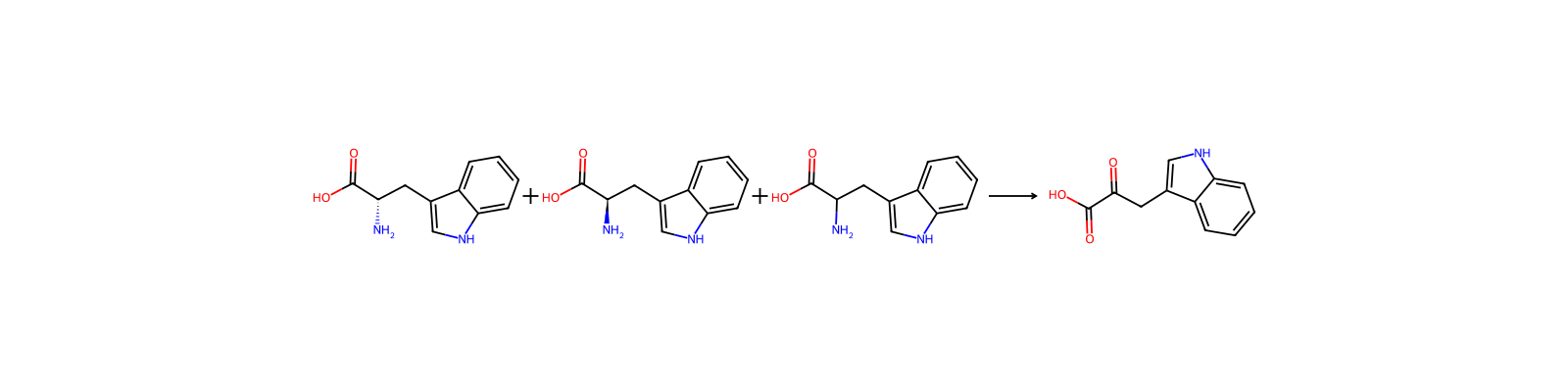
Indole-3-pyruvic acid

Basic information
- CAS
392-12-1- Standard SMILES
O=C(O)C(=O)Cc1c[nH]c2ccccc12- InChIKey
RSTKLPZEZYGQPY-UHFFFAOYSA-N- Molecular formula
- C11H9NO3
- Average molar mass
- 203.19 g/mol
- Monoisotopic mass
- 203.05824315
Overview
3-(indol-3-yl)pyruvic acid is a 2-oxo monocarboxylic acid that is pyruvic acid substituted by a 1H-indol-3-yl group at position 3. It has been found in Lycopersicon esculentum. It has a role as a Saccharomyces cerevisiae metabolite and a plant metabolite. It is an indol-3-yl carboxylic acid and a 2-oxo monocarboxylic acid. It is functionally related to a pyruvic acid. It is a conjugate acid of a 3-(indol-3-yl)pyruvate.
Names & identifiers
- Preferred name
- Indole-3-pyruvic acid
- IUPAC
- 3-(1H-indol-3-yl)-2-oxopropanoic acid
- English name
- 3-(3-Indolyl)-2-oxopropanoic acid
- Molecular formula
- C11H9NO3
- Molecular weight
- 203.19
Names & synonyms
Indole-3-pyruvic acid392-12-1indolepyruvateindol-3-yl pyruvic acid1H-Indole-3-propanoic acid, alpha-oxo-alpha-Oxo-1H-indole-3-propanoic acidDTXSID30420534QM0LT13A8NSC-888743-(1H-indol-3-yl)-2-oxidanylidene-propanoic acidDTXCID1022053RefChem:790954
Show more names
indole-3-pyruvicIndole-3-pyrubateTIMTEC-BB SBB003515INDOLE PYRUVIC ACID3-INDOLEPYRUVIC ACIDb-Indolepyruvic acid
206-874-13-(1H-Indol-3-yl)-2-oxopropanoic acidIndole-3-pyruvateIndolepyruvic acid3-Indolylpyruvic acid3-(indol-3-yl)pyruvic acidIndolyl-3-pyruvate3-(3-Indolyl)-2-oxopropanoic acid
Database identifiers
- CAS
392-12-1- PubChem CID
- 803
- DTXSID
DTXSID3042053- ChEMBL
CHEMBL485012- ChEBI
CHEBI:29750- UNII
- 4QM0LT13A8
- EC Number
- 206-874-1
- Nikkaji
- J39.033J
Properties
Computed structural properties
- XLogP
- 1.3
- Topological polar surface area
- 70.2 Ų
- Hydrogen bond donors
- 2
- Hydrogen bond acceptors
- 3
- Rotatable bonds
- 3
- Heavy atoms
- 15
- Formal charge
- 0
- Complexity
- 277
Experimental & physicochemical properties
Collision Cross Section
141.6 Ų [M-H]- [CCS Type: DT; Buffer gas: N2; Ionization: ESI-; Dataset: TOXCAST; Source Identifier: DTXSID3042053]
138.82 Ų [M-H]- [CCS Type: DT; Method: single field calibrated with Agilent tune mix (Agilent)]
137.6 Ų [M-H]- [CCS Type: DT; Method: single field calibrated with ESI Low Concentration Tuning Mix (Agilent)]
137.8 Ų [M-H]-
Physicochemical properties
- Melting point
- 215 °C · 215 °C (dec.)(lit.)
- Boiling point
- 341.49 °C · 341.49°C (rough estimate)
- Density
- 1.2621 · 1.2621 (rough estimate)
- refractive index
- 1.495 · 1.4950 (estimate)
- storage temp.
- -20 °C · -20°C
- solubility
- DMSO (Slightly), Methanol (Slightly)
- form
- Solid
- pka
- 2.61 · 2.61±0.54(Predicted)
- color
- light yellow
- BRN
- 172966 · 172966
- InChI
- 1S/C11H9NO3/c13-10(11(14)15)5-7-6-12-9-4-2-1-3-8(7)9/h1-4,6,12H,5H2,(H,14,15)
- InChIKey
- RSTKLPZEZYGQPY-UHFFFAOYSA-N
- SMILES
- OC(=O)C(=O)Cc1c[nH]c2ccccc12
- CAS DataBase Reference
- 392 · 392-12-1(CAS DataBase Reference)
- EWG's Food Scores
- 1 · 1
- FDA UNII
- 4 QM0LT13A8 · 4QM0LT13A8
- NIST Chemistry Reference
- -3 · Indole-3-pyruvic acid(392-12-1)
- EPA Substance Registry System
- -3 · Indole-3-pyruvic acid (392-12-1)
- UNSPSC Code
- 12352100 · 12352100
- NACRES
- 22 · NA.22
- Symbol(GHS)
- 7 · GHS07
- Signal word
- Warning
- Hazard statements
- 315 · H315-H319-H335
- Precautionary statements
- 261 · P261-P264-P271-P280-P302+P352-P305+P351+P338
- target organs
- Respiratory system
- PPE
- 95 · dust mask type N95 (US), Eyeshields, Gloves
- Hazard Codes
- Xi
- Risk Statements
- 36 · 36/37/38
- Safety Statements
- 26 · 26-36-24/25
- WGK Germany
- 3 · 3
- RTECS
- 1880000 · NM1880000
- F
- 8 · 8-10-23
- HS Code
- 2933998090 · 2933998090
- Storage Class
- 11 · 11 - Combustible Solids
- Hazard Classifications
- 2 Skin · Eye Irrit. 2Skin Irrit. 2STOT SE 3
Safety & regulation
Safety information is for reference only and does not replace the supplier’s Safety Data Sheet (SDS), applicable regulations, or professional assessment.
GHS classification
GHS Classification
Warning
H315 (100%): Causes skin irritation [Warning Skin corrosion/irritation]
P261, P264, P264+P265, P271, P280, P302+P352, P304+P340, P305+P351+P338, P319, P321, P332+P317, P337+P317, P362+P364, P403+P233, P405, and P501 (click each P-code to see the statement)
Aggregated GHS information provided per 40 reports by companies from 3 notifications to the ECHA C&L Inventory. Each notification may be associated with multiple companies.
Hazard information
Hazard Classes and CategoriesSkin Irrit. 2 (100%)
Safety data
- F
- 8-10-23
- PPE
- dust mask type N95 (US), Eyeshields, Gloves
- wgk
- 3
- rtecs
- NM1880000
- hs_code
- 2933998090
- risk_code
- 36/37/38
- Signal word
- Warning
- Symbol(GHS)
- GHS07
- hazard_code
- Xi
- safety_code
- 26-36-24/25
- Storage Class
- 11 - Combustible Solids
- target organs
- Respiratory system
- Hazard statements
- H315-H319-H335
- Hazard Classifications
- Eye Irrit. 2Skin Irrit. 2STOT SE 3
- Precautionary statements
- P261-P264-P271-P280-P302+P352-P305+P351+P338
Chemistry & industry
Pharmacology
MeSH Pharmacological Classification
Drugs used to prevent SEIZURES or reduce their severity.
Agents that alleviate ANXIETY, tension, and ANXIETY DISORDERS, promote sedation, and have a calming effect without affecting clarity of consciousness or neurologic conditions. ADRENERGIC BETA-ANTAGONISTS are commonly used in the symptomatic treatment of anxiety but are not included here.
Substances that eliminate free radicals. Among other effects, they protect PANCREATIC ISLETS against damage by CYTOKINES and prevent myocardial and pulmonary REPERFUSION INJURY.
Applications
Description3-(3-Indolyl)-2-oxopropanoic acid is an important organic compound and an important precursor for the preparation of tryptophan. Tryptophan and D-tryptophan, and DL-tryptophan can also be synthesized by amination hydrogenation. In addition, 3-(3-Indolyl)-2-oxopropanoic acid is an intermediate in the conversion of tryptophan to indoleacetic acid in plants. Indoleacetic acid is an important growth hormone in plants and also plays an important role in regulating plant growth.
UsesIndole-3-pyruvic acid can be used:As a precursor for the synthesis of chromopyrrolic acid by a heme-containing enzyme.As a reactant in the Biginelli-like scaffold syntheses.
Upstream & downstream products
Downstream products
Additional notes
DefinitionChEBI: A 2-oxo monocarboxylic acid that is pyruvic acid substituted by a 1H-indol-3-yl group at position 3. It has been found in Lycopersicon esculentum
Related reactions
48 records


Compound notes
Loading…