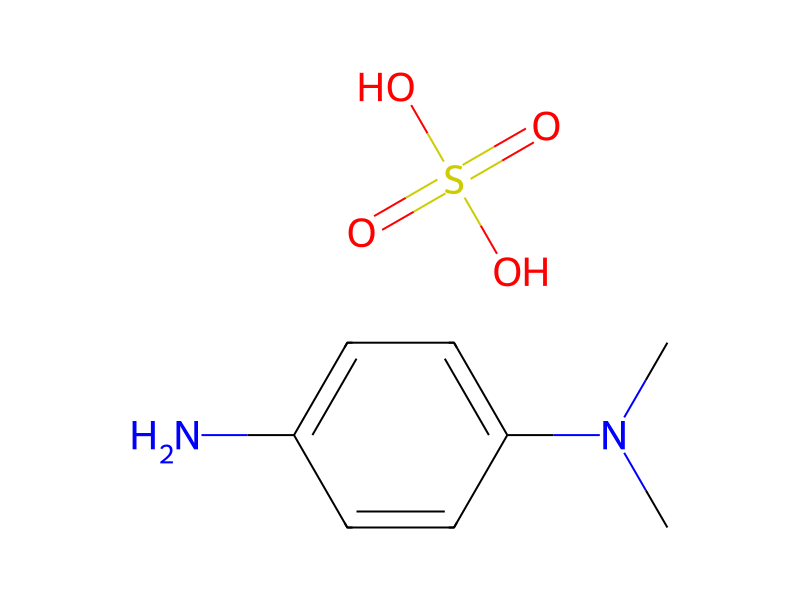
Basic information
- Standard SMILES
CN(C)c1ccc(N)cc1.O=S(=O)(O)O- InChIKey
GLUKPDKNLKRLHX-UHFFFAOYSA-N- Molecular formula
- C8H12N2.H2O4S
- Average molar mass
- 234.28 g/mol
- Monoisotopic mass
- 234.06742793
Names & identifiers
- Preferred name
- N,N-Dimethyl-p-phenylenediamine sulfate
- IUPAC
- 4-N,4-N-dimethylbenzene-1,4-diamine;sulfuric acid
- English name
- N N-DIMETHYL-1 4-PHENYLENEDIAMINE SULFA&
- Molecular formula
- C8H14N2O4S
- Molecular weight
- 234.27
Names & synonyms
Show more names
Database identifiers
- CAS
536-47-0、56331-39-6、60160-75-0、6219-73-4- PubChem CID
- 80351
- DTXSID
DTXSID40883430- UNII
- X997IVP3JA
- EC Number
- 208-636-2、228-292-7、262-092-0
Properties
Computed structural properties
- Topological polar surface area
- 112 Ų
- Hydrogen bond donors
- 3
- Hydrogen bond acceptors
- 6
- Rotatable bonds
- 1
- Heavy atoms
- 15
- Formal charge
- 0
- Complexity
- 175
Experimental & physicochemical properties
Physicochemical properties
- Melting point
- 200 · 200-205 °C (dec.)(lit.)
- Boiling point
- 495 °C · 495 °C(lit.)
- RTECS
- 1575000 · ST1575000
- storage temp.
- Refrigerator
- solubility
- 50 mg/mL, · water: soluble50mg/mL, clear to hazy, colorless to faintly yellow or pink
- form
- Powder
- color
- Beige-grayish to orange or brown
- Water Solubility
- Soluble in water.
- Sensitive
- Light Sensitive & Hygroscopic
- BRN
- 4612278 · 4612278
- InChI
- 1S/C8H12N2.H2O4S/c1-10(2)8-5-3-7(9)4-6-8;1-5(2,3)4/h3-6H,9H2,1-2H3;(H2,1,2,3,4)
- InChIKey
- GLUKPDKNLKRLHX-UHFFFAOYSA-N
- SMILES
- OS(O)(=O)=O.CN(C)c1ccc(N)cc1
- CAS DataBase Reference
- 536 · 536-47-0
- FDA UNII
- 997 IVP3JA · X997IVP3JA
- EPA Substance Registry System
- 1 · 1,4-Benzenediamine, N,N-dimethyl-, sulfate (1:1) (536-47-0)
- UNSPSC Code
- 12352100 · 12352100
- NACRES
- 22 · NA.22
- Symbol(GHS)
- 6 · GHS06
- Signal word
- Danger
- Hazard statements
- 301 · H301+H311+H331-H315-H319-H335
- Precautionary statements
- 501 · P501-P261-P270-P271-P264-P280-P337+P313-P305+P351+P338-P361+P364-P332+P313-P301+P310+P330-P302+P352+P312-P304+P340+P311-P403+P233-P405
- target organs
- Respiratory system
- PPE
- 2 · Eyeshields, Faceshields, Gloves, type P2 (EN 143) respirator cartridges
- Hazard Codes
- T
- Risk Statements
- 23 · 23/24/25-36/37/38
- Safety Statements
- 26 · 26-36/37/39-45
- RIDADR
- 2811 · UN 2811 6.1/PG 2
- WGK Germany
- 3 · 3
- F
- 3 · 3-8
- TSCA
- TSCA listed
- HazardClass
- 6.1 · 6.1
- PackingGroup
- II
- HS Code
- 29215900 · 29215900
- Storage Class
- 6.1 A · 6.1A - Combustible acute toxic Cat. 1 and 2very toxic hazardous materials
- Hazard Classifications
- 3 DermalAcute · Acute Tox. 3 DermalAcute Tox. 3 InhalationAcute Tox. 3 OralEye Irrit. 2Skin Irrit. 2STOT SE 3
Safety & regulation
GHS classification
GHS Classification
Danger
H301 (100%): Toxic if swallowed [Danger Acute toxicity, oral]
P261, P262, P264, P264+P265, P270, P271, P280, P301+P316, P302+P352, P304+P340, P305+P351+P338, P316, P319, P321, P330, P332+P317, P337+P317, P361+P364, P362+P364, P403+P233, P405, and P501 (click each P-code to see the statement)
Aggregated GHS information provided per 46 reports by companies from 5 notifications to the ECHA C&L Inventory. Each notification may be associated with multiple companies.
Danger
H301 (100%): Toxic if swallowed [Danger Acute toxicity, oral]
Hazard information
Regulatory Information
Chemical: 1,4-Benzenediamine, N,N-dimethyl-, sulfate (1:1)
Chemical: 1,4-Benzenediamine, N1,2-dimethyl, sulfate(1:1)
Chemical: 1,4-Benzenediamine, N,N-dimethyl-, sulfate
1,4-Benzenediamine, N,N-dimethyl-, sulfate: Does not have an individual approval but may be used as a component in a product covered by a group standard. It is not approved for use as a chemical in its own right.
Other Safety Information
IMAP assessments - 1,4-Benzenediamine, N,N-dimethyl-, sulfate: Environment tier I assessment
Evaluation - Chemicals not considered for in depth evaluation - Not commercially active in Australia
Hazard Classes and Categories
Acute Tox. 3 (100%)
Acute Tox. 3 (100%)
Acute Tox. 3 (66.7%)
Safety data
- F
- 3-8
- PPE
- Eyeshields, Faceshields, Gloves, type P2 (EN 143) respirator cartridges
- wgk
- 3
- tsca
- TSCA listed
- ridadr
- UN 2811 6.1/PG 2
- hs_code
- 29215900
- risk_code
- 23/24/25-36/37/38
- Signal word
- Danger
- Symbol(GHS)
- GHS06
- hazard_code
- T
- safety_code
- 26-36/37/39-45
- hazard_class
- 6.1
- Storage Class
- 6.1A - Combustible acute toxic Cat. 1 and 2very toxic hazardous materials
- packing_group
- II
- target organs
- Respiratory system
- Hazard statements
- H301+H311+H331-H315-H319-H335
- Hazard Classifications
- Acute Tox. 3 DermalAcute Tox. 3 InhalationAcute Tox. 3 OralEye Irrit. 2Skin Irrit. 2STOT SE 3
- Precautionary statements
- P501-P261-P270-P271-P264-P280-P337+P313-P305+P351+P338-P361+P364-P332+P313-P301+P310+P330-P302+P352+P312-P304+P340+P311-P403+P233-P405
Chemistry & industry
Uses & manufacturing
General Manufacturing Information
1,4-Benzenediamine, N1,N1-dimethyl-, sulfate (1:1): ACTIVE
1,4-Benzenediamine, N1,N1-dimethyl-, sulfate (1:?): ACTIVE
Applications
UsesN,N-Dimethyl-p-phenylenediamine sulfate salt is used to investigate the role of H2S in cardioprotection induced by ischemic preconditioning in rat heart, in spectrophotometric determination of gold(III) in gold-pharmaceuticals such as sodium aurothimaleate and auranofin, to investigate colonic tissue H2S production using the acetate trapping assay system.
Suppliers3 total
Related reactions
No reaction records under the current filter.
Linked notes
Loading…